Russia Putin (Pavel Bednyakov / AP)

Russians have put up withdrone attacks,rising pricesanda crackdown on free speech. But now, they are increasingly being asked to go without the internet on their phones, fraying nerves and leaving many feeling disconnected after four years ofwar in Ukraine.

Mobile internet outages have become part of the norm across the country, a measure authorities say is necessary to prevent attacks byUkrainian drones, some of which use the technology for navigation.

But Russians who spoke to NBC News, experts and even the country's hard-line pro-war bloggers have questioned this justification. Ukrainian drones continue to reach their targets inside Russia, even while users as far away as Kamchatka — some 4,350 miles from the Ukrainian border — are told "security concerns" are to blame for their lack of connectivity.

The outages have left ordinary Russians frequently unable to use their phones on the go — to make calls, order a taxi or pay for groceries. They have affected small businesses and left some people resorting to carrying cash or staying home for reliable Wi-Fi.

Russia Ukraine War (Source in the Ukrainian Security Service / via AP)

Parents of children with diabetes have told Russian media they are unable to use phone applications to monitor their blood sugar levels during blackouts.

It's not just outages that are causing consternation.

Russian authorities have increasingly enforced a so-called "white list" — a limited registry of government-approved websites that people can still access on their phones during outages, severely limiting the kind of information they get.

It comes against the backdrop of increasing restrictions on what Russians can do online, in a wider crackdown on free speech since the Kremlin's invasion —bans on Instagram and Facebook,YouTubeslowdowns, restrictions on foreign messaging apps such as WhatsApp and Telegram, as well as virtual private network services many Russians use to access censored content online.

All those interviewed by NBC News said they were wary of speaking to foreign media about a sensitive security topic, and did not want their personal details shared, fearing possible repercussions.

While the outages have not caused a mass outpouring of anger, some have tried to rally against the measures.

Russia Daily Life (Alexander Zemlianichenko / AP)

Anastasia, from the Tver region northwest of Moscow, said she had intended to join a protest for internet freedom in November that ultimately did not go ahead. She was fed up, she said, because outages leave her frequently unable to use messaging or taxi apps or navigation maps on her phone. Even some of the websites on the "white list" don't load during these blackouts, she said.

Anastasia said that on one occasion, her mother, a disabled pensioner, was left unable to pay for her groceries because card machines at her local store wouldn't work without a mobile connection. She had to walk to the nearest postal office, some distance away, to get cash. "Since then, she has been keeping some cash around. But it's inconvenient — we live in the 21st century," Anastasia said.

The official explanation aside, Anastasia said, she thinks the Kremlin is using the outages to prepare the Russian public for a "North Korea-like" model of the internet, heavily censored and restricted.

"I think authorities want to do something similar in our country," she said.

Some government officials have urged residents to treat the outages as an opportunity for a "digital detox," while a senior lawmaker for information policy told the state news agency Tass last month that the outages should be seen as a welcome break from "endlessly watching useless videos."

The governor of Oryol region, Andrey Klychkov, said the inconvenience is nothing compared to the "heroism" of Russian soldiers in Ukraine.
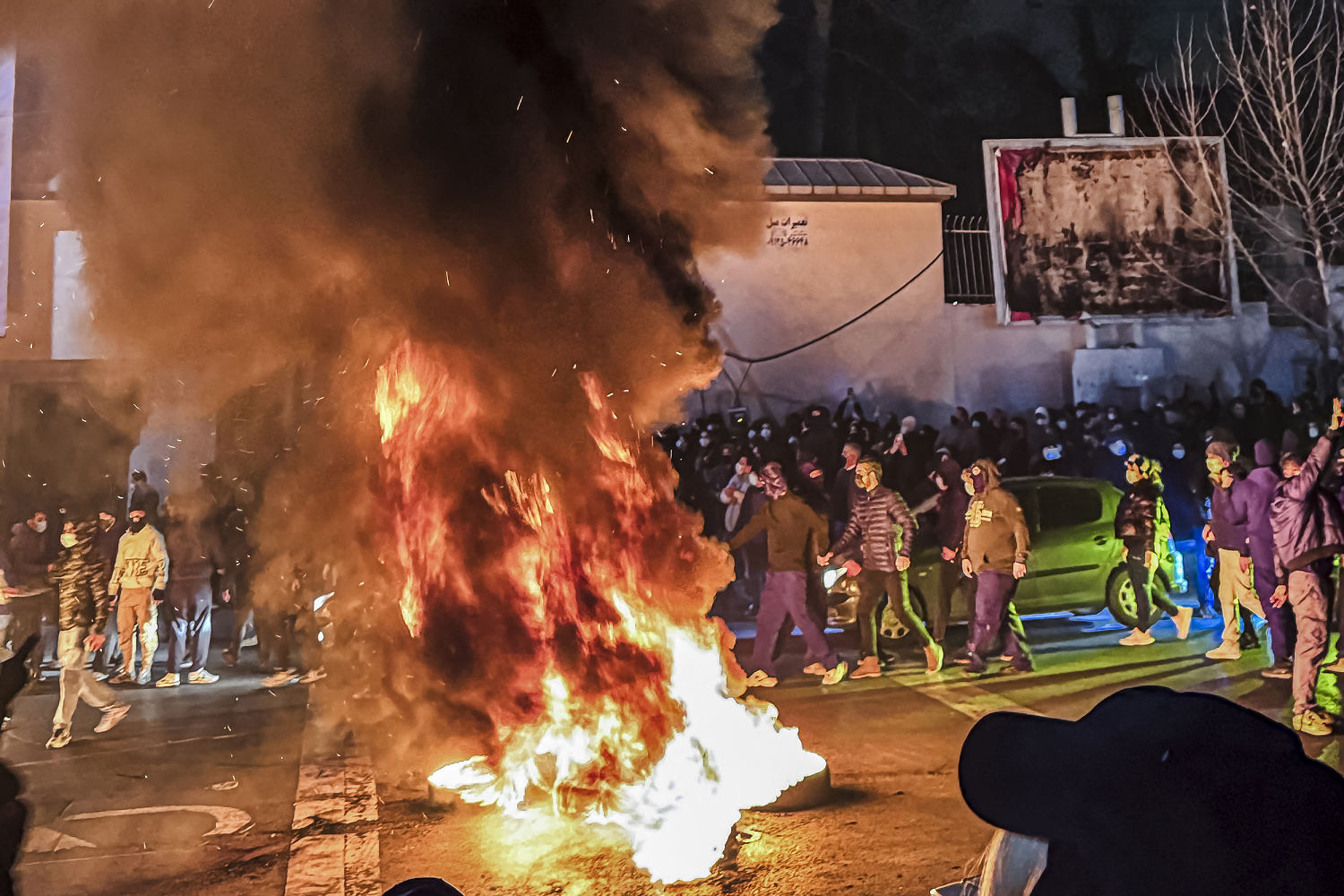
Protests in Iran January 2026 (MAHSA / Middle East Images / AFP via Getty Images)

Increasingly, regional authorities have signaled that the outages don't have an expiry date and could last until the war ends.

"This is quite a desperate tactic because you are accepting mounting economic loss and disruption of civilian life," said Bob Tollast, a land warfare expert at the Royal United Services Institute, a defense and security think tank in London. Many Ukrainian drones have multiple navigation methods, such as GPS, to mitigate the impact of the outages, he said.

Stopping drones connecting to a civilian cell network also requires the Russian government to black out large areas, he said, adding that any attempt to stop what is essentially a flying explosive device could have the unintended effect of sending it off course.

Artyom, from the western Chuvash Republic, told NBC News he has been experiencing mobile internet outages nearly every day. "It's happening because Ukrainian drones reach our territory, but blocking the internet doesn't seem to help," he said.

Even the country's prominent pro-war bloggers have expressed doubts.

"There's no evidence yet that shutting down the Internet has any impact on the effectiveness of enemy drone strikes,"war bloggerYuri Kotenok wrote last month, adding that the measure makes a "mockery" of ordinary Russians.

"The enemy immediately understood what countermeasures we would take. And they switched to satellites — they can't be jammed," popular pro-war Telegram channel "Two Majors"wrote, while blaming bureaucracy and lack of technological knowledge among Russia's upper military brass for the outages.

In September, the Russian Digital Ministry released a "white list" of websites that could still be accessed during outages — mostly government services, Russian search engine Yandex and Russian social networks. The list wasexpanded in Novemberto include some state media outlets, the website of Russia's post office, as well as taxi and weather services, among others.

Some people have complained that Telegram, that millions of Russians use and rely on for information daily — including for drone alerts — is not on the list despite being created by the Russian tech mogul Pavel Durov.

Presented as a temporary measure, the white lists have become part of Russia's wide-ranging censorship, said Sarkis Darbinyan, cyber lawyer and founder of digital rights organization RKS Global. "At any moment, Russian officials could get this idea — why not use this as a default model for the entire country?" Darbinyan said. "There is a big danger that in 2026, the authorities will adopt this model permanently."

The Russian Duma is currently reviewing a bill that would allow the country's powerful Federal Security Service to make telecom operators shut down communication services on their request "to protect against emerging threats to the security of citizens and the state."

The mobile internet outages are causing "huge discontent" among the Russian public, Darbinyan said, which the Kremlin can't ignore.

Russians aren't alone, with Iranianscut off from the internet for weeksafter authorities cracked down on nationwide unrest. In its own spin on white lists, the Islamic Republic is allowing access to the global Internet only for those with security clearance,according to an analysisfrom London-based think tank Chatham House.

Russia Internet Clampdown (Alexander Zemlianichenko / AP)

Ilya, from the Belgorod region that borders Ukraine, called the outages and the inconveniences they cause to ordinary people like him "complete nonsense."

He said he had experienced intermittent outages, which left him feeling "completely disconnected from the world."

Another Russian, Anastasia, a marketing specialist from the western city of Voronezh, said she had experienced near-daily mobile internet outages — they come without any warning too, she said. "You just empirically realize that nothing is loading."

The outages have affected Anastasia's work, hampering her ability to respond to clients via messaging apps.

So she finds herself connecting to public Wi-Fi at coffee shops and shopping malls to stay connected on the go.

"We are not used to this anymore. It feels as if we are communicationally degrading," she said.

Anastasia said she was ready to accept the restrictions if they were "truly" protecting her safety. "But I know people are not very happy about it," she added.

Russians feel strain of Putin's war with mobile internet shutdowns

Russians have put up withdrone attacks,rising pricesanda crackdown on free speech. But now, they are increasingly being asked to go without...
Gas leak caused blast in Iran's Bandar Abbas, Iranian media say

Jan 31 (Reuters) - An explosion that hit a building in the southern Iranian port city of Bandar Abbas on Saturday was caused by a gas leak, according to a preliminary assessment, the local head ​of the fire department said.

Earlier, Iranian state media reported that at least one person had been killed ‌and 14 injured in the blast, which comes amid heightened tensions between Tehran and Washington over Iran's crackdown earlier this month on nationwide protests and ‌over the country's nuclear programme.

"This (gas leak and accumulation) is the preliminary assessment. My colleagues will give more details in the next few hours," Mohammad Amin Liaqat, the fire department chief, said in a video published by Iran's semi-official Mehr news agency.

A video published on social media showed people standing among debris and wrecked cars in front of a damaged building following the explosion.

Reuters was ⁠able to verify the location by analysing ‌buildings, trees, and road layout, which matched satellite and file imagery. Reuters could not independently verify the date the video was filmed.

Separately, four people were killed after another gas explosion in ‍the city of Ahvaz near the Iraqi border, according to state-run Tehran Times. No further information was immediately available.

NERVES STRAINED AS TRUMP PILES PRESSURE ON IRAN

The explosions highlighted the jittery mood prevailing in Iran amid its clerical rulers' standoff with the Trump administration.

Before the reports ​of the two blasts on Saturday, Iranian President Masoud Pezeshkian accused U.S., Israeli and European leaders of exploiting Iran's ‌economic problems, inciting unrest and providing people with the means to "tear the nation apart".

The semi-official Tasnim news agency said social media reports alleging that a Revolutionary Guard navy commander had been targeted in the Bandar Abbas explosion were "completely false".

Two Israeli officials told Reuters that Israel was not involved in Saturday's blasts. The Pentagon did not immediately respond to a request for comment.

U.S. President Donald Trump said on January 22 an "armada" was heading toward Iran. Multiple sources said on Friday that Trump was ⁠weighing options against Iran that include targeted strikes on security forces.

Bandar ​Abbas, home to Iran's most important container port, lies on the Strait ​of Hormuz, a vital waterway between Iran and Oman which handles about a fifth of the world's seaborne oil.

The port suffered a major explosion last April that killed dozens and injured over 1,000 ‍people. An investigative committee at ⁠the time blamed the blast on shortcomings in adherence to principles of civil defence and security.

Iran has been rocked by nationwide protests that erupted in December over economic hardship and have posed one of the toughest challenges ⁠to the country's clerical rulers.

U.S.-based rights group HRANA has said at least 6,500 people were killed in the protests, including hundreds of security personnel.

(Reporting ‌by Dubai Newsroom and Menna Alaa El-Din and Enas Alashray in Cairo; Additional reporting by Phil Stewart ‌in Washington and Edward Carronin London; Editing by Gareth Jones)

Gas leak caused blast in Iran's Bandar Abbas, Iranian media say

Jan 31 (Reuters) - An explosion that hit a building in the southern Iranian port city of Bandar Abbas on Saturday was cau...
Pope gets invitation to visit Peru during a Vatican garden party, then stays for lunch

VATICAN CITY (AP) — Peru's ambassador to the Holy See publicly invited Pope Leo XIV to visit his second homeland on Saturday, as 2026 is shaping up to be an important year for the pontiff's travel with big trips under study for Africa and South America.

Associated Press Pope Leo XIV arrives to bless a mosaic of the Virgin Mary and a statue of St. Rose of Lima in the Vatican Gardens, Saturday, Jan. 31, 2026. (AP Photo/Andrew Medichini) Pope Leo XIV arrives to bless a mosaic of the Virgin Mary and a statue of St. Rose of Lima in the Vatican Gardens, Saturday, Jan. 31, 2026. (AP Photo/Andrew Medichini) Pope Leo XIV blesses a mosaic of the Virgin Mary and a statue of St. Rose of Lima in the Vatican Gardens, Saturday, Jan. 31, 2026. (AP Photo/Andrew Medichini) Pope Leo XIV blesses a mosaic of the Virgin Mary and a statue of St. Rose of Lima in the Vatican Gardens, Saturday, Jan. 31, 2026. (AP Photo/Andrew Medichini) Nuns take photos of statue of the Virgin Mary that was inaugurated by pope Leo XIV in the Vatican Gardens, Saturday, Jan. 31, 2026. (AP Photo/Andrew Medichini)

Vatican Pope

In recent days, the president of Equatorial Guinea and the Vatican ambassador in Angola have both confirmed that plans are underway for a papal trip this year, on top of rumored stops in Cameroon and Algeria. No dates have been announced but Vatican officials say the four-country Africa visit would likely take place sometime after Easter.

Leo himself has saidhe wants his second trip as pope to be in Africa, especially Algeria, which has special significance for Leo's Augustinian religious order. Algeria also plays an important role in Christian-Muslim relations that the Vatican is keen to highlight.

Leo has also said he hoped to visit three countries in Latin America in either 2026 or 2027: Argentina, Uruguay and Peru, where he lived for two decades as a missionary and where he holds citizenship. Argentina especially has been waiting for a papal visit, after Pope Francis never went home after his 2013 election.

On Saturday, Peru's new ambassador to the Vatican, Jorge Ponce San Roman, publicly invited Leo to visit during a ceremony in the Vatican gardens to inaugurate a new mosaic and statue dedicated to the Virgin Mary that Peru sponsored.

Advertisement

With all Peru's bishops on hand, Ponce said he and his fellow citizens "hoped to see you very soon in Peru."

Leo didn't respond but in his brief remarks at the ceremony recalled Peru was "such a beloved country to me."

In a break with usual protocol, Leo then stayed for a buffet lunch that the Peruvian Embassy organized for the invited diplomats and Vatican officials in the gardens. For around an hour, Leo sat with Ponce and the Peruvian bishops in a shady, hidden spot back where the caterers were preparing pisco sour cocktails and plates of ravioli with huancaina, the typical Peruvian creamy sauce.

Despite an occasional rain, the party had a joyful, relaxed vibe and Leo's prolonged presence suggested he feels very much at home with his fellow Peruvians.

Associated Press religion coverage receives support through the AP'scollaborationwith The Conversation US, with funding from Lilly Endowment Inc. The AP is solely responsible for this content.

Pope gets invitation to visit Peru during a Vatican garden party, then stays for lunch

VATICAN CITY (AP) — Peru's ambassador to the Holy See publicly invited Pope Leo XIV to visit his second homeland on S...
Hospitals on alert as Egypt readies for opening of Rafah crossing to Gaza's wounded

A key border crossing betweenthe Gaza Stripand Egypt is expected to partially open on Sunday morning, with Egyptian officials readying help for sickand injured Palestinians.

NBC Universal Image: FILES-PALESTINIAN-GAZA-ISRAEL-US-CONFLICT-DIPLOMACY (Said Khatib / AFP - Getty Images)

Dozens of Egyptian ambulances have assembled in front of the Rafah crossing gateon the Egyptian side. Hospitals in North Sinai are also on high alert and prepared to receive Palestinians arriving from Gaza in need of care.

Israel's Coordinator of Government Activities in the Territories said in a statement that the crossing will open on Sunday for the "limited movement of people only," with entry and exits from Gaza permitted "in coordination with Egypt, following prior security clearance of individuals by Israel."

For residents who left Gaza during the war, re-entry will only be permitted after clearance by Israel and additional screening and identification processes, the statement said.

The Associated Press, citing an Israeli official, has reported that only 50 medical evacuees will be permitted to exit Gaza each day. Medical evacuations were similarly prioritized under past ceasefire deals.

The opening comes just days after the remains ofthe last hostage held by Hamasin Gaza, 24-year-old police officer Ran Gvili, were returned to Israel on Monday, completing a key pillar of the truce after tensions over delays and accusations of ceasefire violations. Israel has repeatedly postponed reopening the crossing, signaling it would not open until the bodies of all the hostages were recovered.

Khaled Mujawir, the governor of Egypt's North Sinai province, told Egyptian state television earlier this week that officials are "100% ready" for the crossing to open, according to the Anadolu news agency. He also expressed hope that the crossing would be opened to aid convoys.

The Rafah crossing, the main checkpoint between Gaza and Egypt, has long been the primary gateway to the rest of the world for Palestinians living in the enclave, and now it is a considered a lifeline for the tens of thousands in need of treatment outside the territory, where the majority of medical infrastructure has been destroyed.

The reopening marks the first major step of the U.S.-brokered ceasefire's second phase, after the first phase came into effect nearly four months ago.

Advertisement

The second stage of the truce will alsorequire the disarmament of Hamas, a key sticking point in negotiations, as well as the development of Trump's international force to oversee security in Gaza.

For months, only Gvili's remains had yet to be returned, with Israel announcing their recovery Monday after launching a sweeping operation to locate them amid mounting pressure from the Trump administration to move forward with the next phase of the deal.

Hundreds of thousands of families across Gaza have been forced to wait out the first phase of the ceasefire in makeshift tents with little protection from the winter weather, as heavy rains flooded campsites.

While the ceasefire brought an end to the most severe attacks on the enclave, Israel has killed more than 500 people in Gaza since the ceasefire began, according to the Palestinian Health Ministry in the enclave, with Israel and Hamas both accusing the other of violating the truce.

Hospitals in Gaza saidIsraeli strikes killed at least 29 Palestinians Saturday, one of the highest tolls since the October ceasefire began.

Israel's military said in a statement that Saturday's strikes followed what it described as ceasefire violations a day earlier, when the army killed at least four militants emerging from a tunnel in an Israeli-controlled area.

For Palestinians on the ground, the crossing reopening would be a small glimmer of light.

"We hope the Rafah crossing opens so we can travel freely and meet many of our family members, those who have been forcibly displaced outside the Gaza Strip," Duaa Basem Al-Masri, a 26-year-old pharmacist from Beit Hanoun, told NBC News earlier this week.

She hoped the progress would soon also see the entry of "medical aid, medicines and proper shelter equipment into the strip, to ease the suffering" in Gaza.

"We hope there will be international pressure on them from President Donald Trump," Basem Al-Masri said.

Hospitals on alert as Egypt readies for opening of Rafah crossing to Gaza's wounded

A key border crossing betweenthe Gaza Stripand Egypt is expected to partially open on Sunday morning, with Egyptian offic...
U.S. warns Iran over planned military drills close to American forces

The United States warned Iran on Saturday over its plans to conduct live-fire drills close to U.S. forces in the region, as partners sought to de-escalaterising tensions between the two nations.

Iran announced Friday that its Islamic Revolutionary Guard Corps (IRGC) was conducting a two-day live-fire naval exercise in the Strait of Hormuz, a vital shipping lane that handles about 20% of global oil supply.

The drills comeas U.S. Navy ships arrive in the region, with President Donald Trump deploying what he called a "massive armada," which he said earlier this week could act against Iran "with speed and violence, if necessary."

"We will not tolerate unsafe IRGC (Islamic Revolutionary Guard Corps) actions including overflight of U.S. military vessels engaged in flight operations, low-altitude or armed overflight of U.S. military assets when intentions are unclear, highspeed boat approaches on a collision course with U.S. military vessels, or weapons trained at U.S. forces," U.S. Central Command said in a statement on Friday.

"U.S. forces acknowledge Iran's right to operate professionally in international airspace and waters," it added, before noting that "any unsafe and unprofessional behavior near U.S. forces, regional partners or commercial vessels increases risks of collision, escalation, and destabilization."

Tensions have continued to rise between the two nations after the Iranian regime's brutal crackdown on nationwide protests against the government left thousands dead. Trumprecently called for regime changein the country, while also pressing Iran to make a "deal" to address concerns over its nuclear capabilities.

The New York Times, citing multiple U.S officials, reported Friday that Trump had been presented with a list of military options against Iran that included proposals for American forces to carry out raids on sites inside Iran. NBC News could not verify these details.

A U.S. Navy destroyer made a port visit to the southern Israeli city of Eilat on Friday. The USS Delbert D. Black is one of six U.S. destroyers now in the Middle East, along with an aircraft carrier and three other combat ships.

The arrival of the destroyer in Israel was planned and part of ongoing cooperation between the U.S. and Israeli militaries, Israeli media reported.

On Friday, Iranian Foreign Minister Abbas Araghchi said he was prepared for the resumption of negotiations, but they should be"fair and equitable"and not include Iran's defense capabilities.

Egypt said Saturday that Foreign Minister Badr Abdel-Aty had held calls with his Iranian, Turkish and Omani counterparts, along with U.S. special envoy Steve Witkoff and Qatar's prime minister, on continuing "serious efforts" to de-escalate tensions and seek diplomatic solutions.

Egypt's foreign ministry said "constructive interaction and communication" could help bring the U.S. and Iran back to the negotiating table to forge "a peaceful and consensual settlement."

Turkey has opposed military intervention against Iran, warning that such an action would lead to regional instability. President Recep Tayyip Erdogan's office said in a statement Friday that he had offered to act as a "facilitator" between Iran and the U.S. in a phone call with Iranian President Masoud Pezeshkian.

Earlier this week, Saudi Arabia and the United Arab Emirates both ruled out the use of their airspace or territory to launch attacks on Iran.

Pezeshkian has blamed the West and Israeli Prime Minister Benjamin Netanyahu for stoking tensions within Iran, the country's Student News Network, a hard-line news website close to the regime, reported Saturday.

"Unfortunately Trump, Netanyahu and some Europeans tried to provoke the situation and create division," Pezeshkian said, according to the report.

"They equipped and encouraged some people, pulled innocent citizens into this process and pushed them into the streets to break the country apart and create conflict, hatred and division among people," he added.

The protests in Iranbegan in late December as inflation soared and the cost of living became unbearable for many. They quickly grew to include young and old, working classes and professionals, men and women, and expanded across the country.

At least 6,300 people have been killed, including some 200 security services personnel, according to the U.S.-based Human Rights Activists News Agency (HRANA). The group, which says that it verifies each death with a network of activists on the ground in Iran and that its data goes through "multiple internal checks," said it is investigating 17,000 additional reported deaths.

Amid the heightened tensions, an explosion in the southern Iranian port of Bandar Abbas on Saturday sparked alarm.

The semiofficial Tasnim news agency said that social media reports alleging that a Revolutionary Guard navy commander had been targeted in the explosion were "completely false."

Iranian state media outlet IRIB News later reported that the explosion, which was reported to have killed one person and injured 14, was caused by a gas leak, citing Bandar Abbas Fire Department.

U.S. warns Iran over planned military drills close to American forces

The United States warned Iran on Saturday over its plans to conduct live-fire drills close to U.S. forces in the region, ...
Journalist Don Lemon appears in court following arrest over protest at Minnesota church

Journalist Don Lemon was arrested overnight in Los Angeles on Friday. The arrest comes nearly two weeks after Lemon was at an anti-ICE protest that disrupted a service at a church in St. Paul, Minnesota.

A source familiar with the matter said a grand jury was empaneled Thursday. The FBI and Homeland Security Investigations, a law enforcement agency within the Department of Homeland Security, were involved in the arrest, sources said.

Lemon appeared in federal court in L.A. on Friday afternoon, where he was released on his own recognizance without posting bond.

The charges are related to a protest in which demonstrators entered St. Paul's Cities Church after discovering that one of its pastors is an ICE official.

According to court documents, Lemon and eight co-defendants were all indicted on one count each of conspiracy against religious freedom at a place of worship and injuring, intimidating and interfering with the exercise of the right of religious freedom at a place of worship. He did not enter a plea on Friday. His next hearing is scheduled for Feb. 9 in federal court in Minneapolis.

Journalist Don Lemon departs federal court on Jan. 30, 2026, in Los Angeles, California.  / Credit: Mario Tama / Getty Images

He does not have to report to probation or pretrial services for supervision, the judge said. Court permission is required for international travel, with the exception of a preplanned trip to France in June. He must also avoid contact with known victims or witnesses and known co-defendants.

Lemon appeared before the judge in a cream-colored double-breasted suit with a matching T-shirt, the same clothes he was wearing when he was arrested, CBS News learned. L.A. Mayor Karen Bass attended the hearing and was in the gallery.

"Last night, the DOJ sent a team of federal agents to arrest me in the middle of the night for something that I've been doing for the last 30 years, and that is covering the news," Lemon told reporters outside the courthouse following the hearing. "The First Amendment of the Constitution protects that work for me and for countless other journalists who do what I do. I stand with all of them, and I will not be silenced. I look forward to my day in court."

Abbe Lowell, Lemon's lawyer, previously confirmed he was in L.A. to cover this weekend's Grammy Awards.

"Don has been a journalist for 30 years, and his constitutionally protected work in Minneapolis was no different than what he has always done," Lowell said in a statement. "The First Amendment exists to protect journalists whose role it is to shine light on the truth and hold those in power accountable. There is no more important time for people like Don to be doing this work."

Lowell said the Justice Department has focused on arresting Lemon instead of investigating the federal agents who killedRenee GoodandAlex Prettiin Minnesota earlier this month, calling it "the real indictment of wrongdoing in this case."

"This unprecedented attack on the First Amendment and transparent attempt to distract attention from the many crises facing this administration will not stand. Don will fight these charges vigorously and thoroughly in court," he said.

According to the indictment, on Jan. 17, one day before the incident, two of the defendants posted plans for the protest to social media, but kept the location hidden.

The following morning, several dozen people, including Lemon and his eight co-defendants, gathered in the parking lot of a grocery store, where some of them "provided instruction" on what to do once they arrived at the church, the document reads.

Lemon began livestreaming to his social media channel during this gathering, the court documents state, during which he told his audience the group was preparing for a "resistance" operation against federal immigration policies.

"He took steps to maintain operation secrecy by reminding certain co-conspirators to not disclose the target of the operation and stepped away momentarily so his mic would not accidentally divulge certain points of the planning session," the indictment alleges.

Later in the livestream, before the group arrived at the church, Lemon again reiterated to his audience he would not divulge details of where they were going, the document states. And when driving to the church, Lemon said to one of the defendants during the livestream, "Don't give anything away," the court documents read.

Once in the church, Lemon and his eight co-defendants "oppressed, threatened, and intimidated the Church congregants and pastors by physically occupying most of the main aisle and row of chairs near the front of the Church, engaging in menacing and threatening behavior," prosecutors said in the indictment.

The indictment also alleges that Lemon and two co-defendants "largely surrounded" the pastor "in an attempt to oppress and intimidate him," and that Lemon and the protesters ignored the pastor's request that they leave the church.

At one point, the document reads, Lemon stood near the main door of the church and allegedly "confronted some congregants and physically obstructed them" as they tried to leave.

U.S. Attorney General Pam Bondi said in astatementFriday morning shared to social media that federal agents arrested Lemon and three of his co-defendants "in connection with the coordinated attack on Cities Church in St. Paul, Minnesota." They were identified as Jamael Lydell Lundy, Trahern Jeen Crews and Georgia Ellyse Fort, Bondi said.

Lundy, Fort and Crews all had their initial appearances in Minnesota federal court Friday, and they were all released on personal recognizance bonds.

The Justice Departmenthas arrestedat least seven of the nine co-defendants in the case. Nekima Levy Armstrong, former president for the Twin Cities chapter of the NAACP, and Chauntyll Louisa Allen, an elected member of the St. Paul School Board, along with William Kelly, were arrested last week.

CNN, where Lemon previously worked, said his arrest raises "profoundly concerning questions about press freedom and the First Amendment." The network said it will be following Lemon's case closely.

"The Department of Justice already failed twice to get an arrest warrant for Don and several other journalists in Minnesota, where a chief judge of the Minnesota Federal District Court found there was 'no evidence' that there was any criminal behavior involved in their work," CNN said in astatement."The First Amendment in the United States protects journalists who bear witness to news and events as they unfound, ensuring they can report freely in the public interest, and the DOJ's attempts to violate those rights is unacceptable."

Last week, a federal appellate courtdeclinedto order a lower court judge to sign arrest warrants for five people, including Lemon, in connection with a Jan. 18 anti-ICE protest inside the church. However, one of the three appellate court judges said he felt there was probable cause to justify the arrests, according to court filings and sources familiar with the matter.

The Justice Department had asked the appellate court to compel the U.S. District Court in Minnesota to sign the arrest warrants over civil rights charges alleging the defendants were unlawfully interfering with the churchgoers' constitutional-protected freedom to practice religion.

Federal prosecutors in the Minneapolis-based U.S. Attorney's Office had significant concerns with the strength of the evidence in the church protests, a source familiar with the matter told CBS News.

When the first three defendants were initially charged, no career officials from that office appeared in court, and the Justice Department sent two lawyers from the Civil Rights Division in Washington to handle the proceedings.

The magistrate judge overseeing the case only approved one civil rights charge in those original cases againstArmstrongand Allen. But the judge nixed a FACE Act charge against each of them on the grounds that there was no probable cause. Both were among those named in Friday's indictment.

The magistrate judge, Douglas Micko, also rejected five arrest warrants in the case for lacking probable cause, including Lemon's, CBS News previously reported.

The Justice Department has been scrutinizing the video of the pre-meeting that Lemon filmed before the protest, the source said. The Justice Department has been focusing on the gathering as alleged evidence of a conspiracy to interfere with people's religious rights. Lemon was filming the meeting as part of his reporting, the source added.

"Although Lemon's factual assertions and DOJ's justifications must be tested in court, this case could set a dangerous precedent for charging reporters who cover protests for the conduct of the protesters if there was any prior communications with the protesters, and could even expose American journalists embedded with the U.S. military to being charged with war crimes along with soldiers who may commit such crimes," said Julius Nam, a former federal prosecutor who handled civil rights cases.

Lemon worked at CNN for more than 15 years, butwas firedin 2023. He announced in early 2024 that he would be launching The Don Lemon Show on X, but the social media site owned by billionaire Elon Muskended the partnershipmonths later, shortly after Lemon interviewed Musk. Lemon now hosts ashowon YouTube.

Don Lemon arrested in Los Angeles, sources say

Alex Pretti's family reacts to video of scuffle 11 days before death

School principal speaks out about father and son detained by ICE: "Open your eyes"

Journalist Don Lemon appears in court following arrest over protest at Minnesota church

Journalist Don Lemon was arrested overnight in Los Angeles on Friday. The arrest comes nearly two weeks after Lemon was a...
As officials disparage Pretti and Good, families of Black people killed by police have déjà vu

The shooting deaths of white protestersAlex PrettiandRenee Goodby federal officers in Minneapolis followed a playbook that is painfully familiar to Black Americans: Authorities quickly moved to disparage the victims, only to be contradicted as more evidence emerged.

Associated Press People gather in The Commons after a protest march, Friday, Jan. 30, 2026, in Minneapolis. (AP Photo/Alex Brandon) Federal agents stand near the site of a shooting Saturday, Jan. 24, 2026, in Minneapolis. (AP Photo/Abbie Parr)

Immigration Enforcement Minnesota

Black families who have lost loved ones to police violence said the killings inMinnesotahave brought back painful memories of their own fights for justice as law enforcement agencies spun up narratives to suggest officers had no other choice but to kill their relatives.

And these law enforcement agencies often make no effort to publicly correct misstatements or falsehoods that might have impact on a fair justice process, experts said.

Timothy Welbeck, the director of the Center for Anti-Racism at Temple University, said it "regrettably" took the deaths of Pretti and Good to again shine a spotlight on this issue.

"Black people have leveled a critique against law enforcement for as long as we've had policing in America," said Welbeck, an assistant professor at Temple's Africology and African American Studies Department.

He also called it "painfully ironic" that Pretti and Good died in "the same place" where other high-profile cases brought the issue to the fore:George Floyd, who was murdered in 2020 by a Minneapolis police officer, andPhilando Castile, who was fatally shot in 2016 as he tried to show a suburban Minneapolis police officer his license to carry a concealed firearm.

Clarence Castile, an uncle of Philando Castile, said it was eerie to hear federal authorities make snap conclusions in the Pretti and Good shootings.

"Right away they backed up their officers and said they had justifiable shoots, their lives were in danger, they feared for their lives," Castile said. "I heard the same thing, (officials) said the same things when that cop shot my nephew."

"We know, from the beginning, that they haven't taken the time to investigate," he said. "They're just putting out something, because they think they have to respond. Sometimes the best response is no response."

'Protecting the integrity of the investigation'

Leonard Sipes, who worked for 35 years in public affairs and communications for federal and state law enforcement agencies and is also a former officer, said the standard practice for shootings or any other major breaking case is to simply state that "it's under investigation." Sipes said he typically waited 24 hours before releasing information to the public.

"Getting the story correct is vital to the reputation of the agency," Sipes said. "You are also obligated to protect the integrity of the investigation. A rush to judgment can violate that."

The killings of Pretti, a Veterans Affairs hospital ICU nurse, and Good, who described herself as a poet, mother and wife, quickly became rallying cries for Minnesotans protesting the largest surge of federal law enforcement into an American city.

After Pretti and Good were killed, administration officials from Homeland Security Secretary Kristi Noem to President Donald Trump claimed the two were far-left radicals acting with malicious intent to harm federal officers.

"The sickening lies told about our son by the administration are reprehensible and disgusting," Pretti's family said in a statement this week, noting that videos showed Pretti holding his phone, not a gun, when he was tackled by federal agents before he was shot several times. "Please get the truth out about our son."

Good was remembered by her family as "the beautiful light of our family and brought joy to anyone she met."

"She was our protector, our shoulder to cry on and our scintillating source of joy."

While Justice Department officials have declined to launch acivil rights investigation into Good's death, on Friday they announced acivil rights probe into Pretti's killing.

Still, officials have not walked back claims that Pretti and Good were avowed extremists who intended to harm federal agents when they were killed.

Advertisement

Frustration over past and present cases

Some Black activists and police reform advocates expressed frustration that people who are outraged by how the Pretti and Good cases have been handled often ignored the same dynamics when the victims were Black.

"Ultimately, this demonstrates the insidious nature of racism and how it's embedded its ways into the systems and structures of society," Welbeck said. "When Black people try to point out not only the logical fallacies of it, but just the callousness of it, we were often lambasted or told that we were overreacting and needed to wait for justice to play itself out."

Melina Abdullah, co-founder of Black Lives Matter Grassroots, said it's a common misconception that Black racial justice organizers won't get active when white people die at the hands of law enforcement.

"I want to be very clear that I mourn and rage about the murder of Alex Pretti and Renée Good," said Abdullah, organizer of a national hub for BLM chapters. "What they suffered is what Black people suffer every single day, and it doesn't make it right for them, but it's also not right for us."

Justin Hansford, who participated in Black Lives Matter protests afterthe 2014 police shooting death of Michael Brownin Ferguson, Missouri, said the Minneapolis shootings should be a reminder to all Americans that injustice disproportionately impacting Black people can impact them, too.

"It's the idea that Black folks were always the ones whose experience signaled to the rest of the country what was soon to come," said Hansford, a professor at the Howard University School of Law and executive director of the Thurgood Marshall Civil Rights Center.

"It was because this is the Black experience that you looked at it narrowly, and you failed to address it. And then the experience becomes mimicked nationally."

Tulsa shooting victim's sister knows Minneapolis families' pain

Tiffany Crutcher, the twin sister ofTerence Crutcher, a Black man killed in 2016 by a Tulsa, Oklahoma, police officer, said she couldn't watch videos showing the killings of Pretti and Good. Just hearing authorities speak about their deaths was re-traumatizing, she said.

She's "been there before," she said, recalling how law enforcement officials made snap judgements about her brother.

Crutcher's family maintained that Terence was in need of help after his vehicle stalled on the road. The officer who fatally shot him claimed she feared he was reaching into his car for a weapon. Terence Crutcher was unarmed.

Video footage from the scene recorded an operator saying Terence "looks like a bad dude" who "could be on something." Ultimately, the officer who shot him wasacquitted at trial for manslaughter.

"In our trauma and shock, we had to control the narrative about who Terrence was," Tiffany said. "While we're grieving and mourning, at the same time, we have to rally and let the world know that our loved one did not deserve to die."

She said the Pretti and Good shootings are helping people wake up to the problem of unequal justice for people killed by police.

"Naturally, there's an affinity more broadly towards law enforcement and people believing them," Tiffany said. "However, I think that is shifting."

"Our voice is all that we have. And we made a conscious decision that we were going to utilize our voice and get ahead of the harmful narratives."

AP writer Matt Brown in Washington, D.C., contributed.

As officials disparage Pretti and Good, families of Black people killed by police have déjà vu

The shooting deaths of white protestersAlex PrettiandRenee Goodby federal officers in Minneapolis followed a playbook tha...
Israeli strikes kill 27 in Gaza, Palestinian health officials say

By Nidal al-Mughrabi and Maayan Lubell

CAIRO/JERUSALEM, Jan 31 (Reuters) - Israel carried out its heaviest airstrikes in Gaza in weeks on Saturday, killing 27 people including three children in attacks on a police station, houses and tents, Palestinian health officials said.

The Israeli ​military said it had targeted commanders and sites belonging to Palestinian militant group Hamas and its ally, Islamic Jihad, in response ‌to a breach of a U.S.-brokered ceasefire agreed last October after two years of war in Gaza.

Hamas, which retains control of just under half of Gaza, said Israel had violated ‌the truce. It did not say whether any of its members or sites were struck in Saturday's attacks.

Israel carried out the attacks a day before the Rafah border crossing between the Gaza Strip and Egypt is due to reopen under U.S. President Donald Trump's plan to end a war that has left much of Gaza in ruins.

The war began after Hamas-led gunmen attacked southern Israel on October 7, 2023. Israeli officials have said the war could resume if Hamas ⁠does not lay down its weapons.

FIGHTERS STILL IN ‌TUNNELS

Israeli warplanes bombed the Sheikh Radwan police station west of Gaza City, killing 10 officers and detainees, medics and police in Gaza said. Rescue teams were searching for more casualties at the site, said the Hamas-run police.

Other airstrikes ‍hit at least two houses in Gaza City, in northern-central Gaza, and a tent encampment sheltering displaced Palestinians in Khan Younis further south, local officials said.

Video footage from Gaza City showed charred, blackened and destroyed walls at an apartment in a multi-storey building, and debris scattered inside it and outside on the street.

"We found my ​three little nieces in the street. They say 'ceasefire' and all. What did those children do? What did we do?" said Samer al-Atbash, an ‌uncle of the three dead children.

The Israeli military said that in addition to targeting Hamas commanders, it also hit weapon caches and manufacturing sites.

It said the strikes were carried out in response to an incident on Friday in which troops identified eight gunmen emerging from a tunnel in Rafah, an area in southern Gaza where Israeli forces are deployed under the truce agreement.

Three of the gunmen were killed by the forces and a fourth, whom the Israeli military described as a Hamas commander in the area, was arrested. Hamas did not comment on the incident.

Dozens of its fighters have ⁠been trapped in tunnels under Rafah since the ceasefire although some have since been ​killed in clashes with Israeli forces.

HUNDREDS OF PEOPLE KILLED SINCE CEASEFIRE

Violence has repeatedly shaken ​the ceasefire. Israeli fire has killed over 500 people, most of them civilians according to Gaza health officials, and Palestinian militants have killed four Israeli soldiers, according to Israeli authorities.

The two sides have traded blame over truce violations, even as ‍Washington presses them to proceed to ⁠the next phases of the ceasefire deal, which is meant to end the conflict for good.

The next phase of Trump's Gaza plan includes complex issues such as Hamas disarmament, which the group has long rejected, further Israeli withdrawal from Gaza and the deployment of an ⁠international peacekeeping force.

Reuters reported on Monday that Hamas is seeking to incorporate its 10,000 police officers into the new U.S.-backed Palestinian administration for Gaza, a demand likely to be ‌opposed by Israel.

(Additional reporting by Dawoud Abu Elkas in Gaza City, Nuha Sharf in Jerusalem and Menna Alaa El Din in ‌Cairo; Writing by Maayan Lubell; Editing by Hugh Lawson and Timothy Heritage)

Israeli strikes kill 27 in Gaza, Palestinian health officials say

By Nidal al-Mughrabi and Maayan Lubell CAIRO/JERUSALEM, Jan 31 (Reuters) - Israel carried out its heaviest airst...
This photo provided by the New York State Sex Offender Registry shows Jeffrey Epstein, March 28, 2017. - New York State Sex Offender Registry/AP/File

The Justice Department on Friday announced thelong-awaited release of an enormous tranche of Jeffrey Epstein files,spanning more than 3 million pages, which it said fulfilled its obligations under transparency legislation passed last year by Congress.

The volume of documents related to the late convicted sex offender means sorting through everything is going to take some time.

But here are some early takeaways:

The key Trump mentions so far

President Donald Trump's name shows up a lot in the latest batch of files, which includes material ranging from investigative documents to emails to news clips. A few of the mentions stand out so far.

First is an email chain from August 2025 in which an apparent FBI employee displays a list of apparentlyunsubstantiated tips involving Trumpand Epstein – many of them quite salacious.

"Yellow highlighting is for the salacious piece," one official writes to explain how the allegations were being sorted.

Trump has never been accused by law enforcement of Epstein-related wrongdoing, and he has denied engaging in any.

The allegations appear to be unverified, and the officials note that some are secondhand information. The document notes that in many instances, there was no contact made with the individuals who sent in the allegations, or no contact information was provided.

Some of the allegations were followed up on. One was sent to the FBI's Washington field office to conduct an interview, and another was deemed not credible, according to the document.

There are also allegations made in the document against former President Bill Clinton, who has denied wrongdoing related to Epstein.

Two files featuring that particular email were later removed temporarily from DOJ's website then restored. A DOJ official said the document had gone down "due to overload."

It's not clear why officials created the list of allegations related to Trump last year. But the political sensitivities of Trump's proximity to Epstein – with whom he associated for years before Trump said he ended their relationship in the mid-2000s – were made abundantly clear last year when Trump at one pointfalsely deniedhaving been told his name was in the files.

U.S. President Donald Trump looks on in the Oval Office at the White House on January 29, 2026 in Washington, DC. - Samuel Corum/Getty Images

Asked for comment, the White House referred CNN to a DOJ press release, which emphasized that the files "may include fake or falsely submitted images, documents or videos" that it was required to release under transparency legislation passed last year.

"Some of the documents contain untrue and sensationalist claims against President Trump that were submitted to the FBI right before the 2020 election," the department said.

Another email chain shows someone who appears to be Ghislaine Maxwell, Epstein's former girlfriend who was later convicted of child sex trafficking, strategizing with Epstein in 2011 about an accuser who worked at Trump's Mar-a-Lago resort – and the two even discussing getting Trump involved.

Epstein contacts a Trump associate who worked in Trump's hotel business and asks about details of the accuser's employment, hoping to dispute her account.

"I thought you said not to involve Donald," an account labeled "GMAX" responds to Epstein.

The details of the emails match the account ofVirginia Giuffre, a prominent Epstein accuser whom Maxwell allegedly recruited from Mar-a-Lago in 2000.

Draft indictment from 2000s included alleged co-conspirators

The big reason many have anticipated the release of the Epstein files for years is the prospect that they could identify others who participated in Epstein's crimes. Only Maxwell was charged, but many Americans think others participated.

On Friday came a major sign that, at least at one point, prosecutors felt others could be charged.

A much-anticipated draft indictment from the Southern District of Florida from the 2000s would have charged Epstein alongside what appear to be three others who are described as having been "employed" by Epstein. The individuals, whose names are redacted, are mostly described as facilitating appointments between Epstein and girls.

The document describes all of them as having conspired to "persuade, induce, and entice individuals who had not attained the age of 18 years to engage in prostitution."

It's not the much-rumored "client list" that many have anticipated – despite that the Justice Department has denied it exists. But it is likely to lead to questions about who these people are and why they weren't ultimately charged.

Epstein'ssweetheart dealto avoid much more serious charges in the late 2000s – he pleaded guilty to a prostitution-related charges – is a major piece of this scandal.

This will likely add to the complaints about a lack of full accountability and delayed justice.

New questions about prominent figures including Lutnick and Musk

The new releases could create problems for a few others, including some prominent Trump allies who have sought to distance themselves from Epstein.

Documents show Trump Commerce Secretary Howard Lutnick in 2012 planning a trip to Epstein's island, years after when he said he had cut ties with Epstein.

Lutnick in a podcast interview last year said he and his wife decided around 2005 never to associate with Epstein. But the2012 emailshows Lutnick asking where Epstein was located so they could meet for a meal.

When contacted Friday by the New York Times, Lutnick said, "I spent zero time with him," and hung up.

Anotheremailshows Lutnick inviting Epstein (through Epstein's assistant) to a 2015 fundraiser for then-Democratic presidential candidate Hillary Clinton that Lutnick was hosting. It's unclear whether Epstein attended.

CNN has reached out to the Commerce Department for comment.

Elon Musk and Howard Lutnick walk on the South Lawn of the White House before boarding Marine One on March 14, 2025. - Al Drago/Bloomberg/Getty Images/File

Similarly, the documents show tech billionaireElon Musktrying to coordinate trips to Epstein's island in 2012 and 2013, despite Musk's claims to having rebuffed Epstein's attempts to invite him.

Musk at one point asks which time would feature the "wildest party."

On November 24, 2012, EpsteinemailedMusk asking, "how many people will you be for the heli to island." Musk responded that it would likely just be him and his then-wife.

It's not clear from the emails whether Musk actually visited. His representatives didn't immediately respond to a request for comment .

Musk last year cited Trump's presence in the Epstein filesduring a brief feudwith the president.

The files continue to feature significant mentions of Clinton. Those include Epstein in a2016 depositionbeing asked about Clinton, and repeatedly invoking his Fifth Amendment right against self-incrimination.

A spokesperson has repeatedly said Clinton cut ties with Epstein before Epstein wascharged with soliciting prostitution in 2006and knew nothing of his crimes. Clinton has denied visiting Epstein's island.

The documents also suggest an extensive relationship between Epstein and former Trump adviserSteve Bannonthat could add to pressure on Bannon to account for it.

One2020 FBI memoindicates a witness told the agency about Bannon's "relationship with Jeffrey Epstein," but "was hesitant" to discuss the matter in detail because Bannon was "friends with powerful people."

CNN has reached out to a Bannon spokesperson for comment.

None of these men have been accused of Epstein-related wrongdoing by law enforcement.

More problems with DOJ's releases

The Justice Department's previous releases of the files were marred by problems including allegations of overzealous redactions and missing the late-December deadline that Congress gave the administration to release all the files.

And there was more where that came from on Friday.

Perhaps the biggest issue was allegations that DOJ failed to fully redact information about Epstein's victims.

Bradley Edwards, an attorney whorepresented dozens of Epstein's victims, said DOJ had "violated the trust, privacy, and the rightsof more victims than perhaps ever before." And survivors who spoke with CNNsaid they foundnumerous examples of victims' names appearing unredacted.

US Deputy Attorney General Todd Blanche speaks during a press conference at the US Department of justice on January 30 in Washington, DC. - Alex Wroblewski/AFP/Getty Images

Deputy Attorney General Todd Blanche said Friday morning when the files were released that mistakes were "inevitable" given the volume of documents. DOJ has had an inbox for victims to raise concerns.

But it's difficult to imagine a more significant failure in the release of these records.

The files also continue to redact the names of Justice Department employees involved in the investigations and other matters related to Epstein.

Blanche said DOJ also decided to redact images of any women except Maxwell, while declining to redact images of any men unless it had to in order to protect the anonymity of a woman.

A poignant reminder of the victims

This item features some graphic and disturbing descriptions of sexual violence.

Indeed, the files serve as a reminder of what Epstein's hundreds of victims went through – many of whom lost the chance to get justice when he died while awaiting trial on sex trafficking charges in 2019.

Disturbing allegations surfaced on Friday drive home that point.

AsCNN's Marshall Cohen recaps, one victim recalled to the FBI in 2021 that she had confided in Epstein when she was about 14 years old about having previously been molested. She said Epstein went on to sexually abuse her.

The account came in an FBI memo known as a "302," which describes a witness interview, but there is no indication whether it was corroborated.

The notes say the victim "felt taken advantage of," but she said she also "felt happy because she had a bunch of money" from massages she was paid for.

If you need help:

  • National Domestic Violence Hotline: Call 1-800-799-SAFE (7233), text START to 88788 or chat through website.

  • National Sexual Assault Hotline: Call 1-800-656-HOPE (4673), text HOPE to 64673 or chat through website. Provided by RAINN (Rape, Abuse & Incest National Network).

For more CNN news and newsletters create an account atCNN.com

5 early takeaways from DOJ’s big Epstein files drop

The Justice Department on Friday announced thelong-awaited release of an enormous tranche of Jeffrey Epstein files,spanning more than 3 mil...
Judge blocks additional citizenship provisions in latest setback to Trump's election executive order

SACRAMENTO, Calif. (AP) — A federal judge on Friday blocked certain federal agencies from requesting citizenship status when distributing voter registration forms, the latest blow to a wide-rangingexecutive orderon elections President Donald Trump signed last year.

Associated Press

U.S. District Judge Colleen Kollar-Kotelly in Washington ruled that the Constitution's separation of powers, giving states and to an extent Congress authority over setting election rules, are at the heart of the case.

"Put simply, our Constitution does not allow the President to impose unilateral changes to federal election procedures," wrote the judge, an appointee of former President Bill Clinton.

Specifically, Kollar-Kotelly permanently blocked two provisions of theexecutive orderthat sought to impose proof-of-citizenship rules.

Her decision said agencies will not be allowed to "assess citizenship" before providing a federal voter registration form to people enrolling in public assistance programs. It also said the Secretary of Defense cannot require documentary proof of citizenship when military personnel register to vote or request ballots.

Advertisement

"Our democracy works best when all Americans can participate, including members of our military and their families living overseas. Today's ruling removes a very real threat to the freedom to vote for overseas military families and upholds the separation of powers," said Danielle Lang, a voting rights expert with the Campaign Legal Center, which is representing plaintiffs in the case.

The White House said Trump's executive order was intended to ensure "election security" and said Friday's ruling would not be the last word.

"Ensuring only citizens vote in our elections is a commonsense measure that everyone should be able to support," said Abigail Jackson, a White House spokeswoman. "This is not the final say on the matter and the administration looks forward to ultimate victory on the issue."

The specter of noncitizens voting and tainting elections wasa central strategyfor Trump and Republicans during the 2024 campaign, and congressional Republicans are continuing to pushproposalsthat would require proof of citizenship to register to vote. Research,even among Republican state officials, has shown voting by noncitizensis a rare problem.

Friday's ruling is among several setbacks for the president's executive order, which has faced multiple lawsuits. In October, Kollar-Kotellyblocked the administrationfrom adding a documentary proof of citizenship requirement to the federal voter registration form. Separate lawsuits byDemocratic state attorneys generaland byOregon and Washington, which rely heavily on mailed ballots, have blocked various portions of Trump's order.

Judge blocks additional citizenship provisions in latest setback to Trump's election executive order

SACRAMENTO, Calif. (AP) — A federal judge on Friday blocked certain federal agencies from requesting citizenship status w...
ICE claim that a man shattered his skull running into wall triggers tension at a Minnesota hospital

MINNEAPOLIS (AP) — Intensive care nurses immediately doubted the word of federal immigration officers when they arrived at aMinneapolishospital with a Mexican immigrant who had broken bones in his face and skull.

Immigration and Customs Enforcement agentsinitially claimed Alberto Castañeda Mondragón had tried to flee while handcuffed and "purposefully ran headfirst into a brick wall," according to court documents filed by a lawyer seeking his release.

But staff members at Hennepin County Medical Center determined that could not possibly account for the fractures and bleeding throughout the 31-year-old's brain, said three nurses familiar with the case.

"It was laughable, if there was something to laugh about," said one of the nurses, whospoke to The Associated Presson the condition of anonymity because they were not authorized to discuss patient care. "There was no way this person ran headfirst into a wall."

The explanation from ICE is an example of recent run-ins between immigration officers andhealth care workersthat have contributed to mounting friction at Minneapolis hospitals. Workers at the Hennepin County facility say ICE officers have restrained patients in defiance of hospital rules and stayed at their sides for days. The agents have also lingered around the campus and pressed people for proof of citizenship.

Since the start ofOperation Metro Surge, President Donald Trump's immigration crackdown in Minnesota, ICE officers have become such a fixture at the hospital that administrators issued new protocols for how employees should engage with them. Some employees complain that they have been intimidated to the point that they avoid crossing paths with agents while at work and use encrypted communications to guard against any electronic eavesdropping.

Similar operationshave been carried out by federal agents inLos Angeles,Chicagoand other cities, where opponents have criticized what they say are overly aggressive tactics. It's not clear how many people have required hospital care while in detention.

Injuries appeared inconsistent with ICE account

The AP interviewed a doctor and five nurses who work at HCMC, who spoke on condition of anonymity to talk about Castañeda Mondragón's case. AP also consulted with an outside physician, and they all affirmed that his injuries were inconsistent with an accidental fall or running into a wall.

ICE's account of how he was hurt evolved during the time that federal officers were at his bedside. At least one ICE officer told caregivers that Castañeda Mondragón "got his (expletive) rocked" after his Jan. 8 arrest near a St. Paul shopping center, the court filings and a hospital staff member said. His arrest happened a day afterthe firstoftwo fatal shootingsin Minneapolis by immigration officers.

The situation reached a head when ICE insisted on using handcuffs to shackle his ankles to the bed, prompting a heated encounter with hospital staff, according to the court records and the hospital employees familiar with the incident.

At the time, Castañeda Mondragón was so disoriented he did not know what year it was and could not recall how he was injured, one of the nurses said. ICE officers believed he was attempting to escape after he got up and took a few steps.

"We were basically trying to explain to ICE that this is how someone with a traumatic brain injury is — they're impulsive," the nurse said. "We didn't think he was making a run for the door."

Security responded to the scene, followed by the hospital's CEO and attorney, who huddled in a doctor's office to discuss options for dealing with ICE, the nurse said.

"We eventually agreed with ICE that we would have a nursing assistant sit with the patient to prevent him from leaving," the nurse said. "They agreed a little while later to take the shackles off."

TheDepartment of Homeland Security, which includes ICE, did not respond to repeated requests for comment on Castañeda Mondragón's injuries. A deportation officer skirted the issue in the court documents, saying that during the intake process at an ICE detention center, it was determined he "had a head injury that required emergency medical treatment."

Gregorio Castañeda Mondragón said his older brother is from Veracruz, Mexico, and worked as aroofer. He has a 10-year-old daughter living in his hometown he helps support.

According to his lawyers, Alberto Castañeda Mondragón entered the U.S. in 2022 with valid immigration documents. Minnesota incorporation filings show he founded a company called Castañeda Mondragón the following year with an address listed in St. Paul.

He appears to have no criminal record. His lawyers told a court that Castañeda Mondragón was racially profiled during the crackdown, and that officers determined only after his arrest that he had overstayed his visa.

"He was a brown-skinned, Latino Spanish speaker at a location immigration agents arbitrarily decided to target," his lawyers wrote in a petition seeking his release from ICE custody.

Hours after arrest, immigrant has eight skull fractures

Castañeda Mondragón was initially taken to an ICE processing center at the edge of Minneapolis. Court records include an arrest warrant signed upon his arrival by an ICE officer, not an immigration judge.

About four hours after his arrest, he was taken to a hospital emergency room in suburban Edina with swelling and bruising around his right eye and bleeding. A CT scan revealed at least eight skull fractures and life-threatening hemorrhages in at least five areas of his brain, according to court documents. He was then transferred to HCMC.

Castañeda Mondragón was alert and speaking, telling staff he was "dragged and mistreated by federal agents," though his condition quickly deteriorated, the documents show.

The following week, a Jan. 16 court filing described his condition as minimally responsive and communicative, disoriented and heavily sedated.

AP shared the details of Castañeda Mondragón's injuries with Dr. Lindsey C. Thomas, a board-certified forensic pathologist who worked as a medical examiner in Minnesota for more than 30 years. She agreed with the assessment of hospital staff.

"I am pretty sure a person could not get these kinds of extensive injuries from running into a wall," Thomas said, adding that she would need to see the CT scans to make a more definitive finding.

"I almost think one doesn't have to be a physician to conclude that a person can't get skull fractures on both the right and left sides of their head and from front to back by running themselves into a wall," she said.

ICE officers stay with hospitalized detainees for days

ICE officers have entered the hospital with seriously injured detainees and stayed at their bedside day after day, staffers said.The crackdownhas been unsettling to hospital employees, who said ICE agents have been seen loitering on hospital grounds and asking patients and employees for proof of citizenship.

Hospital staff members said they were uncomfortable with the presence of armed agents they did not trust and who appeared to be untrained.

The nurses interviewed by AP said they felt intimidated by ICE's presence in the critical care unit and had even been told to avoid a certain bathroom to minimize encounters with officers. They said staff members are using an encrypted messaging app to compare notes and share information out of fear that the government might be monitoring their communications.

The hospital reminded employees that ICE officers are not permitted to access patients or protected information without a warrant or court order.

"Patients under federal custody are first and foremost patients," hospital officials wrote in a bulletin outlining new protocols. The hospital's written policy also states that no shackles or other restraints should be used unless medically necessary.

"We have our policies, but ICE personnel as federal officers don't necessarily comply with those, and that introduces tension," said a doctor who spoke on condition of anonymity because they were not authorized to comment for the hospital.

Hospital spokeswoman Alisa Harris said ICE agents "have not entered our facilities looking for individuals."

On Saturday, more than two weeks after Castañeda Mondragón was arrested, a U.S. District Court judge ordered him released from ICE custody.

"We are encouraged by the court's order, which affirms that the rule of law applies to all people, in every corner of our country, including federal officers," said Jeanette Boerner, director of Hennepin County Adult Representation Services, which filed the lawsuit on Castañeda Mondragón's behalf.

To the surprise of some who treated him, Castañeda Mondragón was discharged from the hospital Tuesday. A hospital spokeswoman said she had no information about him.

The Justice Department filed court documents this week affirming Castañeda Mondragón is no longer in custody. Prosecutors did not respond to a request for comment on the man's injuries.

Castañeda Mondragón has no family in Minnesota and coworkers have taken him in, the man's brother said. He has significant memory loss and a long recovery ahead. He won't be able to work for the foreseeable future, and his friends and family worry about paying for his care.

"He still doesn't remember things that happened. I think (he remembers) 20% of the 100% he had," said Gregorio Castañeda Mondragón, who lives in Mexico. "It's sad that instead of having good memories of the United States, you're left with a bad taste in your mouth about that country because they're treating them like animals."

Mustian reported from New York, and Biesecker reported from Washington.

Associated Press reporters Steve Karnowski and Sarah Raza in Minneapolis, Valerie Gonzalez in McAllen, Texas, and Joshua Goodman in Miami contributed.

ICE claim that a man shattered his skull running into wall triggers tension at a Minnesota hospital

MINNEAPOLIS (AP) — Intensive care nurses immediately doubted the word of federal immigration officers when they arrived a...
Retired Couple Set Out for a Honeymoon Cruise, but Wound Up Fighting for Their Lives When Sailboat Sank

Acey Harper/Getty; The LIFE Picture Collection/Shutterstock

People Richard & Evelyn Shanklin (left) and during the rescue Acey Harper/Getty; The LIFE Picture Collection/Shutterstock 

NEED TO KNOW

  • Richard and Evelyn Shanklin were retirees and experienced sailors planning on taking a roughly 50-mile open-water journey from Spanish Wells, in the Bahamas, to the Abaco Islands

  • However, weather and a series of technical issues forced them to abandon ship when their boat capsized

  • PEOPLE detailed the story in an April 1991 article

Richard and Evelyn Shanklin had grand plans to set off on a roughly 50-mile honeymoon cruise through the West Indies in their sailboat in March 1991.

The vessel's name,Go For It, offered insight into the personalities of the adventurous couple, who had gotten married just two months prior after meeting at a Fort Lauderdale, Fla., sailing club.

Richard, then 51, was a retired clothing salesman, while Evelyn, then 49, was a former chemical company employee. After retirement, the two were more focused on traveling the globe by navigating the high seas. Sailing was a frequent pastime for both, with their planned open-water trip to the Abaco Islands from Spanish Wells, in the Bahamas, looking fairly straightforward.

Until, that is, the wind shifted — turning what should have been a 10-hour trip into a far more arduous journey.

"Everything was going fine," Richard told PEOPLE in April 1991, until suddenly, a gust of wind hit the boat forcefully.

Richard and Evelyn Shanklin Acey Harper/Getty

Acey Harper/Getty

Even after cranking the engine, he said they "were barely moving."

Then, the navigational equipment began to malfunction, and they realized that they "might not make it to the Abacos by dark." By the time the boat struck a coral reef at 11 p.m., they realized they might not make it at all.

As PEOPLE detailed at the time, water began rushing in, making its way up to the couple's thighs as they prepared to abandon the sailboat and hop onto their eight-foot emergency dinghy.

They put on life vests, with Evelyn gathering supplies, while Richard tried to put out a Mayday call on the boat's radio — but that wasn't working either.

Evelyn recounted how the two then attempted to send distress signals on a portable two-way radio. ''Come back, come back,'' she remembered someone saying.

She relayed the boat's position, but before she heard anything back, the boat began to sink, with Richard telling PEOPLE it "went straight down."

As reported in 1991, Evelyn, then standing in the stern, "was catapulted into the air, striking the mast," before being caught in the ropes of the boat and choking on salt water.

As she told PEOPLE, she began to calm down, assuming the worst was soon to come: "You relax when you know you're going to die and there's nothing you can do about it."

Advertisement

But Richard, undeterred, frantically worked toward his wife, tearing the ropes away and untangling her. He had left the dinghy behind, however, and the two watched as it slid away into the ocean.

Soon, they were left with nothing but their life jackets and an air-filled boat fender, which Evelyn strapped herself to. Her husband, meanwhile, strapped himself to her, as both did little more than bob in the water. At one point, they even saw a helicopter pass by overhead — but it did not see them.

Rather than being scared, Evelyn recalled feeling "angry."

Richard on the Coast Guard rescue boat The LIFE Picture Collection/Shutterstock 

The LIFE Picture Collection/Shutterstock

"Here I was starting out a new life, and it was going to be taken away," she told PEOPLE.

Minutes stretched into hours as Evelyn focused on ensuring her wedding ring didn't slip off her fingers, now waterlogged and wrinkled.

Richard focused on the future, telling his new wife, "You promised me 39 years."

"Can I yell at you every day for 39 years?" she replied.

The jokes didn't last, however, with Evelyn at one point begging Richard to cut her loose so he could attempt to swim to shore. "You can let go," he told her, ''but I'm not letting go of you."

Never miss a story — sign up forPEOPLE's free daily newsletterto stay up-to-date on the best of what PEOPLE has to offer​​, from celebrity news to compelling human interest stories.

With the dawn of a new day, the couple found hope in the form of another helicopter. This time — 24 hours after they set out and now with sharks visibly circling beneath them — the rescuers in the helicopter saw them, too.

Within minutes, they found themselves safe and aboard a Coast Guard cutter, two miles off the coast of the Abacos, and quickly flown to Miami.

They were too weak to stand, but without any major injuries. After leaving the hospital, they checked into a hotel and watched the following morning's sunrise.

As Evelyn told PEOPLE, "We're going to stay on land for a while," adding, "we're going to have fun — but we'll go by train."

Read the original article onPeople

Retired Couple Set Out for a Honeymoon Cruise, but Wound Up Fighting for Their Lives When Sailboat Sank

Acey Harper/Getty; The LIFE Picture Collection/Shutterstock NEED TO KNOW Richard and Evelyn Shanklin were ret...
Undocumented parents in hiding in Minneapolis (Christian Monterrosa for NBC News)

MINNEAPOLIS — A south Minneapolis mother cried as she watched her daughter get ready for high school graduation. She wouldn't be there as her daughter crossed the stage. It was too dangerous.

The girl wore a white dress and cowboy boots, a nod to her parents' native Mexico.

"Take my coat so you can bring a little of me with you," the mother tearfully said in Spanish.

Her mother hasn't left the house in two months and didn't attend the graduation because she is fearful of being deported amid themassive immigration operation in the city, which DHS said has resulted in the arrest of 3,000 people. Similarly, the girl's father has stayed inside for almost three weeks after closing his small service-based business indefinitely. NBC News is not describing his business in order to protect his identity.

Their adult children, all U.S. citizens, have decided they would stay behind if their parents were removed from the country.

"It's so heartbreaking," the mother said, wiping away tears. "I always wanted to see her graduate."

Undocumented parents in hiding in Minneapolis (Christian Monterrosa for NBC News)

Four years ago, the girl's eighth grade graduation was canceled because of the Covid pandemic. Now, her parents will have to settle for a livestreamed high school graduation because both lack U.S. citizenship and they're too afraid to leave home.

The couple, who asked NBC News not to use their names, isamong thousands of Minnesota residentswho are not U.S citizens.

The mother, 53, stopped leaving the house a week after the family moved into their new rental in December. She heard reports that Operation Metro Surge would intensify in Minneapolis and worried that her pending work permit, which she submitted in 2024, would make her a target.

The husband, 58, began staying indoors after the shooting death of Renee Good by federal agents, which coincided with the deportations of several friends and relatives, he said. Once Alex Pretti was killed, he began to wonder who would be next.

Undocumented parents in hiding in Minneapolis (Christian Monterrosa for NBC News)

"At this point anything can happen," he said.

Their anxiety has made even daily tasks, like taking out the trash, a struggle. Just stepping into their own backyard could attract immigration agents, the wife said. One of their two daughters who still live at home has taken on the trash responsibility.

A tiny hamster running inside a clear plastic ball rolled around on the living room carpet. A brown labradoodle wearing a diaper watched from underneath the dining room table. The dog was wearing a diaper because it rarely goes outside for walks as the family fears drawing attention to themselves.

Like the couple, these furry companions are trapped inside this one-floor home.

Outside the home, two medium-sized boxes sat untouched by the front door. The father inspected one and left the other untouched before quickly ducking back inside, locking the door and securing a deadbolt.

Undocumented parents in hiding in Minneapolis (Christian Monterrosa for NBC News)

One of the boxes had been at his doorstep for several days and the other one was new, he said. He refused to bring them in, he explained, because he worried that accepting unknown packages could tip off Immigration and Customs Enforcement about who lived there.

Inside, cases of bottled water sat neatly stacked near the kitchen. The family had been relying on food and water delivery from a local pastor. A friend of some 20 years, Pastor Sergio Amezcua of Dios Habla Hoy church has organized an ambitious mutual aid network comprising some 5,000 volunteers who are helping to feed nearly 28,000 people afraid of being detained or deported if they go in public.

Interest in his church's operation skyrocketed after Pretti's death, Amezcua said. He said he was shocked when this family called saying they had run out of food and feared going to the grocery store.

"To hear a big strong man crying, asking for food, is horrible," Amezcua said earlier this week while sitting in his office.

The immigration enforcement crackdown has upended everything the family planned for this year. The idea had been for the husband to be closer to work and for his wife to sell her colorful desserts and Mexican dishes through a small catering operation.

She hasn't sold a single thing since moving, she said.

Undocumented parents in hiding in Minneapolis (Christian Monterrosa for NBC News)

"There's no one to buy my food," she said. "If things return to normal, I would like to bake and cook for people again."

Still, on a cold morning, she made chicken tamales and champurrado, a hot chocolate drink, from scratch while her daughter dressed for graduation.

The family's two eldest came here as young children with their parents and received protection from deportation under the Deferred Action for Childhood Arrivals, or DACA, program, devised by President Barack Obama, the couple said.

But the parents have failed where their children succeeded in becoming citizens. The wife said she has not received a response from the federal government on her work permit.

She carries the application neatly folded in her wallet along with Mexican pesos. The small leather wallet stays with her at all times, she said, even inside her home, in case immigration agents arrive to detain her.

"If they're willing to kill white, U.S citizens, what will they do to me?" she asked, referring to Pretti and Good.

Undocumented parents in hiding in Minneapolis (Christian Monterrosa for NBC News)

Her husband, who came to the U.S. in 1996 from Mexico, said he never applied for citizenship, thinking it was out of reach. He heard stories from friends and relatives who paid their lawyers thousands of dollars and still waited several years before receiving green cards or work permits, he said.

The couple, who grew up in the same Mexican village, did not get married until 2023. They shared the same vision for their families. They wanted their children to receive a good education so they would never struggle for work and money like their parents did.

The husband started in Los Angeles and found the smog and traffic overwhelming. He heard through word of mouth that Minnesota had the kind of access to nature he was used to, and the sparsity of population he preferred.

Sitting at their dining room table on a freezing January afternoon, he joked that he once wanted to have his ashes spread over one of Minnesota's many lakes when he died. But now that he and his wife are in hiding, he said perhaps moving back to Mexico is safer.

"We still love this country," he said of the United States. "But with everything that's happening, I'm determined to leave."

Husband and wife have watched from their phones and TV as immigration agents flooded their snow-covered city, arresting people allegedly here unlawfully and protesters who oppose President Donald Trump's immigration policies.

After the deaths of Pretti and Good, the couple contacted family in Mexico and in the U.S. to start making plans to relocate. They said they feelcomforted by protesters' support, but remain terrified of being ripped from their home without the chance to pack or ensure their two youngest daughters, 18 and 19 respectively, have somewhere to live without them.

Undocumented parents in hiding in Minneapolis (Christian Monterrosa for NBC News)

"I've been here 30 years. That's how many presidents?" the father said.

"I've never seen anything like this," he added, referring to immigration enforcement.

Each day is blending into the next, the mother said. Eat, watch TV, sleep and repeat. Except the couple can't get more than a few hours of sleep at a time, they said. Both are on edge, expecting ICE to show up any moment and tear their lives apart. The wife said she frequently has headaches, which she attributes to the lack of fresh air. The husband, who has diabetes, gets his insulin prescription directly from his doctor, who he said is sympathetic to their plight.

Ideally the couple would have two or three more years to save more money before returning to Mexico, where the wife still owns a small home, they said. The husband is confident he can open a business like the one he has here and bristles at the idea of leaving behind his expensive equipment, some of which cost several thousand dollars, he said.

Like many Mexican-Americans in the United States, each of the couple's children speaks a different level of Spanish, they said. The son's Spanish fades every year and his older sister has stopped using it altogether, their dad said. The two oldest children support Trump's immigration crackdown and now have strained relationships with their parents, the couple said.

Undocumented parents in hiding in Minneapolis (Christian Monterrosa for NBC News)

Their youngest daughters, on the other hand, prefer to speak Spanish even with their friends.

"They look Mexican and sound Mexican," the mother said. "I'm worried they will get picked up by ICE."

Standing in the living room touching up her makeup, the high school graduate looked like any other girl her age preparing for the big day. Her mom pushed back a stray hair and straightened the small chain with a crucifix around the girl's neck.

When asked if she has any plans after graduation, the girl paused. She said she was considering joining the National Guard. Parents of service members can potentially gain citizenship or legal status through programs that provide temporary deportation relief or expedited naturalization options.

Whatever she chooses for her future, her father said one thing is certain.

"I came here to give them a different life," he said. "Now they have it."

This Minneapolis family has been in hiding for weeks, fearful of being deported

MINNEAPOLIS — A south Minneapolis mother cried as she watched her daughter get ready for high school graduation. She wouldn't be there ...
Inside Zohran Mamdani's first big test of his mayoral term

Four days before one of the biggest winter storms in years arrived in New York City, Mayor Zohran Mamdani met with top officials and tore up his schedule for the rest of the week. His first major management test was approaching, and the next few days were going to be all about snow.

Mamdani knew his response would be intensely scrutinized. In his meeting with top staffers that Wednesday, the mayor specifically mentioned to his team that his three immediate predecessors — Mayors Michael Bloomberg, Bill de Blasio and Eric Adams — had all botched snowstorm responses because they were caught flat-footed and appeared aloof, a senior aide detailed. Mamdani's press secretary, Joe Calvello, printed out old newspaper headlines detailing those failures and his colleagues hung them above their desks in the office. Bulletin board material for "motivation," he said.

"Old-school locker room stuff," Calvello said, adding: "Take notes from history. Simple as that. A lot of mayors have stumbled in their first big snow. And he made it clear that this wouldn't be a test, but an opportunity. And then it was on us and workers across the city to step up to the plate like he was doing."

A front end loader dumps snow into a snow melter in New York on Jan. 29, 2026. (Angela Weiss / AFP - Getty Images)

A self-described democratic socialist seeking to enact a sprawling agenda, Mamdani is keenly aware that voters won't believe he is capable of delivering on bigger promises if he fails at managing the nuts and bolts of city government. The storm was an early test — and provided him an opportunity to prove himself.

In the run-up to the storm, Mamdani tasked Deputy Mayor Julia Kerson to take the lead on interagency coordination, a senior aide detailed. Beginning last week, City Hall was hosting daily weather briefings across the administration and crafting a game plan for snow removal with the Department of Sanitation. At the same time, Mamdani was ramping up his public communications around the storm, making appearances on TV and radio and with a number of local content creators on social media, in addition to holding multiple press conferences.

As snow accumulated Sunday, Mamdani left a press briefing and, wearing a custom-made jacket embroidered with "The City of New York" on the chest and "Mayor" on the sleeve,picked up a shovel himself,makingstops in Brooklyn and Queens to clear snow — andto dig out a motorist. Most of his staff was unaware he was doing that until they saw videos circulating on social media, two aides said.

New York Mayor Zohran Mamdani arrives at a salt depot to speak about preparations for the winter storm in New York on Jan. 24, 2026.  (Angela Weiss / AFP via Getty Images)

An administration official said the mayor's team was "extraordinarily cognizant" that any mishaps with the snow response could pose serious problems for the mayor's ability to govern.

"It was never about putting change or the big, ambitious agenda items over excellence in delivering on the nuts and bolts of government," the official said. "It was always both."

Now, days after roughly a foot of snow blanketed the city, Mamdani has won strong reviews for his administration's response to the storm, largely because city workers were able to salt and plow the streets efficiently and clear snow from roads and sidewalks to keep the city from grinding to a halt. Meanwhile, city governments inPhiladelphiaandWashington, D.C., have struggled.

A headlinein City & State New York read: "OK Zohran, so you aced the storm." Benny Polatseck, who served in Adams' administration and has been a critic of Mamdani's,tweetedSunday afternoon: "Credit where due, looks like @NYCMayor is handling this storm very well so far." And during a storm response press conference on Monday, Zach Iscol, an Adams appointee who has continued to serve as commissioner of the city's emergency management agency, praised Mamdani for the team he built, saying, "I know this city is in great, great hands."

For Mamdani, handling the snow is just a first step as his first winter in office continues to surface new challenges. Days of bitter cold — projected to beone ofthe longest stretches with temperaturesbelow freezingin recorded New York City history — have followed the snowstorm. So far, atleast 10 people, many ofwhom were known by the city's Department of Homeless Services, have died from cold exposure.

Ice floats on the Hudson River in front of the Manhattan skyline on January 28, 2026.  (Angela Weiss / AFP - Getty Images)

Meanwhile, the persistent freezing temperatures have prevented the snow from naturally melting, sucking up more city resources.

"We're in the middle of what could be the harshest winter stretch New York has ever seen," Mamdanisaid in a videoposted to social media on Thursday evening. "While the sun and rising temperatures would typically help the city's response after snowfall, this cold is persistent, this snow is stubborn, and this danger is real. That means this work takes longer, and it takes all of us."

Mamdani did face some criticism of his response — including fromsome parentsof thehundreds of thousands of public school studentswho did not receive a snow day on Monday and instead participated in remote learning. Others claimed Mamdani's shift away from Adams' policy of using the New York Police Department to clear homeless encampmentscontributedto the death toll from the storm.

"What about the ten homeless who died?" billionaire hedge fund executive Bill Ackman, a frequent Mamdani critic,tweetedat the mayor on Thursday.

The city remains on its "Code Blue" protocol, an emergency weather declaration that removes barriers for homeless residents to enter shelters amid freezing temperatures. But Mamdani hassaid that protocol aloneis not enough.

Mamdani said Thursday that the city is deploying hundreds of additional sanitation workers — and extending shifts — to clear crosswalks and bus stops. Histeam has also put a callouton social media for New York City residents to serve as paid emergency snow shovelers. A spokesperson said that effort has contributed to roughly 500 New Yorkers per day picking up their own shovels and participating in the effort since Tuesday.

The mayor's staff said outreach teams have so far made more than 600 placements in homeless shelters since last week, in addition to opening 20 warming buses and 18 enhanced warming centers across the city for residents.

"As the city does its part, I'm asking you, New York City, to do yours," Mamdani said Thursday. "If you see someone out in the cold, call 311, so we can get them help."

Bradley Tusk, who served in Bloomberg's administration, said he thinks Mamdani has done "pretty well" handling the crisis. He suggested Mamdani keep acting Sanitation Department Commissioner Javier Logan in the role permanently, saying the department met the moment under his leadership.

"His youth and energy served him well publicly," Tusk said of Mamdani, adding: "Obviously the deaths were tragic, but in a city with a huge homeless and addict population and a mayor who's been on the job for a few weeks, [it's] hard to blame him for it."

Ice floats on the Hudson River in front of the Manhattan skyline on January 28, 2026.  (Charly Triballeau / AFP - Getty Images)

New York City mayoral history islittered with snowstorm flubs, including by Bloomberg, de Blasio and Mayor John Lindsay, who was pilloried for his response to a blizzard that left a death toll of more than 40 people in its wake.

With this in mind, Mamdani wanted to overcommunicate and be "everywhere," as a senior administration official said, noting the mayorprioritizedworking with online contentcreatorsand through his own social media megaphone to spread his message — much as he did during his successful campaign last fall. A major goal for Mamdani was to drive sign-ups to Notify NYC, the city's free emergency alert program. An administration official said the platform received about 70,000 sign-ups in the past week. The system saw 35,000 new subscribers on Tuesday alone, the largest single-day enrollment in the program's history.

Overall, Mamdani's staff is pleased with the reception his efforts have garnered so far, with one example of negative news coverage showing, to them, how relatively little material his opposition had to work with. A Monday story in the New York Post mocked the mayor for having "poor snow shoveling form" when he sought to join in the recovery efforts on Sunday.

But Mamdani and his team know they're not out of the woods yet. A potential nor'easter is bearing down on the city this weekend.

"We know there's more work to be done," Calvello said.

Inside Zohran Mamdani's first big test of his mayoral term

Four days before one of the biggest winter storms in years arrived in New York City, Mayor Zohran Mamdani met with top of...


CR GLOW © 2015 | Distributed By My Blogger Themes | Designed By Templateism.com