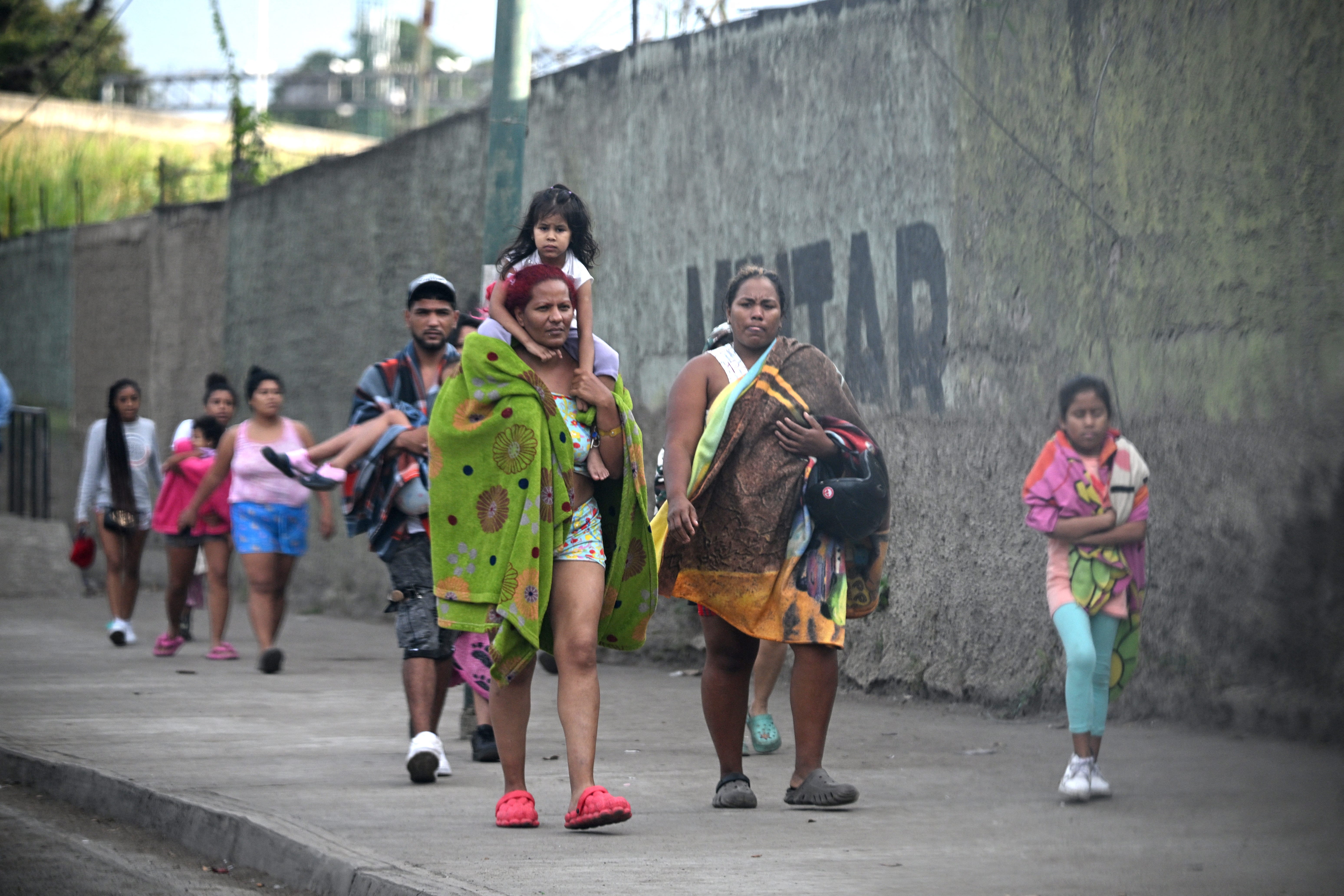
What's next in Venezuela? Panama raid that ousted Noriega offers clues.

Gunfire in the streets of a Latin American capital. U.S. military troops swooping in by helicopter. A foreign leader, accused of drug trafficking, hauled off to America in handcuffs.

The Trump administration's Jan. 3capture of President Nicolás Madurobore some familiar echoes to the 1989 U.S. invasion of Panama that ousted military strongman Manuel Noriega — and marked the most direct U.S. intervention in Latin America since.

But experts say that despite some similarities, the two key moments in America's long and checkered history of interventions differ in major ways that could make achieving U.S. goals more challenging this time following a raid that has revived regional anxiety.

PresidentDonald Trumpsaid Jan. 3 that his administration will "run the country" for a time and described an apparent nation-building effort. He said it would be funded by Venezuela's vast oil reserves to be tapped by American oil companies, some of which were forced out in the 2000s.

While many in Panama view Noriega's ouster as setting it on a path to become a growing and stable democracy, despite the deaths and trauma, that result is far less certain in a much bigger and complex nation beset by poverty, crime and lingering resistance, experts said.

Shaping a post-invasion future was a much easier task in relatively tiny Panama, in part because existing American troops linked to the Panama Canal were present before and after the invasion, said Will Freeman, a Latin America fellow at the Council on Foreign Relations.

While details remain scant, Freeman said he doubts the U.S. will field a full Iraq-style occupation force.

"This is not going to be so simple in Venezuela," he said. "One, it's not even likely that we get to democracy. And two, many of the problems that were there with Maduro are going to remain."

Leaders seek in vain to avoid capture

Trump's announcement of the raid came 36 years after the U.S. took Manuel Noriega into custody.

The famously acne-pocked military strongman was once a U.S. ally who had been recruited by the CIA to stanch the spread of communism. But he drew increasing U.S. ire for growing hostility and actions such as annulling an election and cracking down violently on opposition.

<p style=Exactly 36 years before the U.S. captured Venezuelan President Nicolás Maduro in an early morning military operation in Venezuela, U.S. forces took Panamanian General Manuel Noriega on Jan. 3, 1990. The arrest of Noriega shares more similarities with the Trump administration's alleged capture of Maduro than just a date on the calendar. See the impact of the U.S. operation in Panama.

" style="max-width:100%; height:auto; border-radius:6px; margin:10px 0;" loading="lazy" /> <p style=Thousands of Panamanians marched towards the Vatican Embassy where Manuel Noriega has been seeking asylum on January 3, 1990. Noriega was first a CIA asset before he rose to power as Panama's military strongman leader. The U.S. indicted him on drug trafficking charges, and in late 1989, then-President George H.W. Bush dispatched tens of thousands of troops to Panama to capture Noriega and bring him to face trial in the U.S.

" style="max-width:100%; height:auto; border-radius:6px; margin:10px 0;" loading="lazy" /> Telephone technicians tap into telephone box as US troops look on outside the Vatican Embassy, where Manuel Noriega has taken refuge, December 27, 1989. Helicopter used to take Manuel Noriega into United States custody flies over anti-Noriega demonstration, hours before his surrender, January 3, 1990. Felicidad Noriega, wife of deposed Panamanian leader General Manuel Noriega, walks to the Federal Courthouse September 13, 1991 as the jury selection process in Noriega's trial continues. Frank Ruino(C), attorney for Panamanian strong-man Manuel Noriega, speaks April 9, 1992 outside Miami's Federal Courthouse with his assistant Jon May(L). A twelve member federal jury found Manuel Noriega guilty on eight of ten counts. Panamanian leader Manuel Noriega leans through barred window in HQ to wave to supporters celebrating his crushing of an attempted coup, October 5, 1989. This is the scene overlooking the Chorillo district of downtown Panama City near the command of Manuel Noriega, December 26, 1989. The area was heavily damaged. President George Bush announces that deposed Panamanian leader Manuel Noriega had turned himself over to the US marshalls in Panama. January 3, 1990 US soldier Gerarde Walyun walks past an advertisement for Panama beer, as he patrols Panama City, January 15, 1990. A soldier from the US army surveys an area in Panama after the US invasion from the window of a Shinook helicopter, December 20, 1990 6 soldiers patrol the Curundu neighborhood, Panama City, January 15, 1990.

See photos of the US invasion of Panama, capture of Manuel Noriega

Exactly 36 years before the U.S.captured Venezuelan President Nicolás Maduroin an early morning military operation in Venezuela, U.S. forces took Panamanian General Manuel Noriega on Jan. 3, 1990. The arrest of Noriega shares more similarities with the Trump administration's alleged capture of Maduro than just a date on the calendar. See the impact of the U.S. operation in Panama.

In 1989, President George H.W. Bush, citing authoritarian rule, concerns about the security of the Panama Canal and U.S. drug trafficking and money laundering charges, ordered "Operation Just Cause." It tapped more than 20,000 U.S. troops, many already in Panama, to seize control of military and infrastructure sites. A new president was sworn in soon after.

Maduro's capture also stems from a history of conflict with the United States.

Maduro came to power as the successor to President Hugo Chávez, a socialist leader who gained leadership in the late 1990s. The nation has since faced a mix of authoritarianism and skyrocketing poverty, crime and inflation.

Like Noriega, Maduro was indicted by U.S. prosecutors in 2020 on drug trafficking charges. But he was a less significant figure in drugs than Noriega or Juan Orlando Hernandez, the former president of Honduras, who Trump recently pardoned, said Michael Shifter, an adjunct professor at Georgetown University's Walsh School of Foreign Service.

Pressure to oust Maduro gained steam since Trump's reelection last year. And in recent months, U.S. military buildup in the region included the deployment of aircraft carriers and fatal military strikes on small boats alleged to be carrying drugs.

Air Force Gen. Dan "Razin" Caine, chairman of the Joint Chiefs of Staff, said U.S. authorities spent time tracking Maduro's daily routines and moves before the military raid in which Maduro was captured by U.S. Special forces at his compound.

As U.S. forces cut power and descended on Maduro, the military encountered some resistance, including a helicopter struck by a bullet, and returned fire. Maduro did not make it to a reinforced steel safe room he was trying to reach, Caine said.Images and videoshowed explosions, burning vehicles, plumes of smoke rising over the capital city of Caracas, and a swarm of low-flying helicopters.

<p style=Venezuelan leader Nicolás Maduro and his wife landed in New York on Saturday, Jan. 3, 2026 to face several criminal charges after the United States conducted a large-scale operation in Caracas that captured the couple.

" style="max-width:100%; height:auto; border-radius:6px; margin:10px 0;" loading="lazy" /> Stairs lead to a U.S. federal airplane before Venezuela's President Nicolas Maduro is led out in custody ahead of his scheduled court appearance at Manhattan federal court, at Stewart Air National Guard Base in Newburgh, New York, U.S. January 3, 2026. Venezuela's President Nicolas Maduro is led in custody from a U.S. federal airplane before his scheduled court appearance at Manhattan federal court, at Stewart Air National Guard Base in Newburgh, New York, U.S., January 3, 2026. Venezuela's President Nicolas Maduro is led in custody from a U.S. federal airplane before his scheduled court appearance at Manhattan federal court, at Stewart Air National Guard Base in Newburgh, New York, U.S. January 3, 2026. The airplane carrying Venezuelan President Nicolas Madura lands at Stewart Air National Guard Base in Newburgh, N.Y. at approximately 4:30pm Jan. 3, 2026. The airplane carrying Venezuelan President Nicolas Madura lands at Stewart Air National Guard Base in Newburgh, N.Y. at approximately 4:30pm Jan. 3, 2026. A person demonstrates against US military action in Venezuela outside Stewart Air National Guard Base in Newburgh, New York, on January 3. 2026. US President Donald Trump said Saturday that the United States will A United States government plane believed to be carrying Venezuela President Nicolás Maduro taxis after landing at Stewart Air National Guard Base in Newburgh, N.Y., Jan. 3, 2026. People demonstrate against US military action in Venezuela outside Stewart Air National Guard Base in Newburgh, New York, on January 3. 2026. US President Donald Trump said Saturday that the United States will

Nicolás Maduro lands in US: See the captured Venezuela leader's arrival

Venezuelan leaderNicolás Maduro and his wifelanded in New York on Saturday, Jan. 3, 2026to face several criminal chargesafter the United Statesconducted a large-scale operationin Caracas that captured the couple.

By that night, Maduro and his wife Cilia Flores were in New York, where he stands accused of trafficking in cocaine during a 25-year career in public posts.

More than three decades earlier, Noriega also tried to slip away, driving through the streets to evade capture and eventually hiding in the Vatican embassy on Dec. 24.

Surrounded by U.S. forces, who couldn't storm the site, the U.S. military blasted constant music by Alice Cooper and Black Sabbath on loudspeakers, according toofficial accounts. He surrendered on Jan. 3, 1990.

Noriega was convicted, spending the rest of his life in U.S., French and Panamanian prisons before dying in 2017.

Interventions bring criticism and challenges

Both attacks were part of a century-long history of U.S. intervention – directly and indirectly – in the politics of Latin American countries such as Cuba, the Dominican Republic and Haiti.

In the 1950s for example, the U.S. sought to remove Guatemala's democratically elected president amid land reforms that were affecting the U.S.-based United Fruit Company's exploitative labor practices.

The U.S. helped install a military dictatorship whose policies eventually triggered a civil war and led to mass human rights abuses during which more than 200,000 Guatemalans were killed or forcibly disappeared.

During the Panama invasion, at least 514 Panamanian soldiers and civilians were killed. However, some local reports have put the figure at double that. Twenty-three U.S. military personnel were killed. And the event was viewed by critics as yet another example of the U.S. ignoring sovereignty.

At that time, the U.S. sought to have a relatively quick intervention at a time when leaders were keen to avoid a quagmire, said Eduardo Gamarra, a professor of politics and international relations at Florida International University.

In contrast, the Trump administration has turned away from the post-Cold War international order in actions and policies that have also drawn comparison toPresident Theodore Roosevelt's takeon the Monroe Doctrine that the U.S. should "exercise international police power" to end what Roosevelt called "chronic unrest or wrongdoing" in the hemisphere.

And it comes as some countries in Latin America have made a move to right-leaning governments. More were heading away from authoritarian leadership during the time of the Panama invasion, Gamarra said.

Trump has criticized Venezuela, which nationalized its oil industry in the 1970s, for added expropriations and other changes in the 2000s that forced many major U.S. oil companies out and led to legal battles over compensation.

While Trump said his administration plans to oversee Venezuela, U.S. forces have no control over the country itself, Reuters reported, though Trump didn't rule out having some "boots on the ground."

"We will run the country until such time as we can do a safe, proper and judicious transition," Trump said during a Jan. 3 press conference.

While Trump said Venezuelan Vice PresidentDelcy Rodriguezhad no choice but to be cooperative, Rodriguez appeared on Venezuelan television Saturday afternoon with other top officials to decry what she called a kidnapping.

Those efforts will face complexities not present in Panama decades ago, such as the presence of large oil reserves and security challenges from criminal groups to illegal mining interests, Shifter said.

<p style=This file photo shows a group of U.S. sailors from the battleship Connecticut and a gun they captured at Cape Haitien during the U.S. occupation of Haiti in 1915.

" style="max-width:100%; height:auto; border-radius:6px; margin:10px 0;" loading="lazy" /> <p style=Officers at Jacmel, Haiti, during the U.S. occupation in 1915.

" style="max-width:100%; height:auto; border-radius:6px; margin:10px 0;" loading="lazy" /> <p style=A group of Cuban revolutionaries with Fidel Castro are seen with artillery after routing the U.S.-backed invasion at the Bay of Pigs in 1961.

" style="max-width:100%; height:auto; border-radius:6px; margin:10px 0;" loading="lazy" /> <p style=Children cheer on the U.S. Marines following offensive in Vecca Monte west of Panama City, during "Operation Just Cause," the U.S. invasion to remove Manuel Noriega, which lasted from December 1989 through January 1990.

" style="max-width:100%; height:auto; border-radius:6px; margin:10px 0;" loading="lazy" /> <p style=A U.S. Marine corps crew takes up position on the outskirts of Santo Domingo, on May 2, 1965, during the Dominican Civil War.

" style="max-width:100%; height:auto; border-radius:6px; margin:10px 0;" loading="lazy" /> <p style=The U.S. Army Airborne troops drive down a street in Santo Domingo during the occupation of the Dominican Republic in 1965.

" style="max-width:100%; height:auto; border-radius:6px; margin:10px 0;" loading="lazy" /> <p style=U.S. troops in full combat gear run on the docks of Port-au-Prince harbor, on Sept. 19, 1994, after arriving on an assault helicopter. Thousands of U.S. soldiers arrived in Haiti on Sept. 19, 1994, as part of "Operation Uphold Democracy," to pave the way for the restoration of the elected president Jean-Bertrand Aristide.

" style="max-width:100%; height:auto; border-radius:6px; margin:10px 0;" loading="lazy" /> <p style=Hundreds of local residents run towards the U.S. Chinook helicopters, on Sept. 24, 1994, as a detachment of over 100 U.S. troops arrive in this small southern coastal town, 120 km south of Port-au-Prince, as part of the "Operation Uphold Democracy."

" style="max-width:100%; height:auto; border-radius:6px; margin:10px 0;" loading="lazy" />

From Cuba to Panama: US interventions that shaped Latin America

This file photo shows a group of U.S. sailors from the battleship Connecticut and a gun they captured at Cape Haitien during the U.S. occupation of Haiti in 1915.

Uncertainty also stems from mixed reactions – some celebrating hopes for new freedom and others saying a line had been crossed – in a region where the military action revived anxieties about past U.S. interventions.

In Panama, which has drawn the spotlight of the Trump administration over immigration and canal oversight, Panama's president, José Raúl Mulino, weighed in onsocial mediathat included support of the "democratic process and the acceptance of the legitimate wishes of the Venezuelan people."

While the invasion of Panama 36 years ago wasn't widely seen as a precursor to other interventions, Trump's rhetoric aimed atColombia, Mexico and Cubaover various issues including illegal drugs has left some countries on edge.

"U.S. military intervention in the region has not always had a very happy record. And so I think that creates a lot of anxiety and a lot of apprehension," Shifter said. "If there are no limits and no rules, you know, why can't Trump do the same to them?"

Contributing: Kim Hjelmgaard of USA TODAY, Reuters

This article originally appeared on USA TODAY:Venezuela raid echoes Panama invasion that captured Manuel Noriega

What's next in Venezuela? Panama raid that ousted Noriega offers clues.

Gunfire in the streets of a Latin American capital. U.S. military troops swooping in by helicopter. A foreign leader, acc...
More than 100 firefighters battle massive blaze in Denver

More than 100 firefighters battled a massive five-alarm fire Friday evening in Denver at an apartment building construction site -- about the size of a city block -- working for hours to keep the flames from spreading to nearby structures, officials said.

One firefighter was injured battling the fire and taken to the hospital, the Denver Fire Department told ABC News.

There were no other injuries immediately reported.

AP - PHOTO: US Denver Fire

The fire spurred evacuation orders for nearby residents.

By late evening, the fire was largely under control but not fully extinguished. Officials estimated the blaze was about 70% contained, with pockets of deep-seated fire still burning inside the structure. Firefighters were expected to remain on scene through the night to fully suppress hot spots.

Denver Fire Department - PHOTO: This photo provided by The Denver Fire Department shows a large blaze in Denver, Friday evening, Jan. 2, 2026.

The building, which was in the early to mid-stages of construction, was primarily made of wood, with some plastic materials used in wrapping and construction.

There's no word yet on the cause of the blaze.

This is a developing story and will be updated.

More than 100 firefighters battle massive blaze in Denver

More than 100 firefighters battled a massive five-alarm fire Friday evening in Denver at an apartment building constru...
Syria begins circulating new post-Assad currency bills

DAMASCUS, Syria (AP) —Syriastarted the process of circulating new currency bills on Saturday as the crisis-hit nation seeks to stabilize the economy as it recovers from the fallof Bashar Assad'sgovernment.

A decree issued earlier this week by PresidentAhmad al-Sharaasaid that "old Syrian currency" will be gradually withdrawn from circulation according to a timetable set by the central bank and through designated exchange centers.

Central Bank Governor Mokhles Nazer posted on X that after months of preparations, the exchange of old Syrian pounds with new banknotes officially began Saturday morning.

The presidential decree posted on the SANA state news agency stipulates that "new Syrian currency" will be issued by removing two zeros from the nominal value of the old currency. It means every 100 Syrian pounds of the old currency will now equate to one Syrian pound.

The largest denomination of the old currency was 5,000 Syrian pound, while under the new currency it is 500 pounds.

The U.S. dollar was selling at exchange shops in Damascus on Saturday for 11,800 pounds for the old banknotes, some of which bear the images of Assad and his late father and predecessor, Hafez Assad.

At the start of Syria's conflict in mid-March 2011, the U.S. dollar was worth 47 Syrian pounds.

Since insurgent groups led by al-Sharaa's Hayat Tahrir al-Sham marched into Damascus in December 2024 to end the Assad family's 54-year rule, work has been ongoing by the country's new authorities to improve the economy battered by years of war and Western sanctions.

The U.S. and the European Union have removed most of thesanctionsimposed on Syria during Assad's rule.

Syria begins circulating new post-Assad currency bills

DAMASCUS, Syria (AP) —Syriastarted the process of circulating new currency bills on Saturday as the crisis-hit nation see...
'Super thrilled' Floridians react to Venezuela strikes

As Floridians awoke to news ofU.S. strikes on Venezuela,Denisse Castillo was already celebrating.

The Venezuelan-born U.S. citizen came here at 15 with her mom and three siblings, but is in close touch with family in the South American country.

Picture of fire at Fuerte Tiuna, Venezuela's largest military complex, after a series of explosions in Caracas on January 3, 2026. Loud explosions, accompanied by sounds resembling aircraft flyovers, were heard in Caracas around 2:00 am on January 3. Smoke rises from explosions in Caracas, Venezuela, January 3, 2026, in this screen grab obtained from video obtained by Reuters. Fire at Fuerte Tiuna, Venezuela's largest military complex, is seen from a distance after a series of explosions in Caracas on January 3, 2026. Helicopters fly past plumes of smoke rising from explosions, in Caracas, Venezuela, January 3, 2026 in this screen grab obtained from video obtained by Reuters. A column of smoke rises during multiple explosions in the early hours of the morning, in Caracas, Venezuela, January 3, 2026 in this screen grab obtained from video obtained by Reuters. A military personnel member walks past debris at La Carlota military air base, after U.S. President Donald Trump said the U.S. has struck Venezuela and captured its President Nicolas Maduro, in Caracas, Venezuela, Jan. 3, 2026. A destroyed anti-aircraft unit at La Carlota military air base, after U.S. President Donald Trump said the U.S. has struck Venezuela and captured its President Nicolas Maduro, in Caracas, Venezuela, Jan. 3, 2026. Civilians who were living inside Fuerte Tiuna, Venezuela's largest military complex leave the compound, in Caracas on Jan. 3, 2026. A firefighter walks past a destroyed anti-aircraft unit at La Carlota military air base, after U.S. President Donald Trump said the U.S. has struck Venezuela and captured its President Nicolas Maduro, in Caracas, Venezuela, January 3, 2026. Destroyed vehicles at La Carlota military air base, after U.S. President Donald Trump said the U.S. has struck Venezuela and captured its President Nicolas Maduro, in Caracas, Venezuela, January 3, 2026. A member of the National Guard stands guard at Fuerte Tiuna, Venezuela's largest military complex, in Caracas on Jan. 3, 2026, after U.S. forces captured Venezuelan leader Nicolas Maduro after launching a A Colombian soldier stands guard at the border between Venezuela and Colombia, after U.S. President Donald Trump said the U.S. has struck Venezuela and captured its President Nicolas Maduro, in Cucuta, Colombia, January 3, 2026. Colombian police and military personnel stand guard at the border between Venezuela and Colombia, after U.S. President Donald Trump said the U.S. has struck Venezuela and captured its President Nicolas Maduro, in Cucuta, Colombia, January 3, 2026. A destroyed anti-aircraft unit at La Carlota military air base, after U.S. President Donald Trump said the U.S. has struck Venezuela and captured its President Nicolas Maduro, in Caracas, Venezuela, January 3, 2026. A man walks next to military vehicles as Colombian soldiers patrol the border between Venezuela and Colombia, after U.S. President Donald Trump said the U.S. has struck Venezuela and captured its President Nicolas Maduro, in Cucuta, Colombia, January 3, 2026. Passengers sleep on the floor, after flights were delayed and cancelled when the airspace was closed due to U.S. strikes on Venezuela overnight, at Rafael Hernandez International Airport in Aguadilla, Puerto Rico January 3, 2026. U.S. Air Force F-22 Raptor fighter jets sit parked on the tarmac at the former Roosevelt Roads naval base, after U.S. President Donald Trump said the U.S. has struck Venezuela and captured its President Nicolas Maduro and his wife Cilia Flores, in Ceiba, Puerto Rico, January 3, 2026. Colombian soldiers in a military vehicle at the border between Venezuela and Colombia, after U.S. President Donald Trump said the U.S. has struck Venezuela and captured its President Nicolas Maduro, in Cucuta, Colombia, January 3, 2026. A car drives on an empty street, after U.S. President Donald Trump said the U.S. has struck Venezuela and captured its President Nicolas Maduro, in Caracas, Venezuela January 3, 2026. A cyclist stops to check their phone, after U.S. President Donald Trump said the U.S. has struck Venezuela and captured its President Nicolas Maduro, in Caracas, Venezuela January 3, 2026. F-22, C-130 and F-35 aircraft are seen at the former Roosevelt Roads naval base, after U.S. President Donald Trump said on Saturday the U.S. has struck Venezuela and captured its President Nicolas Maduro, in Ceiba, Puerto Rico, January 3, 2026. A supporter of Venezuelan President Nicolas Maduro holds a flag of Venezuela on an empty street near Miraflores Palace, after U.S. President Donald Trump said the U.S. has struck Venezuela and captured President Maduro, in Caracas, Venezuela, January 3, 2026. A person wears a Venezuelan flag, as they and others react to the news after U.S. President Donald Trump said the U.S. has struck Venezuela and captured its President Nicolas Maduro, in Miami, Florida, U.S., January 3, 2026. People react to the news after U.S. President Donald Trump said the U.S. has struck Venezuela and captured its President Nicolas Maduro, on the streets of Miami, Florida, U.S., January 3, 2026. A person wearing a hat that reads A man holds a flag reading

US bombs targets in Venezuela and captures Nicolás Maduro, Trump says

"Everyone is super thrilled," she said of the news that U.S. troops captured President Nicolás Maduro.

"He's the worst of the worst," she said, "running a criminal organization and giving away the country's land to the worst enemies of the United States. People need to realize that."

Venezuela's President Nicolás Maduro gestures to supporters after he was sworn in for a third six-year term, in Caracas, Venezuela, on Jan. 10, 2025.  The United States seized Venezuelan leader Nicolás Maduro and his wife in an overnight military operation on Jan. 3, 2026, President Donald Trump said, as explosions rocked Caracas and targets across the country.

Thanks to social media platform WhatsApp, she says Venezuelans were aware military action was imminent and residents near its targets knew to stay put.

"My family lives very near military bases and they knew they needed to hide, though no one knew exactly when it would start until they began hearing explosions," she said.

"At first, they thought it might be fireworks, but then they started hearing the helicopters and stuff."

In a text to the Naples Daily News, U.S. Congressman Byron Donalds praised PresidentDonald Trumpfor the action and accused Maduro of using "foreign terrorist organizations to traffic deadly drugs and violence into our country, killing countless Americans. He was one of the largest narco-traffickers in the world and a threat to our national security," he wrote inan early morning X post.

Byron Donalds speaks at his kickoff party for the governor's race at the Sugarshack in Bonita Springs on Friday, March 28, 2025.

"This morning, he was captured. This is 'Peace Through Strength.' Justice will be served."

Estimates of theVenezuelan population in Southwest Florida aren't precise, but the U.S. Census Bureau's most recent American Community Surveyshowed that there were approximately4,200 in Collier as of 2023, and 2,200 in Lee.

Castillo agrees with Trump's assertions that many of the recent immigrants are "people who hate the U.S.," she said.

As Cuba's Fidel Castro did in 1980, she says, Maduro released prisoners and mentally ill people, encouraging them to come to the U.S. "So you get the worst coming here."

Venezuelan immigrants were one of the groups theTrump administration targetedlast year as it rolled back temporary protected status for citizens from several countries, including Haiti, Venezuela, Honduras, Afghanistan and Yemen.

Amy Bennett Williams is a senior reporter focused on the environment. Reach her by emailing awilliams@news-press.com

Please support local community journalism and stay informed about Southwest Florida news by subscribing toThe News-PressandNaples Daily News; download the freeNews-PressorNaples Daily News app, and sign up for daily briefing email newsletter, food & dining and growth & development newslettershereandhere.

This article originally appeared on Naples Daily News:What are they saying about strikes on Venezuela, capture of Maduro?

'Super thrilled' Floridians react to Venezuela strikes

As Floridians awoke to news ofU.S. strikes on Venezuela,Denisse Castillo was already celebrating. The Venezuelan...
Venezuela's President Nicolas Maduro gestures during a ceremony to swear in new community-based organisations in Caracas, Venezuela, on December 1. - Leonardo Fernandez Viloria/Reuters

Nicolás Madurobelieved that his predecessor and political father, the lateHugo Chávez, appeared before him in the form of a small bird and a butterfly. He also though that celebrating Christmas two months early – by presidential decree – would help "lift the spirits of Venezuelans."

He confused "gremlin" with "grinch," invented words in Spanish, and often made one linguistic slip after another. His decisions and statements were seen as so eccentric that many Venezuelans and Latin Americans have a name for them: "maduradas."

He had, however, proven for years that underestimating him can be a mistake for his critics.

But all that changed in the early hours of Friday morning, when Maduro and his wife were dragged from their bedroom by United States soldiers and put on a plane out of Venezuela.

TheUS operationhas put an end to Maduro's contentious 12-year rule, which saw Venezuela lose millions of inhabitants, 72% of its economy, democratic legitimacy in the eyes of much of the world, and many of its most important international allies.

The 'son of Chávez'

Mockery of Maduro existed even before hetook officeas president of Venezuela in 2013. Back then, he was just one among several potential successors to the cancer-stricken Chavez, despite having served as foreign minister and vice president. Maduro received only minority support from followers of the United Socialist Party of Venezuela (PSUV), and his circle, according to reports, was in strong tension with supporters of the influential Diosdado Cabello, then president of the National Assembly, for being the chosen one in a country dominated by uncertainty.

But overwhelmed by illness, at the beginning of December 2012, Chávez put an end to internal disputes and unequivocally blessed Maduro to lead chavismo and Venezuela. The "son of Chávez" then inaugurated a government in which, year after year, he defied criticism of his electoral system, protests, sanctions, arrest warrants, possible rebellions, international isolation, and speculation about his future.

Maduro himself says he does not know why Chávez chose him among several candidates because he never aspired to "be president." "But he was preparing me," he said shortly after Chávez's death.

Venezuelan President Hugo Chavez gives his first press conference after winning national elections on October 9, 2012, in Caracas, Venezuela. - Gregorio Marrero/LatinContent/Getty Images

The son of a political activist from a traditional Venezuelan party, Maduro began preparing very early. As a student, he joined the Socialist League and began working as a bus driver for the Caracas Metro.

His activism made him aunion leader, from where he jumped into politics. Union and political activity allowed him to meet two decisive people in his life: Cilia Flores and Chávez.

Flores was a young lawyer, and Maduro was a rising union leader. She was one of Chávez's legal defenders over the 1992 coup attempt. Flores and Maduro visited him in Yare prison.

The path of love, politics, and loyalty began. Flores became Maduro's partner and, eventually, the first woman to lead the National Assembly and the person many today see as the "power behind the throne," Carmen Arteaga, PhD in Political Science and professor at Simón Bolívar University, told CNN. And he became the "son of Chávez."

The mysteries of Cuban support

When Chávez was elected president in 1999, Maduro entered the National Assembly. As the then-president gained power inside and outside Venezuela, Maduro climbed the ranks, first in the National Assembly and then in government as "a good second, always obedient," Ronal Rodríguez, researcher at the Venezuela Observatory at Colombia's Universidad del Rosario, told CNN.

"Maduro was always an underestimated leader. There were many possible successors when Chávez fell ill. But none achieved what he did: on one hand, Cuban support, and on the other, distributing power within chavismo," said Rodríguez.

Maduro'srelationship with Cubaspans decades and has various forms and mysteries. One of the few unauthorized biographies of Maduro – "De Verde a Maduro: el sucesor de Hugo Chávez" (a play on words, since "maduro" also means ripe; "From green to Maduro: The Successor of Hugo Chávez") – says that the current president may have been trained in revolutionary politics on the island during his youth.

Neither he nor official biographies mention this alleged experience. But Maduro did build, first with the government of Fidel and Raúl Castro, and later with Miguel Díaz-Canel, a bond that is among the most important for today's Venezuela. And that, according to former officials of Trump's first administration, was decisive for the president to anticipate and contain, through Cuban security services, the opposition uprising of April 2019, among other things.

Maduro deepened his ties with the Castros when he became Chávez's foreign minister in 2006, and became a "key player" in 2011, when the then-president fell ill and traveled to Cuba for treatment. From then on, he was the key link in managing the strategic relationship between the Castros and chavismo.

That relationship helped Maduro strengthen his position to be the successor to Chávez, who had the charisma and influence that none of his potential heirs possessed. And also to oil a narrative first perfected by Fidel Castro and then by Chávez himself – both leaders in the Latin American left. It was an anti-imperialist and anti-US narrative, amplified by geopolitical alliances with historic US rivals.

The start of the ever-returning cycle

Maduro leaned on that epic from the very start of his first administration. The "son of Chávez" received his blessing, but not all his votes. In theApril 2013 electionsto choose the late president's successor, the chavista candidate defeated opposition leader Henrique Capriles by just 1.59% of the vote. Six months earlier, in the October 2012 presidential elections, Chávez had beaten Capriles by a margin of 9.5%.

Suspicious for years of the government's electoral transparency, Capriles and the opposition refused to accept the results. Even chavismo itself, through Cabello, showed Maduro its dissatisfaction with the result and called for self-criticism.

He responded that it was a "legal, fair, and constitutional" victory and celebrated chavismo's continued rule.

But there began the pattern that best defined the self-proclaimed defender of "popular and revolutionary democracy" throughout his tenure: contested elections, opposition in the streets, allegations of repression and persecution of dissent, and distribution of benefits within chavismo to avoid internal challenges and retain power. Outside Venezuela, the "Maduro model" relied on the support and "know-how" of the traditional US adversaries: China, Russia, and Iran.

From 2013 onward, all national elections were shrouded in doubts and controversies among the Venezuelan opposition, international organizations, and even allied governments: the 2017 constitutional elections, the 2020 legislative elections, and the 2018 and2024 presidential elections. The 2015 parliamentary elections were, in fact, won by the opposition, but chavismo used political maneuvers to neutralize that victory. Time and again, elections were followed by opposition challenges and marches and, as documented by the United Nations in its reports, repression and death.

Maduro defended these processes as "transparent" and his electoral system as "reliable." He resisted, clenched his fist, and overcame challenges even when many thought he would not. This happened, more than ever, in 2024, when not even Colombia and Brazil, governed by leftist presidents Gustavo Petro and Lula da Silva, recognized the results of the elections in which Maduro supposedly defeated the opposition of Edmundo González Urrutia and María Corina Machado and achieved his second re-election.

The high cost for Venezuelans

For Venezuelans, the price of Maduro's survival method was high and measured in lives, exile, and poverty. Since 2017, several UN agencies and the International Criminal Court (ICC) have been tasked with enumerating that cost, sometimes even with the collaboration of the Venezuelan government itself, in an attempt to ward off the specter of an international arrest warrant for Maduro for crimes against humanity.

Year after year, reports described an increase in human rights violations, "coordinated in accordance with state policies and part of a course of conduct that is both widespread and systematic, thus constituting crimes against humanity," as noted in a2020 UN mission report. "The mission found reasonable grounds to believe that authorities and security forces have planned and executed large-scale human rights violations since 2014."

"The evidence obtained by the mission during this investigative cycle confirms that the crime of persecution based on political motives continues to be committed in Venezuela, without any national authority showing willingness to prevent, prosecute, or punish the serious human rights violations that constitute this international crime," concluded Marta Valiñas, rapporteur of the report.

Excessive force, arbitrary detentions of protesters and opposition leaders, sexual violence, torture, extrajudicial executions – all were present, according to UN reports, in Maduro's manual for managing dissent.

In response to each accusation or international investigation, Maduro and his government resorted, as they had from the beginning, to the well-known anti-imperialist narrative. "It is very concerning that the high commissioner gives in to the pressures of anti-Venezuelan actors and makes biased and untruthful statements, presenting ideologized speculations as facts," Maduro's government responded in 2021 to Michelle Bachelet, then UN High Commissioner for Human Rights.

Bachelet was Chile's first socialist president since the return of democracy to the country. Maduro's confrontation with Bachelet, then a UN diplomat, was a sign that the Venezuelan government was also beginning to lose the support of the Latin American left.

Poor management, war economy, exodus and sanctions

The anti-US crusade narrative was also used by Maduro and his government to justify Venezuela'sdire economic numbers.

These figures, typical of war economies in other countries, starkly expose the weak management of a Maduro who managed to get Venezuela to start growing only in 2021, eight years after taking power. Today, the Venezuelan economy is 28% of what it was in 2013, according to the IMF.

A man holds a grocery bag in front of a store displaying signs with dollar prices at the Quinta Crespo municipal market in Caracas on November 13. - FEDERICO PARRA/AFP/AFP via Getty Images

Behind this collapse is the decline of Venezuela'smain source of incomeover the past 50 years: oil. Targeted by power struggles, chavista disputes, and lack of investment, PDVSA, the company that controls oil production and marketing, collapsed. The general fall in oil prices since 2014 did not help either. Today, oil export revenues are just 20% of what they were in 2013, according to OPEC+ data.

Maduro and his government blamed and continue to blame US sanctions for the economic collapse. But it was only in 2019 that the Trump administration imposed sanctions on PDVSA; until then, the measures were aimed at punishing Maduro and his officials individually.

Unlike in other countries, poor economic management did not alter Maduro's control over Venezuela. But it did change the country's makeup. Overwhelmed by repression and poverty, which at its worst affected 90% of the population, millions ofVenezuelans chose to leavefor destinations where the future seemed possible. Venezuela's exodus, along with Syria's, is among the largest displacement crises worldwide: nearly eight million Venezuelans now live in other countries.

The key to the 'Maduro model' of survival

Maduro's Venezuela is a succession of crises that forced Venezuelans into exile but, at the same time, strengthened the president, who blamed sanctions for the exodus. "Maduro is more skillful than most people think; he always knew how to take advantage of circumstances and turn crises around," says Rodríguez.

To do this, Maduro began building, as soon as his government started, a balance of power in which he became the guarantor. Essential in this map were, from the start, theArmed Forces, a sector with which Maduro had little relationship before being anointed by Chávez.

"Someone once explained this to me: with Chávez, the military thought they had to thank him for the prominence they had. With Maduro, it's the other way around. He has to thank the military and give them concessions like positions or entire economic sectors, so they tolerate him. He turned Venezuela into a confederation in which he is the manager," Amherst College academic Javier Corrales told CNN.

Also key in this power-sharing scheme, which Corrales compares to what the Castros imposed in Cuba, were the oldest chavista leaders, such as Cabello or the now disgraced Rafael Ramírez, former president of PDVSA, among other positions, or Tareck el-Aissami, former vice president of the country.

But, as in any closed power regime, some succumbed, under allegations of supposed corruption, and went into exile or ended up in prison. Many others continued and today are not only part of the balance of power and economic management but also of international justice investigations into alleged crimes against humanity.

Maduro distributed power, money, and responsibilities and, in doing so, ensured his survival.

In the "confederation" of actors that dominate Maduro's Venezuela, paramilitary groups that, according to the UN, participated in the cycle of opposition repression during the most intense social unrest of recent years, also play a central role. The "colectivos" were also a key tool in Maduro's balance of power and his future.

"They are a highly armed sector. They are the regime's sheriffs. And they have a lot to lose if the government falls," said Corrales.

The intense relationship with the US

Former Trump and Biden officials share Corrales's assessment. There are so many legal and supposedly illegal actors involved in Maduro's government, so many interests at stake, that the president's sudden departure could unleash chaos and an even worse drama than what has been corroding Venezuela for years.

Almost thirteen years after Chávez proclaimed him his chosen one, Trump's second administration appeared determined to make it his last. The US policy of weakening Maduro was as intense as the Venezuelan strongman's anti-US rhetoric.

The US pressure spanned several administrations and included economic sanctions, exorbitant arrest warrants, detention of relatives for alleged drug links, arrest and release of the alleged "front man," granting and canceling oil licenses, direct dialogue and secret talks, and even a plan to allow free, fair, and transparent elections that led, in 2024, to elections in which the opposition led by Machado surprised the world.

For years. nothing worked, neither threats nor dialogue with a Maduro who also proved to be an expert in stalling and delaying negotiations.

In the end, it took US military intervention to have finally break Maduro's grip on power.

For more CNN news and newsletters create an account atCNN.com

Venezuelan leader Nicolás Maduro defied his enemies for years. Until now

Nicolás Madurobelieved that his predecessor and political father, the lateHugo Chávez, appeared before him in the form of a small bird and ...


CR GLOW © 2015 | Distributed By My Blogger Themes | Designed By Templateism.com