Why did US strike Venezuela and seize Nicolás Maduro? Live updates

Venezuelan leaderNicolás Maduroand his wife,Cilia Flores, awoke early Saturday morning to U.S. special forcescapturing themfrom their capital city compound, and by the end of the day they were in federal custody in New York.

Over the span of a few hours on Saturday, U.S. strikes targeted air defenses and other sites in Caracas and three other Venezuelan states,whisking awayboth Maduro and Flores and transporting them thousands of miles over sea and air to the United States.

The operation marked a dramatic escalation of PresidentDonald Trump's stance toward Venezuela aftermonths of rising tensions, threats and oil tanker seizures.

Maduro and his wife have beenindicted on federal drug and weapons charges, and are expected to attend an arraignment in New York City as early as Monday, according to multiple media reports.

As globalreverberationscontinue to be felt, many questions remain unanswered, including those regarding the future ofU.S.-Venezuela relationsand how the South American nation will move forward.

Trump: 'We are going to run' Venezuela until transition

Hours after his administration struck Venezuela and deposed its president, Trump said at a Saturday news conference that the U.S. plans to run the country until a transition in leadership can take place.

"We're going to run the country until such time as we can do a safe, proper and judicious transition," Trump said.

Trump said, "It has to be judicious, because that's what we are all about."

The president did not immediately provide additional details on how the U.S. planned to manage the sovereign nation.

During an interview on Fox News' "Fox & Friends" earlier in the day, Trump declined to say whether he would back Venezuelan opposition leader Maria Corina Machado, thewinner of the 2025 Nobel Peace Prize, for the presidency.

−Francesca Chambers

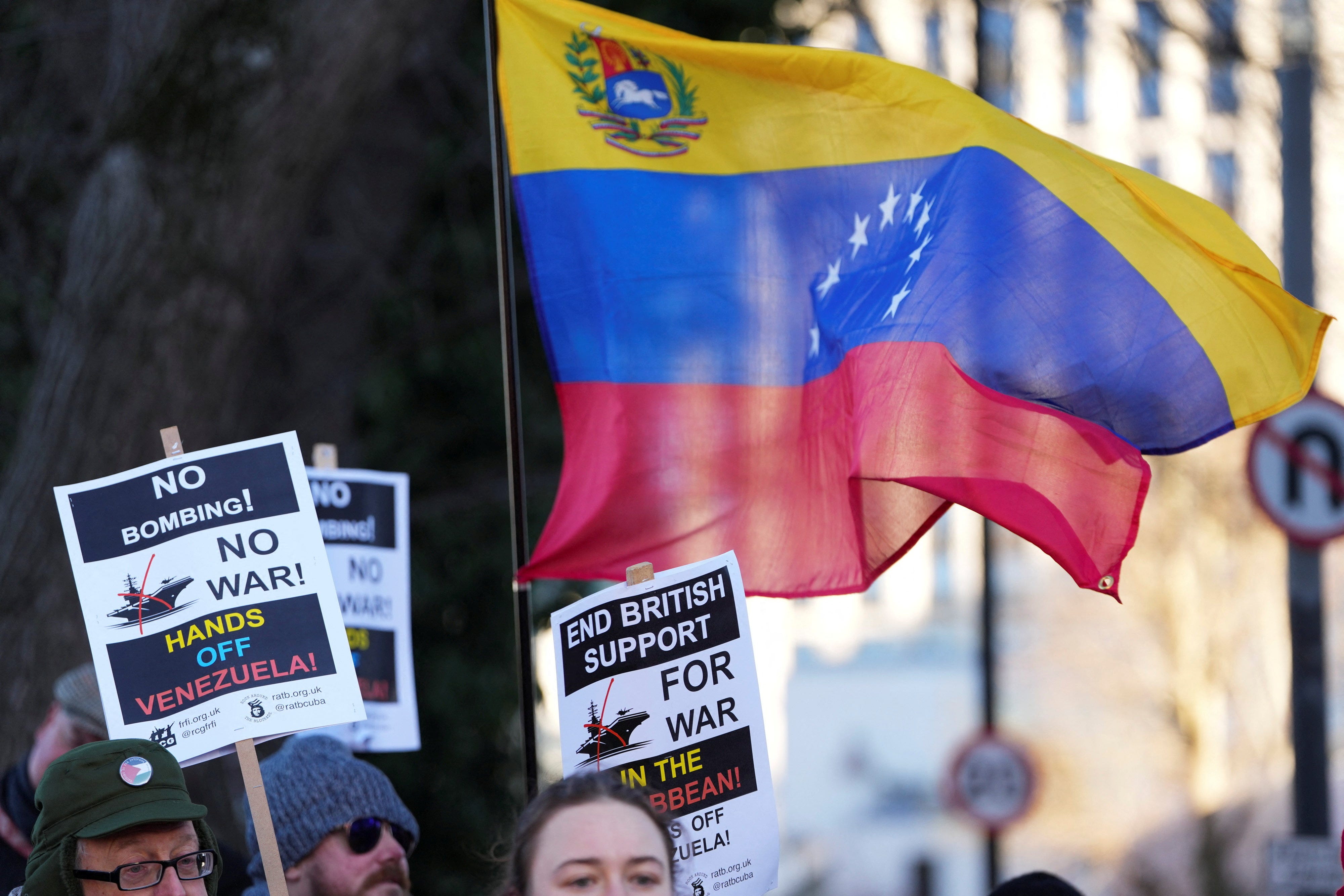
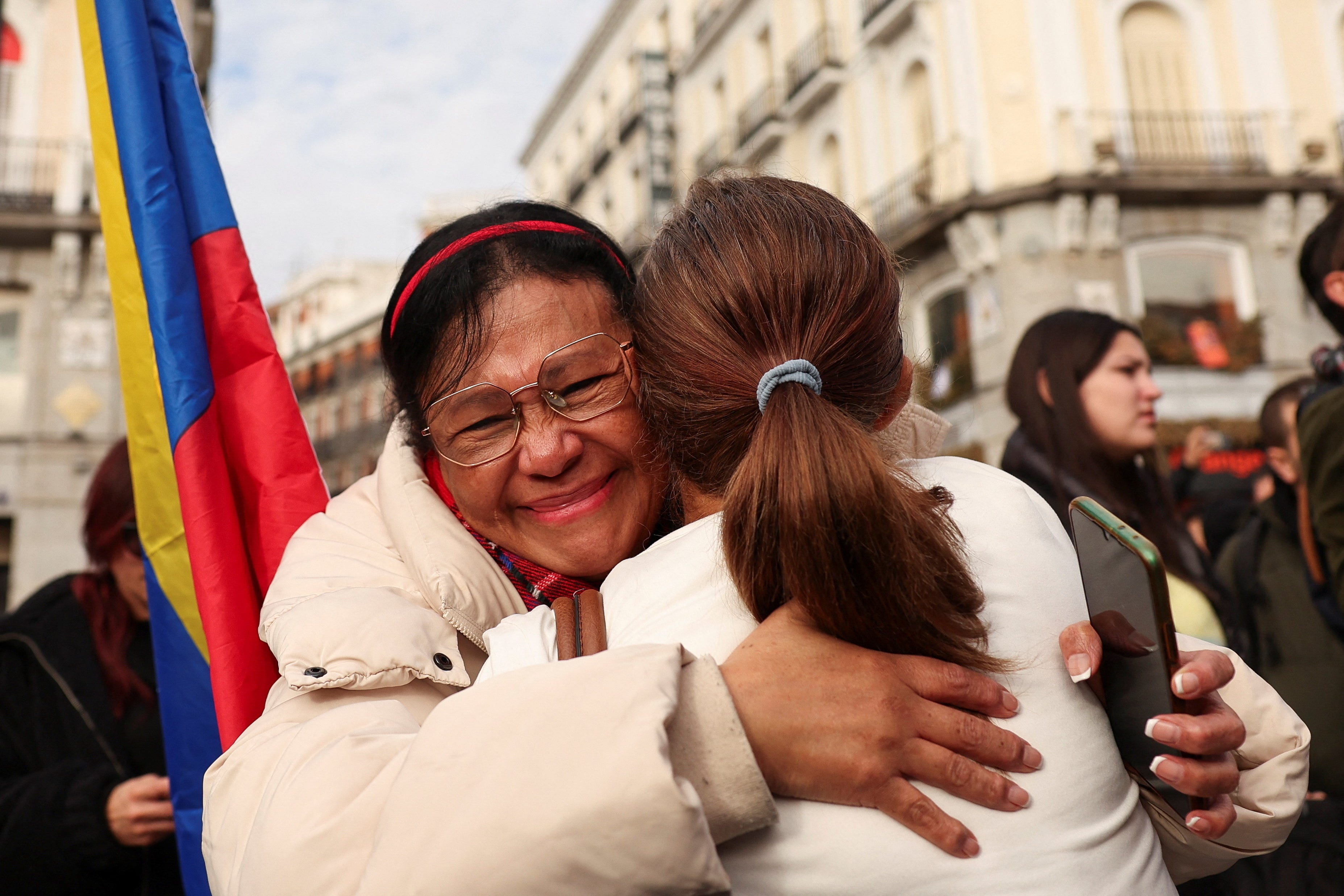
<p style=Reactions to the United States' bombing of Venezuela and capture of the country's president Nicolás Maduro ranged across the world. Some celebrated the operation while others rebuked Trump's intervention in the South American country. See the reactions in photos, beginning here with Venezuelans living in Chile celebrating in Santiago on January 3, 2026.

" style="max-width:100%; height:auto; border-radius:6px; margin:10px 0;" loading="lazy" /> A child holds a placard saying A woman reacts to the news after U.S. President Donald Trump said the U.S. has struck Venezuela and captured its President Nicolas Maduro, in Madrid, Spain, January 3, 2026. Armed supporters of Venezuela's President Nicolas Maduro gather near the Miraflores presidential palace in Caracas on January 3, 2026, after US forces captured him. A Venezuelan man living in Chile celebrates with a national flag and his car reading Venezuelans living in Chile celebrate in Santiago on January 3, 2026, after US forces captured Venezuelan leader Nicolas Maduro after launching a A man holds up a portrait of late Venezuela's leader (1999-2013) Hugo Chavez in Caracas on January 3, 2026, after US forces captured Venezuelan leader Nicolas Maduro. Activists of Socialist Unity Centre of India (SUCI) burn an effigy of US President Donald Trump during a rally in Kolkata on January 3, 2026, to protest against the recent US attack on Venezuela. A supporter of Nicolas Maduro holds a portrait of the Venezuelan President during a gathering near the Palacio de Miraflores in Caracas on January 3, 2026, after US forces captured Venezuelan leader Nicolas Maduro after launching a Venezuelans living in Chile celebrate in Santiago on January 3, 2026, after US forces captured Venezuelan leader Nicolas Maduro after launching a Venezuelans living in Chile celebrate in Santiago on January 3, 2026, after US forces captured Venezuelan leader Nicolas Maduro after launching a Demonstrators hold up a banner with the lettering reading 'Stop Trump - Free Venezuela' during a rally organised by left-wing 'Anti-Imperialist Coordination' (Antiimperialistische Koordination - AIK) under the motto 'Hands off Venezuela' at Vienna's Votive Park on January 3, 2026. The EU called for Demonstrators march with a banner with the lettering reading 'Hands off Venezuela' during a rally organised by left-wing 'Anti-Imperialist Coordination' (Antiimperialistische Koordination - AIK) in Vienna on January 3, 2026. The EU called for Venezuelans living in Peru celebrate outside the Venezuelan Embassy in Lima on January 3, 2026, after US forces captured Venezuelan leader Nicolas Maduro. President Donald Trump said Saturday that US forces had captured Venezuela's leader Nicolas Maduro after bombing the capital Caracas and other cities in a dramatic climax to a months-long standoff between Trump and Venezuelan. Venezuelans living in Peru celebrate outside the Venezuelan Embassy in Lima on January 3, 2026, after US forces captured Venezuelan leader Nicolas Maduro. President Donald Trump said Saturday that US forces had captured Venezuela's leader Nicolas Maduro after bombing the capital Caracas and other cities in a dramatic climax to a months-long standoff between Trump and Venezuelan. Venezuelans living in Peru celebrate at the Miguel de Cervantes park, near the Venezuelan Embassy in Lima on January 3, 2026, after US forces captured Venezuelan leader Nicolas Maduro. Venezuelans living in Peru dance to celebrate at the Miguel de Cervantes park, near the Venezuelan Embassy in Lima on January 3, 2026, after US forces captured Venezuelan leader Nicolas Maduro. A Venezuelan woman living in Peru celebrates with a national flag at the Miguel de Cervantes park, near the Venezuelan Embassy in Lima on January 3, 2026, after US forces captured Venezuelan leader Nicolas Maduro. Activists of Socialist Unity Centre of India (SUCI) protest against the recent US attack on Venezuela, in Kolkata on January 3, 2026. Members of the Communist Party of Britain (CPB) group hold banners outside the U.S. Embassy in London calling for People embrace next to a Venezuelan flag, as they react to the news after U.S. President Donald Trump said the U.S. has struck Venezuela and captured its President Nicolas Maduro, in Madrid, Spain, January 3, 2026.

See reactions after US explosions in Venezuela, Maduro capture

Reactions to theUnited States' bombing of Venezuela and capture of the country's president Nicolás Maduroranged across the world. Some celebrated the operation while others rebuked Trump's intervention in the South American country. See the reactions in photos, beginning here with Venezuelans living in Chile celebrating in Santiago on January 3, 2026.

Maduro's journey to NY: Ships, planes and helicopters

Maduro and Flores landed in Brooklyn before heading to the Metropolitan Detention Center the evening of Jan. 3.

By then, they had been on multiple types of aircraft, plus a massive warship, in a journey spanning at least three nations and two time zones.

After the couple was taken from their Caracas home, they were loaded onto a helicopter, where the raid force had to fight its way out of Venezuelan airspace, according to Chairman of the Joint Chiefs of Staff. Gen. Dan "Razin" Caine.

More:'A lot of gunfire': Here's how the US raid to capture Maduro unfolded

They were then loaded onto the USS Iwo Jima, a U.S. Navy amphibious assault ship, and sailed across the Caribbean Sea to the U.S military base in Guantanamo Bay, Cuba.

Next, they were transferred to a plane to fly the final stretch to New York, landing shortly before sunset Eastern time at Stewart Air National Guard Base about 50 miles north of Manhattan. Once embarked, they were placed in helicopters and flown to Westside Heliport in Manhattan, then finally on to the Brooklyn detention facility.

A 'soul full of concern'

Pope Leo said on Sunday he was following developments in Venezuela after the United States' toppling of Maduro a day earlier with a "soul full of concern."

Leo, the first U.S. pope, called for Venezuela to remain an independent country and respect of human rights.

Maduro walked down hallway in new footage

In the first clear video of the Venezuelan leader since he arrived on U.S. soil Saturday evening, Maduro was seen being walked down a hallway by federal agents.

The 12-second clip was posted to X by Fox News ContributorPaul Mauro and shared by the White House. In the video, Maduro is seen clutching a bottle of water and dressed in black pants, a black hoodie and hat.

His hands appear to be restrained, while three agents walk him down a hallway with a carpet that reads "DEA." He is overheard saying, "goodnight" and "happy New Year" before walking out of the video frame.

Venezuela Supreme Court orders VP become interim president

The Constitutional Chamber of Venezuela's Supreme Court ordered on Saturday that Vice President Delcy Rodríguez assume the role of acting president of the country.

The court ruling said that Rodríguez would assume "the office of President of the Bolivarian Republic of Venezuela, in order to guarantee administrative continuity and the comprehensive defense of the Nation."

The ruling added that the court will debate the matter in order to "determine the applicable legal framework to guarantee the continuity of the State, the administration of government, and the defense of sovereignty in the face of the forced absence of the President of the Republic."

This article originally appeared on USA TODAY:Nicolás Maduro and wife seized, US to 'run' Venezuela. Live updates.

Why did US strike Venezuela and seize Nicolás Maduro? Live updates

Venezuelan leaderNicolás Maduroand his wife,Cilia Flores, awoke early Saturday morning to U.S. special forcescapturing th...
A mother says goodbye to her son as Swiss community grieves after deadly fire

CRANS-MONTANA, Switzerland (AP) — A Mass was held Sunday for victims of theNew Year's Eve fireat a bar in the Swiss Alpine resort of Crans-Montana, which left 40 dead and many severely injured, as distressed parents waited for news of their children or began the long process of mourning.

Gray-haired parents, teenagers and members of the police were seen comforting one another during the service, which took place at the Chapelle Saint-Christophe in Crans-Montana. Mass was set to be followed by a silent march to the site of the tragedy.

In the crowded pews, a grieving woman listened intently, her hands clasped tightly and sometimes clasping rosary beads, as speakers delivered readings in German, French and Italian. Despite freezing weather, several hundreds followed the Mass on the screen installed outside the church.

The Rev. Gilles Cavin spoke of the "terrible uncertainty" for families unsure if their loved ones are among the dead or still alive among the injured. "We pray for their friends hard hit by misery on this day that was meant to be one of festivities and friendship," he said.

Forty people died and 119 were injured in the blaze that broke out around 1:30 a.m. on Thursday atLe Constellation bar. Police have said many of the victims were in their teens to mid-20s.

By Sunday morning, Swiss authorities identified 24 out of the 40 fatalities. They include 18 Swiss citizens aged 14 to 31 years, two Italians 16 years old, one dual citizen of Italy and the United Arab Emirates also 16 years old, an 18-year-old Romanian, a 39-year-old French and a Turkish citizen, 18.

A grieving mother

One of the victims was 16-year old Arthur Brodard, whose mother had been frantically searching for him.

"Our Arthur has now left to party in paradise," a visibly shaken Laetitia Brodard said in a Facebook story posted on Saturday night, speaking to camera. "We can start our mourning, knowing that he is in peace and in the light."

Brodard's frenzied search for her son reflected the desperation of families of the young people disappeared during the fire, who did not know whether their loved ones were dead or in the hospital.

Swiss authorities said the process of identifying victims was particularly hard because of the advanced degree of the burns, requiring the use of DNA samples. Brodard also had given her DNA sample to help in the identification process.

In her Facebook post, Brodard thanked those who "testified their compassion, their love" and to those who shared information as she anxiously searched and waited for news of her son. Other parents and siblings are still waiting in anguish.

Bar managers face a criminal investigation

Swiss authorities have opened a criminal investigation of the bar managers.

The two are suspected of involuntary homicide, involuntary bodily harm and involuntarily causing a fire, the Valais region's chief prosecutor, Beatrice Pilloud, told reporters Saturday. The announcement of the investigation did not name the managers.

Investigators said Friday they believe sparkling candles atop Champagne bottlesignited the firewhen they came too close to the ceiling of the crowded bar.

Authorities planned to look into whether sound-dampening material on the ceiling conformed with regulations and whether the candles were permitted for use in the bar. Officials said they also would look at other safety measures on the premises, including fire extinguishers and escape routes.

Swiss President Guy Parmelin announced a national day of mourning for the victims on Jan. 9.

France's Health Minister Stéphanie Rist said 17 patients have received care in France, out of a total of 35 transferred from Switzerland to five European countries. Other patients were planned to be transferred to Germany, Italy and Belgium.

Associated Press writers Geir Moulson in Berlin, Sylvie Corbet in Paris and Claudia Ciobanu in Warsaw contributed to this report.

A mother says goodbye to her son as Swiss community grieves after deadly fire

CRANS-MONTANA, Switzerland (AP) — A Mass was held Sunday for victims of theNew Year's Eve fireat a bar in the Swiss A...
President Trump answers questions from the press (Joe Raedle / Getty Images)

President Donald Trump built his political appeal over the past decade partly by vowing to extricate America from military quagmires overseas, promising to avoid "nation building" and wars designed to topple regimes.

But hours after the American military executed a daring attack on Venezuelan soil — capturing its president, Nicolás Maduro — Trump said the U.S. would temporarily run the country and build up its oil industry, as he and his top Cabinet members put other world leaders on notice.

Colombian President Gustavo Petro, a Maduro ally, is "making cocaine" and sending it to the U.S., Trump alleged at a news conference Saturday. "So he does have to watch his ass."

In an interview earlier with Fox News, Trump expressed impatience with Mexican President Claudia Sheinbaum over how to fight drug cartels that are "running" the country. He said, "Something's going to have to be done with Mexico," without elaborating.

Cuba, he said, is "going to be something we'll end up talking about, because Cuba is a failing nation right now."

Secretary of State Marco Rubio was even blunter. "Look, if I lived in Havana and I was in the government, I'd be concerned at least a little bit," Rubio said, standing alongside Trump at the news conference.

"We'll talk and meet with anybody, but don't play games. Don't play games while this president's in office," he said. "It's not going to turn out well."

Trump's use of the U.S. military to oust Venezuela's president and his threats of potentially similar operations to come elsewhere are a dramatic shift from his past "America First" rhetoric, underscoring his pursuit of a more interventionist foreign policy in his second term. His remarks Saturday outlined a new foreign policy doctrine for a president who has demonstrated an increasing willingness to wield military force on multiple fronts.

It's an approach that could carry risk for a president who said in his inaugural address last January that he hoped to be remembered as a "peacemaker."

"We will measure our success not only by the battles we win, but also by the wars that we end and, perhaps most importantly, the wars we never get into," Trump said at the time.

Former Defense Department official Seth Jones, senior fellow at the Center for Strategic and International Studies, said Trump and his national security team will own the results of whatever follows in Venezuela.

"This is theirs," Jones said. "If this goes south, there is no one else you can blame."

As a candidate in 2016, Trump blasted fellow Republicans and previous presidents for backing troubled military interventions in Iraq, Afghanistan and Libya. "Our current strategy of nation-building and regime change is a proven, absolute failure," he said.

In the 2024 presidential campaign, he pledged to fire "warmongers" serving in the government and chose a running mate, JD Vance, who championed his skepticism of waging wars in foreign countries.

Yet in his first year back in office, Trump has ordered military strikes on targets in Yemen, Syria, Iraq, Somalia, Nigeria, Iran — and now in Venezuela to capture Maduro and bring him to the U.S. to face drug trafficking charges.

White House press secretary Karoline Leavitt said that Trump is fulfilling his campaign promises by going after Maduro and that the operation was in keeping with his "America First" agenda.

"President Trump is a decisive and strong leader who does EXACTLY what he says he's going to do," Leavittwrote on X.

"During his historic campaign in 2024, President Trump explicitly promised that he would work to 'demolish foreign drug cartels' to keep our citizens safe and that's exactly what he did today through an unprecedented display of speed, precision, and power," Leavitt wrote.

White House officials also have cited Trump's role in brokering an elusive ceasefire deal between Israel and Hamas as proof that his tough approach can defuse conflicts.

The operation in Caracas early Saturday followed a U.S. air campaign that began in September against dozens of alleged drug smuggling boats in the Caribbean and the eastern Pacific.

Those strikes, which, like the operation against Maduro, have not been authorized by Congress, have killed at least 114 people, according to the Pentagon. They have received both support from Trump's allies in Congress and criticism from lawmakers, former military lawyers and allied governments that the attacks violate U.S. and international law.

U.S. airstrikes on Iran's nuclear sitesin June, which featured the first use of a massive bunker-busting bomb, prompted criticism and concern among some of Trump's supporters and political allies that he was straying from his original anti-interventionist vision.

Trump is now threatening to attack Iran again unless the regime's leaders comply with his latest warning that they must not kill protesters massing in Tehran's streets over economic conditions.

"We are locked and loaded and ready to go,"Trump wrote Friday in a social media postpledging to come to the protesters' rescue if needed.

After Trump announced the capture of Maduro, most Republican lawmakers publicly endorsed the move, while Democrats and a handful of GOP members expressed doubts about the legal basis for the operation and the potential for an open-ended, risky U.S. commitment in Venezuela.

Outgoing Republican Rep. Marjorie Taylor-Greene of Georgia, a staunch supporter of Trump-turned-critic,said on Xthat Trump's Make America Great Again supporters shared a "disgust" with "never ending" military adventures abroad.

"This is what many in MAGA thought they voted to end. Boy were we wrong," she wrote.

Trump's focus on foreign policy, either as a commander in chief presiding over airstrikes or as a "peacemaker" pushing for diplomatic deals, poses a potential political risk. Hisapproval ratingshave slipped as voters who hoped to see economic conditions brighten on his watch struggle to pay their bills.

Mark Mitchell, head pollster at Rasmussen Reports, who briefed Trump and senior White House officials privately in November, said that when voters are asked whether the government's focus needs to be on domestic or foreign policy, "everyone says domestic."

Mitchell said he told Trump that "the optics of spending too much time on foreign policy were hurting him."

In his remarks Saturday, Trump repeatedly referred to Venezuela's oil as a prize Americans gained in the operation against Maduro. Dissatisfied with the quantity of oil that Venezuela is pumping, he said, U.S. companies will now go in, boost supplies and sell the product.

A U.S. official elaborated later in the day, saying the administration will work with oil executives to begin expanding the country's oil output.

Trump did not rule out additional military strikes in Venezuela if he determines they are needed.

In 2002, as President George W. Bush weighed a possible U.S. invasion of Iraq, his secretary of state, Colin Powell, warned him of the potential risks of regime change.

"Once you break it, you are going to own it,"Powell told him, "and we're going to be responsible for 26 million people standing there looking at us."

Bush eventually opted to go ahead with the invasion and soon learned the harsh lessons of what was dubbed the "Pottery Barn rule."

Trump suggested Saturday that Rubio, Defense Secretary Pete Hegseth and Joint Chiefs of Staff Chairman Dan Caine will manage Venezuela's government transition.

Jones, the former Defense Department official, said the biggest problem Trump will face is creating the conditions for a government that has the support of the people of Venezuela.

"The entire success of the mission will hinge on whether the population views its government as legitimate," Jones said. "This was the fundamental problem the U.S. faced in Iraq."

A new Trump foreign policy doctrine emphasizes threats of regime change

President Donald Trump built his political appeal over the past decade partly by vowing to extricate America from military quagmires overse...
What's next in Venezuela? Panama raid that ousted Noriega offers clues.

Gunfire in the streets of a Latin American capital. U.S. military troops swooping in by helicopter. A foreign leader, accused of drug trafficking, hauled off to America in handcuffs.

The Trump administration's Jan. 3capture of President Nicolás Madurobore some familiar echoes to the 1989 U.S. invasion of Panama that ousted military strongman Manuel Noriega — and marked the most direct U.S. intervention in Latin America since.

But experts say that despite some similarities, the two key moments in America's long and checkered history of interventions differ in major ways that could make achieving U.S. goals more challenging this time following a raid that has revived regional anxiety.

PresidentDonald Trumpsaid Jan. 3 that his administration will "run the country" for a time and described an apparent nation-building effort. He said it would be funded by Venezuela's vast oil reserves to be tapped by American oil companies, some of which were forced out in the 2000s.

While many in Panama view Noriega's ouster as setting it on a path to become a growing and stable democracy, despite the deaths and trauma, that result is far less certain in a much bigger and complex nation beset by poverty, crime and lingering resistance, experts said.

Shaping a post-invasion future was a much easier task in relatively tiny Panama, in part because existing American troops linked to the Panama Canal were present before and after the invasion, said Will Freeman, a Latin America fellow at the Council on Foreign Relations.

While details remain scant, Freeman said he doubts the U.S. will field a full Iraq-style occupation force.

"This is not going to be so simple in Venezuela," he said. "One, it's not even likely that we get to democracy. And two, many of the problems that were there with Maduro are going to remain."

Leaders seek in vain to avoid capture

Trump's announcement of the raid came 36 years after the U.S. took Manuel Noriega into custody.

The famously acne-pocked military strongman was once a U.S. ally who had been recruited by the CIA to stanch the spread of communism. But he drew increasing U.S. ire for growing hostility and actions such as annulling an election and cracking down violently on opposition.

<p style=Exactly 36 years before the U.S. captured Venezuelan President Nicolás Maduro in an early morning military operation in Venezuela, U.S. forces took Panamanian General Manuel Noriega on Jan. 3, 1990. The arrest of Noriega shares more similarities with the Trump administration's alleged capture of Maduro than just a date on the calendar. See the impact of the U.S. operation in Panama.

" style="max-width:100%; height:auto; border-radius:6px; margin:10px 0;" loading="lazy" /> <p style=Thousands of Panamanians marched towards the Vatican Embassy where Manuel Noriega has been seeking asylum on January 3, 1990. Noriega was first a CIA asset before he rose to power as Panama's military strongman leader. The U.S. indicted him on drug trafficking charges, and in late 1989, then-President George H.W. Bush dispatched tens of thousands of troops to Panama to capture Noriega and bring him to face trial in the U.S.

" style="max-width:100%; height:auto; border-radius:6px; margin:10px 0;" loading="lazy" /> Telephone technicians tap into telephone box as US troops look on outside the Vatican Embassy, where Manuel Noriega has taken refuge, December 27, 1989. Helicopter used to take Manuel Noriega into United States custody flies over anti-Noriega demonstration, hours before his surrender, January 3, 1990. Felicidad Noriega, wife of deposed Panamanian leader General Manuel Noriega, walks to the Federal Courthouse September 13, 1991 as the jury selection process in Noriega's trial continues. Frank Ruino(C), attorney for Panamanian strong-man Manuel Noriega, speaks April 9, 1992 outside Miami's Federal Courthouse with his assistant Jon May(L). A twelve member federal jury found Manuel Noriega guilty on eight of ten counts. Panamanian leader Manuel Noriega leans through barred window in HQ to wave to supporters celebrating his crushing of an attempted coup, October 5, 1989. This is the scene overlooking the Chorillo district of downtown Panama City near the command of Manuel Noriega, December 26, 1989. The area was heavily damaged. President George Bush announces that deposed Panamanian leader Manuel Noriega had turned himself over to the US marshalls in Panama. January 3, 1990 US soldier Gerarde Walyun walks past an advertisement for Panama beer, as he patrols Panama City, January 15, 1990. A soldier from the US army surveys an area in Panama after the US invasion from the window of a Shinook helicopter, December 20, 1990 6 soldiers patrol the Curundu neighborhood, Panama City, January 15, 1990.

See photos of the US invasion of Panama, capture of Manuel Noriega

Exactly 36 years before the U.S.captured Venezuelan President Nicolás Maduroin an early morning military operation in Venezuela, U.S. forces took Panamanian General Manuel Noriega on Jan. 3, 1990. The arrest of Noriega shares more similarities with the Trump administration's alleged capture of Maduro than just a date on the calendar. See the impact of the U.S. operation in Panama.

In 1989, President George H.W. Bush, citing authoritarian rule, concerns about the security of the Panama Canal and U.S. drug trafficking and money laundering charges, ordered "Operation Just Cause." It tapped more than 20,000 U.S. troops, many already in Panama, to seize control of military and infrastructure sites. A new president was sworn in soon after.

Maduro's capture also stems from a history of conflict with the United States.

Maduro came to power as the successor to President Hugo Chávez, a socialist leader who gained leadership in the late 1990s. The nation has since faced a mix of authoritarianism and skyrocketing poverty, crime and inflation.

Like Noriega, Maduro was indicted by U.S. prosecutors in 2020 on drug trafficking charges. But he was a less significant figure in drugs than Noriega or Juan Orlando Hernandez, the former president of Honduras, who Trump recently pardoned, said Michael Shifter, an adjunct professor at Georgetown University's Walsh School of Foreign Service.

Pressure to oust Maduro gained steam since Trump's reelection last year. And in recent months, U.S. military buildup in the region included the deployment of aircraft carriers and fatal military strikes on small boats alleged to be carrying drugs.

Air Force Gen. Dan "Razin" Caine, chairman of the Joint Chiefs of Staff, said U.S. authorities spent time tracking Maduro's daily routines and moves before the military raid in which Maduro was captured by U.S. Special forces at his compound.

As U.S. forces cut power and descended on Maduro, the military encountered some resistance, including a helicopter struck by a bullet, and returned fire. Maduro did not make it to a reinforced steel safe room he was trying to reach, Caine said.Images and videoshowed explosions, burning vehicles, plumes of smoke rising over the capital city of Caracas, and a swarm of low-flying helicopters.

<p style=Venezuelan leader Nicolás Maduro and his wife landed in New York on Saturday, Jan. 3, 2026 to face several criminal charges after the United States conducted a large-scale operation in Caracas that captured the couple.

" style="max-width:100%; height:auto; border-radius:6px; margin:10px 0;" loading="lazy" /> Stairs lead to a U.S. federal airplane before Venezuela's President Nicolas Maduro is led out in custody ahead of his scheduled court appearance at Manhattan federal court, at Stewart Air National Guard Base in Newburgh, New York, U.S. January 3, 2026. Venezuela's President Nicolas Maduro is led in custody from a U.S. federal airplane before his scheduled court appearance at Manhattan federal court, at Stewart Air National Guard Base in Newburgh, New York, U.S., January 3, 2026. Venezuela's President Nicolas Maduro is led in custody from a U.S. federal airplane before his scheduled court appearance at Manhattan federal court, at Stewart Air National Guard Base in Newburgh, New York, U.S. January 3, 2026. The airplane carrying Venezuelan President Nicolas Madura lands at Stewart Air National Guard Base in Newburgh, N.Y. at approximately 4:30pm Jan. 3, 2026. The airplane carrying Venezuelan President Nicolas Madura lands at Stewart Air National Guard Base in Newburgh, N.Y. at approximately 4:30pm Jan. 3, 2026. A person demonstrates against US military action in Venezuela outside Stewart Air National Guard Base in Newburgh, New York, on January 3. 2026. US President Donald Trump said Saturday that the United States will A United States government plane believed to be carrying Venezuela President Nicolás Maduro taxis after landing at Stewart Air National Guard Base in Newburgh, N.Y., Jan. 3, 2026. People demonstrate against US military action in Venezuela outside Stewart Air National Guard Base in Newburgh, New York, on January 3. 2026. US President Donald Trump said Saturday that the United States will

Nicolás Maduro lands in US: See the captured Venezuela leader's arrival

Venezuelan leaderNicolás Maduro and his wifelanded in New York on Saturday, Jan. 3, 2026to face several criminal chargesafter the United Statesconducted a large-scale operationin Caracas that captured the couple.

By that night, Maduro and his wife Cilia Flores were in New York, where he stands accused of trafficking in cocaine during a 25-year career in public posts.

More than three decades earlier, Noriega also tried to slip away, driving through the streets to evade capture and eventually hiding in the Vatican embassy on Dec. 24.

Surrounded by U.S. forces, who couldn't storm the site, the U.S. military blasted constant music by Alice Cooper and Black Sabbath on loudspeakers, according toofficial accounts. He surrendered on Jan. 3, 1990.

Noriega was convicted, spending the rest of his life in U.S., French and Panamanian prisons before dying in 2017.

Interventions bring criticism and challenges

Both attacks were part of a century-long history of U.S. intervention – directly and indirectly – in the politics of Latin American countries such as Cuba, the Dominican Republic and Haiti.

In the 1950s for example, the U.S. sought to remove Guatemala's democratically elected president amid land reforms that were affecting the U.S.-based United Fruit Company's exploitative labor practices.

The U.S. helped install a military dictatorship whose policies eventually triggered a civil war and led to mass human rights abuses during which more than 200,000 Guatemalans were killed or forcibly disappeared.

During the Panama invasion, at least 514 Panamanian soldiers and civilians were killed. However, some local reports have put the figure at double that. Twenty-three U.S. military personnel were killed. And the event was viewed by critics as yet another example of the U.S. ignoring sovereignty.

At that time, the U.S. sought to have a relatively quick intervention at a time when leaders were keen to avoid a quagmire, said Eduardo Gamarra, a professor of politics and international relations at Florida International University.

In contrast, the Trump administration has turned away from the post-Cold War international order in actions and policies that have also drawn comparison toPresident Theodore Roosevelt's takeon the Monroe Doctrine that the U.S. should "exercise international police power" to end what Roosevelt called "chronic unrest or wrongdoing" in the hemisphere.

And it comes as some countries in Latin America have made a move to right-leaning governments. More were heading away from authoritarian leadership during the time of the Panama invasion, Gamarra said.

Trump has criticized Venezuela, which nationalized its oil industry in the 1970s, for added expropriations and other changes in the 2000s that forced many major U.S. oil companies out and led to legal battles over compensation.

While Trump said his administration plans to oversee Venezuela, U.S. forces have no control over the country itself, Reuters reported, though Trump didn't rule out having some "boots on the ground."

"We will run the country until such time as we can do a safe, proper and judicious transition," Trump said during a Jan. 3 press conference.

While Trump said Venezuelan Vice PresidentDelcy Rodriguezhad no choice but to be cooperative, Rodriguez appeared on Venezuelan television Saturday afternoon with other top officials to decry what she called a kidnapping.

Those efforts will face complexities not present in Panama decades ago, such as the presence of large oil reserves and security challenges from criminal groups to illegal mining interests, Shifter said.

<p style=This file photo shows a group of U.S. sailors from the battleship Connecticut and a gun they captured at Cape Haitien during the U.S. occupation of Haiti in 1915.

" style="max-width:100%; height:auto; border-radius:6px; margin:10px 0;" loading="lazy" /> <p style=Officers at Jacmel, Haiti, during the U.S. occupation in 1915.

" style="max-width:100%; height:auto; border-radius:6px; margin:10px 0;" loading="lazy" /> <p style=A group of Cuban revolutionaries with Fidel Castro are seen with artillery after routing the U.S.-backed invasion at the Bay of Pigs in 1961.

" style="max-width:100%; height:auto; border-radius:6px; margin:10px 0;" loading="lazy" /> <p style=Children cheer on the U.S. Marines following offensive in Vecca Monte west of Panama City, during "Operation Just Cause," the U.S. invasion to remove Manuel Noriega, which lasted from December 1989 through January 1990.

" style="max-width:100%; height:auto; border-radius:6px; margin:10px 0;" loading="lazy" /> <p style=A U.S. Marine corps crew takes up position on the outskirts of Santo Domingo, on May 2, 1965, during the Dominican Civil War.

" style="max-width:100%; height:auto; border-radius:6px; margin:10px 0;" loading="lazy" /> <p style=The U.S. Army Airborne troops drive down a street in Santo Domingo during the occupation of the Dominican Republic in 1965.

" style="max-width:100%; height:auto; border-radius:6px; margin:10px 0;" loading="lazy" /> <p style=U.S. troops in full combat gear run on the docks of Port-au-Prince harbor, on Sept. 19, 1994, after arriving on an assault helicopter. Thousands of U.S. soldiers arrived in Haiti on Sept. 19, 1994, as part of "Operation Uphold Democracy," to pave the way for the restoration of the elected president Jean-Bertrand Aristide.

" style="max-width:100%; height:auto; border-radius:6px; margin:10px 0;" loading="lazy" /> <p style=Hundreds of local residents run towards the U.S. Chinook helicopters, on Sept. 24, 1994, as a detachment of over 100 U.S. troops arrive in this small southern coastal town, 120 km south of Port-au-Prince, as part of the "Operation Uphold Democracy."

" style="max-width:100%; height:auto; border-radius:6px; margin:10px 0;" loading="lazy" />

From Cuba to Panama: US interventions that shaped Latin America

This file photo shows a group of U.S. sailors from the battleship Connecticut and a gun they captured at Cape Haitien during the U.S. occupation of Haiti in 1915.

Uncertainty also stems from mixed reactions – some celebrating hopes for new freedom and others saying a line had been crossed – in a region where the military action revived anxieties about past U.S. interventions.

In Panama, which has drawn the spotlight of the Trump administration over immigration and canal oversight, Panama's president, José Raúl Mulino, weighed in onsocial mediathat included support of the "democratic process and the acceptance of the legitimate wishes of the Venezuelan people."

While the invasion of Panama 36 years ago wasn't widely seen as a precursor to other interventions, Trump's rhetoric aimed atColombia, Mexico and Cubaover various issues including illegal drugs has left some countries on edge.

"U.S. military intervention in the region has not always had a very happy record. And so I think that creates a lot of anxiety and a lot of apprehension," Shifter said. "If there are no limits and no rules, you know, why can't Trump do the same to them?"

Contributing: Kim Hjelmgaard of USA TODAY, Reuters

This article originally appeared on USA TODAY:Venezuela raid echoes Panama invasion that captured Manuel Noriega

What's next in Venezuela? Panama raid that ousted Noriega offers clues.

Gunfire in the streets of a Latin American capital. U.S. military troops swooping in by helicopter. A foreign leader, acc...
More than 100 firefighters battle massive blaze in Denver

More than 100 firefighters battled a massive five-alarm fire Friday evening in Denver at an apartment building construction site -- about the size of a city block -- working for hours to keep the flames from spreading to nearby structures, officials said.

One firefighter was injured battling the fire and taken to the hospital, the Denver Fire Department told ABC News.

There were no other injuries immediately reported.

AP - PHOTO: US Denver Fire

The fire spurred evacuation orders for nearby residents.

By late evening, the fire was largely under control but not fully extinguished. Officials estimated the blaze was about 70% contained, with pockets of deep-seated fire still burning inside the structure. Firefighters were expected to remain on scene through the night to fully suppress hot spots.

Denver Fire Department - PHOTO: This photo provided by The Denver Fire Department shows a large blaze in Denver, Friday evening, Jan. 2, 2026.

The building, which was in the early to mid-stages of construction, was primarily made of wood, with some plastic materials used in wrapping and construction.

There's no word yet on the cause of the blaze.

This is a developing story and will be updated.

More than 100 firefighters battle massive blaze in Denver

More than 100 firefighters battled a massive five-alarm fire Friday evening in Denver at an apartment building constru...


CR GLOW © 2015 | Distributed By My Blogger Themes | Designed By Templateism.com