International aid groups grapple with what Israel's ban will mean for their work in Gaza

TEL AVIV (AP) — Israel's decision torevoke the licensesof more than three dozen humanitarian organizations this week has aid groups scrambling to grapple with what this means for their operations in Gaza and their ability to help tens of thousands of struggling Palestinians.

The 37 groupsrepresent some of the most prominent of the more than 100 independent nongovernmental organizations working in Gaza, alongside United Nations agencies. Those banned includeDoctors Without Borders, the Norwegian Refugee Council, Oxfam and Medical Aid for Palestinians.

The groups do everything from providing tents and water to supporting clinics and medical facilities. The overall impact, however, remains unclear.

The most immediate impact of the license revocation is that Israel will no longer allow the groups to bring supplies into the Gaza Strip or send international staffers into the territory. Israel says all suspended groups have to halt their operations by March 1.

Some groups have already been barred from bringing in aid. The Norwegian Refugee Council, for example, said it has not been allowed to bring in supplies in 10 months, leaving it distributing tents and aid brought in by other groups.

Israel says the banned groups make up only a small part of aid operations in Gaza.

But aid officials say they fulfill crucial specific functions. In a joint statement Tuesday, the U.N. and leading NGOs said the organizations that are still licensed by Israel "are nowhere near the number required just to meet immediate and basic needs" in Gaza.

The ban further strains aid operations even as Gaza's over 2 million Palestinians still face a humanitarian crisis more than 12 weeks into a ceasefire. The U.N. says that although famine has been staved off, more than a quarter of families still eat only one meal a day and food prices remain out of reach for many; more than 1 million people need better tents as winter storms lash the territory.

Why were their licenses revoked?

Earlier this year, Israel introduced strict new registration requirements for aid agencies working in Gaza. Most notably, it required groups to provide the names and personal details of local and international staff and said it would ban groups for a long list of criticisms of Israel.

The registration process is overseen by Israel's Ministry for Diaspora Affairs and Combating Antisemitism, led by a far-right member of the ruling Likud party.

Israel says the rules aim to preventHamasand other militants from infiltrating the groups, something it has said was happening throughout the2-year-old war. The U.N., which leads the massive aid program in Gaza, and independent groups deny the allegations and Israeli claims of major diversion of aid supplies by Hamas.

Aid organizations say they did not comply, in part, because they feared that handing over staff information could endanger them. More than 500 aid workers have been killed in Gaza during the war, according to the United Nations.

Israel denies targeting aid workers. But the group say Israel has been vague about how it would use the data.

The groups also said Israel was vague about how it would use the data.

"Demanding staff lists as a condition for access to territory is an outrageous overreach," Doctors Without Borders, known by its French acronym MSF, said Friday. It said Israeli officials had refused its attempts to find alternatives.

A December report on MSF issued by an Israeli government team recommended rejection of the group's license. It pointed primarily to statements by the group criticizing Israel, including referring to its campaign in Gaza as genocide and calling its monthslong ban on food entering the territory earlier this year as "a starvation tactic." It said the statements violated neutrality and constituted "delegitimization of Israel."

The report also repeated claims that an MSF employee killed in by an Israeli airstrike in 2024 was an operative with the Islamic Jihad militant group. That, it said, suggested MSF "maintains connections with a terrorist group."

MSF on Friday denied the allegations, saying it would "never knowingly employ anyone involved in military activities." It said that its statements cited by Israel simply described the destruction its teams witnessed in Gaza.

"The fault lies with those committing these atrocities, not with those who speak of them," it said.

Aid groups have a week from Dec. 31 to appeal the process.

Medical services could see biggest impact

Independent NGOs play a major role in propping up Gaza's health sector, devastated by two years of Israeli bombardment and restrictions on supplies.

MSF said Israel's decision would have a catastrophic impact on its work in Gaza, where it provides funding and international staff for six hospitals as well as running two field hospitals and eight primary health centers, clinics and medical points. It also runs two of Gaza's five stabilization centers helping children with severe malnutrition.

Its teams treated 100,000 trauma cases, performed surgeries on 10,000 patients and handled a third of Gaza's births, the group says. It has 60 international staffers in the West Bank and Gaza and more than 1,200 local staff — most medical professionals.

Since the ceasefire began in early October, MSF has brought in about 7% of the 2,239 tons (2,032 metric tonnes) of medical supplies that Israel has allowed into Gaza, according to a U.N. tracking dashboard. That makes it the largest provider of medical supplies after U.N. agencies and the Red Cross, according to the dashboard.

Medecins du Monde, another group whose license is being halted, runs another four primary health clinics.

Overburdened Palestinian staff

Aid groups say the most immediate impact will likely be the inability to send international staff into Gaza.

Foreign staff provide key technical expertise and emotional support for their Palestinian colleagues.

"Having international presence in Gaza is a morale booster for our staff who are already feeling isolated," said Shaina Low, communications adviser for the Norwegian Refugee Council, which is one of the main NGOs providing shelter supplies and fresh water to displaced people.

NRC has roughly 30 international staff who rotate in and out of Gaza working alongside some 70 Palestinians.

While any operations by the 37 groups in the West Bank will likely remain open, those with offices in east Jerusalem, which Israel considers its territory, might have to close.

Halt on supplies

Many of the 37 groups already had been blocked from bringing supplies into Gaza since March, said Bushra Khalidi, Oxfam's policy lead for Israel and the occupied Palestinian territories.

What changes with the formal license revocation is "that these practices are now formalized, giving Israel full impunity to restrict operations and shut out organizations it disagrees with," she said.

Some of the groups have turned to buying supplies within Gaza rather than bringing them in, but that is slower and more expensive, she said. Other groups dug into reserve stocks, pared down distribution and had to work with broken or heavily repaired equipment because they couldn't bring in new ones.

Amed Khan, an American humanitarian philanthropist who has been privately donating medicine and emergency nutrition for children to Gaza, said the impact extends beyond the aid groups.

He relies on NGOs to receive and distribute the supplies, but the fewer groups that Israel approves, the harder it is to find one.

"It's death by bureaucracy," he said.

International aid groups grapple with what Israel's ban will mean for their work in Gaza

TEL AVIV (AP) — Israel's decision torevoke the licensesof more than three dozen humanitarian organizations this week ...
Drone strikes kills 2 in Russian border regions ahead of Ukraine peace talks

Two people were killed in Ukrainian drone strikes in Russian border regions, local officials said Sunday, ahead of peace talks to endthe nearly 4-year-old warin Paris this week.

Belgorod regional Gov. Vyacheslav Gladkov said one person died and two others, including a young child, were wounded when a Ukrainian drone struck a car.

Another person was killed in a drone strike on a village in the Kursk region, regional Gov. Alexander Khinshtein said Sunday.

In Ukraine, three people were wounded in the Kharkiv region in drone strikes overnight into Sunday, the country's State Emergency Service said.

Meanwhile, the death toll from a Russian missile attack on the city of Kharkiv on Friday increased to five when body parts were found under the rubble of a building, Kharkiv Mayor Ihor Terekhov said Sunday.

The latest attacks came after national security advisers from Europe and other allies visited Kyiv on Saturday to discuss security guarantees and economic support, as a U.S.-led diplomatic push to end thewar in Ukraineintensifies.

President Volodymyr Zelenskyy, preparing to travel to Paris for a meeting with partners, said Saturday that work on the peace proposals could now accelerate as Ukraine has shared all documents under discussion with the 18 national security advisers, including those onsecurity guarantees.

He said representatives from Ukraine's General Staff and military sector would meet on Monday in Paris, followed by a meeting Tuesday of European leaders, where he said he hoped documents on security guarantees would be finalized. He said there also would be meetings with U.S. representatives in Paris.

Follow AP's coverage of the war in Ukraine athttps://apnews.com/hub/russia-ukraine

Drone strikes kills 2 in Russian border regions ahead of Ukraine peace talks

Two people were killed in Ukrainian drone strikes in Russian border regions, local officials said Sunday, ahead of peace ...
Portugal's presidential election draws 11 candidates, making a later runoff vote likely

LISBON, Portugal (AP) — A record number of 11 candidates in Portugal's upcoming presidential election kicked off their campaigns on Sunday.

The official two-week campaign period preceding the Jan. 18 election will see the contenders competing to capture voters' support. However, the broad field makes it unlikely that any candidate will capture more than 50% of the vote, leaving the two top candidates to compete in a runoff ballot on Feb. 8.

Among the frontrunners, according to recent opinion polls, are the candidates from the country's two main parties that have alternated in power for the past 50 years: Luís Marques Mendes from the center-right Social Democratic Party, currently in government, and António José Seguro of the center-left Socialist Party.

They are expected to face strong challenges from André Ventura, the leader of thepopulist anti-immigration Chega party,whosesurge in supportmade it the second largest party in Portugal's Parliament last year, and Henrique Gouveia e Melo, a retired rear admiral running as an independent whowon public acclaimfor overseeing the speedy rollout of COVID-19 vaccines during the pandemic.

In Portugal, the president is largely a figurehead with no executive power. Mostly, the head of state aims to stand above the political fray, refereeing disputes to defuse tensions. However, the president also possesses powerful tools, being able to veto legislation from Parliament, although the veto can be overturned, as well as dissolve Parliament and call for snap elections.

After Portugal'sthird general election in three yearsin May, its worst spell of political instability for decades, the next head of state is likely to encourage compromises. But the next occupant of the president's riverside "pink palace" in Lisbon will likely have to rule on some hot-button matters.

The pressing issues include a proposed new bill that introduces limits on who can obtain Portuguese citizenship and under what circumstances they can be stripped of it. The Constitutional Court last month struck down the proposal, which has been returned to Parliament.

A government package of labor reforms that has already brought street protests and a major strike will also land on the president's desk, as could a law permitting euthanasia and physician-assisted suicide in Portugal that Parliament approved in 2022 but has been held up by constitutional objections.

Almost 11 million people are eligible to vote in the election.

Portugal’s presidential election draws 11 candidates, making a later runoff vote likely

LISBON, Portugal (AP) — A record number of 11 candidates in Portugal's upcoming presidential election kicked off thei...
How the Monroe Doctrine factors into US arrest of Venezuela's Nicolás Maduro

In detailing the U.S. military action that led to thearrest of Venezuelan leader Nicolás Maduro, President Donald Trump referenced theMonroe Doctrine, a maxim that has shaped American foreign policy for two centuries.

The doctrine formulated by President James Monroe was originally aimed at opposing European meddling in the Western Hemisphere. It has since been invoked repeatedly by subsequent presidents angling to justify U.S. intervention in the region.

On Saturday, the consequential doctrine of America's fifth president was cited by the 47th president aspartial justificationfor the capture of a foreign leader to face criminal charges in the United States. Trump even quipped that some now called it "the Don-roe Doctrine."

Political scientists are now looking back on the use of the Monroe Doctrine through history and drawing connections to how the Trump administration is seeking to apply it to current foreign policy, including the Republican president's assertion that Washington would "run" Venezuela until a suitable replacement for Maduro was in place,

Here's a look at the Monroe Doctrine, how it has been invoked over time and how it has informed Trump's decision making:

What is the Monroe Doctrine?

Articulated in Monroe's 1823 address to Congress, it was intended to ward off European colonization or other interference in independent nations of the Western Hemisphere. In return, the U.S. also agreed to stay out of European wars and internal affairs.

At the time, many Latin American countries had just gained independence from European empires. Monroe wanted both to prevent Europe from reclaiming control and to assert U.S. influence in the hemisphere.

Through the centuries, much of that has included Venezuela, according to Jay Sexton, a history professor at the University of Missouri.

"Historically, Venezuela has been the pretext or the trigger for a lot of corollaries to the Monroe Doctrine," said Sexton, author of "The Monroe Doctrine: Empire and Nation in Nineteenth-Century America," citing instances from the late 1800s, all the way through Trump's first administration.

"And going back to the 19th century, this has been a divided, fractious country that's had difficult relations with foreign powers and is also courted, relationships with rivals of the United States."

The Roosevelt Corollary and 'Big Stick' diplomacy

European leaders initially paid little attention to the proclamation, but the Monroe Doctrine has been invoked in the two centuries since to justify U.S. military interventions in Latin America.

The first direct challenge came after France installed Emperor Maximilian in Mexico in the 1860s. After the end of the Civil War, France relented under U.S. pressure and withdrew.

In 1904, President Theodore Roosevelt's argument that the U.S. should be allowed to intervene in unstable Latin American countries became known as theRoosevelt Corollary, a justification invoked in a number of places, including supporting Panama's secession from Colombia, which helped secure the Panama Canal Zone for the U.S.

The Cold War era saw the Monroe Doctrine invoked as a defense against communism, such as the U.S. demand in 1962 that Soviet missiles be withdrawn from Cuba, as well as the Reagan administration's opposition of the leftist Sandinista government in Nicaragua.

Gretchen Murphy, a professor at the University of Texas, described Trump's reference to the doctrine as in line with how it had been used by his predecessors, including Roosevelt, who she said "claimed that the Monroe Doctrine could be extended to justify interventions that instead of defending Latin American nations from European intervention, policed them to make sure their governments acted in U.S. commercial and strategic interests."

"I think Trump is jumping on this familiar pattern -– citing the Monroe Doctrine to legitimate interventions that undermine real democracy, and ones where various kinds of interests are served, including commercial interests," said Murphy, author of "Hemispheric Imaginings: The Monroe Doctrine and Narratives of U.S. Empire."

What has Trump said about the Monroe Doctrine?

Trump said that Venezuela, under Maduro's rule, had been "increasingly hosting foreign adversaries in our region and acquiring menacing offensive weapons that could threaten U.S. interests." Trump called those actions "in gross violation of the core principles of American foreign policy dating back more than two centuries."

But, Trump added, "under our new national security strategy, American dominance in the Western Hemisphere will never be questioned again."

"We want to surround ourselves with good neighbors, we want to surround ourselves with stability, and we want to surround ourselves with energy," Trump said. "We have tremendous energy in that country. It's very important that we protect it. We need that for ourselves. We need that for the world."

The Trump Corollary?

Asked Saturday how the U.S. running a country represented his "America First" mentality, Trump defended the move as one that, similarly to the Monroe Doctrine's origin story, was aimed at strengthening America itself.

The administration'snational security strategyreferences "a 'Trump Corollary' to the Monroe Doctrine," intended to "restore American preeminence in the Western Hemisphere."

"Under our new national security strategy, American dominance in the Western Hemisphere will never be questioned again, won't happen," Trump said. "For decades, other administrations have neglected or even contributed to these growing security threats in the Western Hemisphere. Under the Trump administration, we are reasserting American power in a very powerful way in our home region."

"What presidents used to do is they would cloak whatever their agenda was in the Monroe Doctrine by issuing corollaries," Sexton said.

After World War II, Sexton said, rather than devising corollaries to the Monroe Doctrine, presidents started issuing their own, citing Harry S. Truman and Richard Nixon. He Sexton said he assumed Trump might take similar action.

"When you're talking about a Trump Corollary, I just knew Trump wouldn't want to be a corollary to another president's doctrine, that somehow this would evolve into a Trump doctrine," he said.

The national security strategy released by the White House in December portrayed European allies as weak and aimed to reassert America's dominance in the Western Hemisphere.

Laying out a series of military strikes on alleged drug trafficking boats in the Caribbean Sea and the eastern Pacific Ocean as "a 'Trump Corollary' to the Monroe Doctrine" to "restore American preeminence in the Western Hemisphere," the document said it aimed to combat the flow of narcotics and control migration. The strategy marked a reimagining of the U.S. military footprint in the region even afterbuilding up the largest military presencethere in generations.

Sexton said the military operation to capture Maduro — and a possible protracted U.S. involvement in Venezuela — could cause another split among supporters of Trump's "Make America Great Again" movement, similar to the one after the administration's strikes last year on Iran's nuclear facilities.

"This is not just the sort of hit-and-run kind of job where, like in Iran a couple months ago, we dropped the missiles, and then you can then you can go on and carry on as normal," Sexton said. "This is going to be potentially quite a mess and contradict the administration's policies on withdrawing from forever wars — and there's a lot of isolationists, within the MAGA coalition."

Meg Kinnard can be reached athttp://x.com/MegKinnardAP

How the Monroe Doctrine factors into US arrest of Venezuela's Nicolás Maduro

In detailing the U.S. military action that led to thearrest of Venezuelan leader Nicolás Maduro, President Donald Trump r...
Teens as young as 14 among two dozen now identified in Swiss Alps fire, authorities say

Another 16 victims, including four Swiss girls ranging from 14 to 18 years old, have been positively identifiedin the fire that erupted at a New Year's party in Switzerlandlast week, leaving less than half of the victims left to identify.

Valais canton police are still working to identify all of the 40 people who died at the Le Constellation bar in the Swiss Alps on Thursday night. Police are working with the Institute of Forensic Medicine and the country's disaster victim identification protocol to return the victims to their loved ones.

The victims also include six Swiss males ranging from 16 years old to 31, police said.

Two Italian 16-year-olds, an Italian-Emirati who was also 16, an 18-year-old Romanian and an 18-year-old Turkish national were among the identified victims. The oldest of the newly identified victims was a 39-year-old from France, according to police.

"This means that 24 victims have now been identified," police said Sunday.

The deadly blaze that broke out in the town of Crans-Montana appears to have been caused by sparklers on top of Champagne bottles at the bar. Authorities believe the sparklers were too close to the bar's ceiling, which had a soundproof lining that ignited.

Videos from that night show the flames spreading as some attempted to extinguish the fire and others ran out in a panic.

Ebenezer Mehari, 17,told NBC News that he lost four of his friendsin the fire. He was blinded by the thick smoke that enveloped the club but was pulled to safety by a stranger.

Mehari, who has lived in the area for 15 years, described the scene as "hell."

"Somebody was dying in front of me and I couldn't do anything," he said. "Her face was so burned it was red."

Aninvestigation has been opened into the managers of the bar, who are suspected of negligent homicide, negligent bodily harm and causing fire by negligence, police said. Officials plan to look into what safety measures were in place at the time of the fire, as well as whether soundproofing material on the ceiling that is believed to have caught fire conformed with regulations.

Swiss President Guy Parmelin shared his "deepest condolences."

"Behind these numbers are faces, names, families, destinies brutally interrupted," Parmelin said at a press conference Thursday.

Teens as young as 14 among two dozen now identified in Swiss Alps fire, authorities say

Another 16 victims, including four Swiss girls ranging from 14 to 18 years old, have been positively identifiedin the fir...
Venezuelan opposition leader releases letter after Maduro's capture

María Corina Machadoreleased a letter addressing the Venezuelan people after leaderNicolás Maduroand his wife were captured in a U.S. operation overnight Saturday.

Machado, an opposition leader who has mostly been in hiding over the last year, said Maduro will "face international justice for the atrocious crimes committed against Venezuelans and against citizens of many other nations."

"The time for freedom has come!" Machado, who was awarded the 2025 Nobel Peace Prize, wrote in theletter posted on X.

It was not clear on Saturday if Machado, whoescaped to Norway in a secret missionlast month, was in Venezuela. Shetold CBS Newsin mid-December that she was "absolutely" supportive of President Trump's increasing military pressure on the Maduro regime and said she would welcome "more and more pressure so that Maduro understands that he has to go."

Read the full text of her letter, translated by CBS News, below.

María Corina Machado's letter to Venezuelans

Venezuelans, The time for freedom has come!

Nicolás Maduro from today will face international justice for the atrocious crimes committed against Venezuelans and against citizens of many other nations. Given his refusal to accept a negotiated solution, the United States government has fulfilled its promise to enforce the law.

The time has come for popular sovereignty and national sovereignty to prevail in our country. We are going to restore order, release the political prisoners, build an exceptional country, and bring our children back home.

We have fought for years, we have given it our all, and it has been worth it. What was meant to happen is happening.

This is the hour of the citizens. Those of us who risked everything for democracy on June 28th. Those of us who elected Edmundo Gonzalez Urrutia as the legitimate President of Venezuela, who must immediately assume his constitutional mandate and be recognized as Commander-in-Chief of the National Armed Forces by all the officers and soldiers who comprise it.

Today we are ready to assert our mandate and take power. Let us remain vigilant, active, and organized until the democratic transition is complete. A transition that needs ALL of us.

To the Venezuelans who are currently in our country, be ready to put into action what we will be communicating to you very soon through our official channels.

To Venezuelans abroad, we need you to be mobilized, engaging the governments and citizens of the world and committing them from now on to the great operation of building the new Venezuela.

In these crucial hours, receive all my strength, my confidence, and my affection. We remain vigilant and in contact.

VENEZUELA WILL BE FREE! We go hand in hand with God, until the end.

Nicolás Maduro captured, flown out of Venezuela, Trump says | Special Report

Venezuela's Maduro and wife captured, flown out of country in U.S. operation, Trump says

ISIS-inspired New Year's Eve terror attack in North Carolina was prevented, officials say

Venezuelan opposition leader releases letter after Maduro's capture

María Corina Machadoreleased a letter addressing the Venezuelan people after leaderNicolás Maduroand his wife were captur...
A tense calm holds on Venezuela a day after Maduro was deposed by US

CARACAS, Venezuela (AP) — A tense calm held in Venezuela on Sunday, one day afterPresident Nicolás Maduro was deposed and capturedin an Americanmilitary operation.

Venezuela's capital Caracas was unusually quiet Sunday with few vehicles moving around. Convenience stores, gas stations and other businesses were mostly closed.

A day before, lines wound through stores and outside gas stations as uncertain Venezuelans stocked up on goods in case turmoil broke out. Roads typically filled with runners and cyclists sat largely empty and Venezuela's presidential palace was guarded by armed civilians and members of the military.

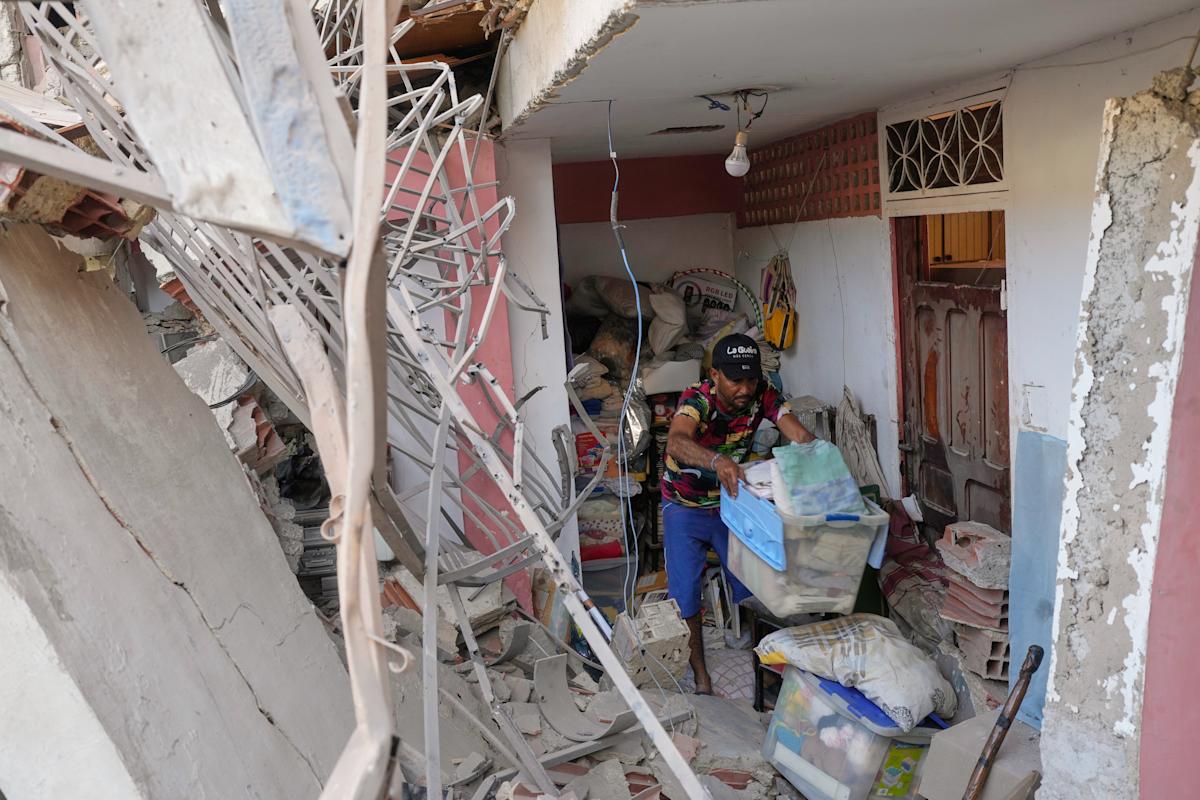
Outside the capital, in La Guira state, families with houses damaged in blasts during the operation that captured Maduro and his wife were still cleaning up debris. Some buildings were left with walls gaping open.

After the seismic shift in Venezuela and promises by President Donald Trump that the United States would "run" Venezuela with the help of Maduro's Vice President Delcy Rodríguez, no one in the country seemed to know where things stood or what lay ahead.

In a low-income neighborhood in eastern Caracas, construction worker Daniel Medalla sat on the steps outside a Catholic church and told a few parishioners that again there would be no morning Mass.

Medalla theorized the streets remained mostly empty not because people are worried about another strike but because they are fearful of government repression if they dare celebrate, coming after a fierce government crackdown during last year's fraught elections.

"We were longing for it," Medalla, 66, said of Maduro's exit.

Janetsky reported from Mexico City.

A tense calm holds on Venezuela a day after Maduro was deposed by US

CARACAS, Venezuela (AP) — A tense calm held in Venezuela on Sunday, one day afterPresident Nicolás Maduro was deposed and...


CR GLOW © 2015 | Distributed By My Blogger Themes | Designed By Templateism.com