OPEC+ set to keep planned oil output pause for March as prices jump, sources say

By Olesya Astakhova and Ahmad Ghaddar

MOSCOW/LONDON, Feb 1 (Reuters) - OPEC+ is likely to keep its planned pause on oil output increases for March when it ​meets later on Sunday, three OPEC+ delegates told Reuters, even after crude prices ‌hit six-month highs on concern the U.S. could launch a military strike on OPEC member Iran.

The meeting of eight ‌OPEC+ members comes as Brent crude closed near $70 a barrel on Friday, close to a six-month high of $71.89 reached on Thursday, despite speculation that a supply glut in 2026 would push prices down.

The eight producers - Saudi Arabia, Russia, the United Arab Emirates, Kazakhstan, Kuwait, Iraq, ⁠Algeria and Oman - raised production ‌quotas by about 2.9 million barrels per day from April through December 2025, roughly 3% of global demand.

They then froze further planned increases ‍for January through March 2026 because of seasonally weaker consumption.

Sunday's meeting is due to start at 1330 GMT, two sources said. It is not expected to take any decisions for output policy beyond March, ​sources said on Friday.

OPEC+ includes the Organization of the Petroleum Exporting Countries, plus Russia ‌and other allies. The full OPEC+ pumps about half of the world's oil.

A separate OPEC+ panel called the Joint Ministerial Monitoring Committee is also scheduled to meet on Sunday, delegates said. The JMMC does not have decision-making authority on production policy.

U.S. President Donald Trump is weighing options against Iran that include targeted strikes on security forces and leaders ⁠to inspire protesters, multiple sources said on Thursday.

Washington has ​imposed extensive sanctions on Tehran to choke off ​its oil revenue, a crucial source of state funding.

Both the U.S. and Iran have since signalled willingness to engage in dialogue, but Tehran on ‍Friday said its defence ⁠capabilities should not be included in any talks.

Oil prices have also been supported by supply losses in Kazakhstan, where the oil sector has suffered a series of ⁠disruptions in recent months. Kazakhstan said on Wednesday it was restarting the huge Tengiz oilfield in stages.

(Reporting ‌by Olesya Astakhova in Moscow, Alex Lawler and Ahmad Ghaddar in London. Writing ‌by Alex Lawler, Editing by Alexander Smith)

OPEC+ set to keep planned oil output pause for March as prices jump, sources say

By Olesya Astakhova and Ahmad Ghaddar MOSCOW/LONDON, Feb 1 (Reuters) - OPEC+ is likely to keep its planned pause...
Gaza's Rafah crossing partially reopens after nearly 2 years of closure

The Rafah crossing between Gaza and Egypt began a trial phase on Sunday ahead of its planned reopening that will allow a limited number of Palestinians to leave the war-torn enclave and completing the first phase of the US-brokered ceasefire plan.

CNN Trucks carrying humanitarian aids line up to enter the Egyptian gate of the Rafah crossing on February 1, 2026. - Mohammed Arafat/AP

The crucial crossing, which has been largely closed since Israel seized it in May 2024, underwent a series of preparations from the European Union, Egypt, and other parties that will be involved in running the crossing, according to Israel's Coordinator for Government Activities in the Territories (COGAT).

The crossing will only be open for the "limited passage of residents only," COGAT made clear, but it did not give a date for how soon residents will be allowed to cross. Ali Shaath, the head of the Palestinian technocratic committee that is supposed to run Gaza, said on social media that the crossing will open in both directions on Monday.

Advertisement

An Israeli security official told CNN that 150 Palestinians a day will be allowed to leave Gaza, but only 50 will be allowed to enter.

The full reopening of the Rafah crossing was part of the first phase of the US-brokered ceasefire agreement that went into effect in mid-October. But Israel refused to open the crossing until the return of all of the living and deceased hostages. The final deceased hostage, Ran Givili, was returned to Israel last week.

For more CNN news and newsletters create an account atCNN.com

Gaza’s Rafah crossing partially reopens after nearly 2 years of closure

The Rafah crossing between Gaza and Egypt began a trial phase on Sunday ahead of its planned reopening that will allow a ...
Tehran warns of regional conflict if US attacks Iran

DUBAI, Feb 1 (Reuters) - Iran's Supreme Leader Ayatollah Ali Khamenei said that if the U.S. attacked Iran it would ​become a regional conflict, state media reported on Sunday, amid ‌heightened tensions between Washington and Tehran.

Reuters

The U.S. has built up its naval presence in ‌the Middle East after President Donald Trump repeatedly threatened Iran with intervention if it did not agree to a nuclear deal or failed to stop killing protesters.

"(Trump) regularly says that he brought ships (...) The Iranian ⁠nation shall not be ‌scared by these things, the Iranian people will not be stirred by these threats," Khamenei said.

"We are not ‍the initiators and do not want to attack any country, but the Iranian nation will strike a strong blow against anyone who attacks and harasses ​them."

A diplomatic solution remains on the cards, with Tehran saying it ‌is ready for "fair" negotiations that do not seek to curtail its defensive capabilities.

Advertisement

The U.S. Navy currently has six destroyers, one aircraft carrier, and three littoral combat ships in the region.

The protests, which started in late December over economic hardships but morphed into the most ⁠acute political challenge to the Islamic Republic ​since its establishment in 1979, have ​now abated after repression.

Official numbers put the unrest-related death toll at 3,117, while U.S.-based HRANA rights group said on ‍Sunday it had ⁠so far verified the death of 6,713 people. Reuters was unable to independently verify the numbers.

Khamenei likened the protests to a "coup", ⁠saying that the goal of the "sedition" was to attack the centres that govern ‌the country, state media reported.

(Reporting by Dubai Newsroom; Editing ‌by Alexander Smith and Jane Merriman)

Tehran warns of regional conflict if US attacks Iran

DUBAI, Feb 1 (Reuters) - Iran's Supreme Leader Ayatollah Ali Khamenei said that if the U.S. attacked Iran it would ​b...
Russia Putin (Pavel Bednyakov / AP)

Russians have put up withdrone attacks,rising pricesanda crackdown on free speech. But now, they are increasingly being asked to go without the internet on their phones, fraying nerves and leaving many feeling disconnected after four years ofwar in Ukraine.

Mobile internet outages have become part of the norm across the country, a measure authorities say is necessary to prevent attacks byUkrainian drones, some of which use the technology for navigation.

But Russians who spoke to NBC News, experts and even the country's hard-line pro-war bloggers have questioned this justification. Ukrainian drones continue to reach their targets inside Russia, even while users as far away as Kamchatka — some 4,350 miles from the Ukrainian border — are told "security concerns" are to blame for their lack of connectivity.

The outages have left ordinary Russians frequently unable to use their phones on the go — to make calls, order a taxi or pay for groceries. They have affected small businesses and left some people resorting to carrying cash or staying home for reliable Wi-Fi.

Russia Ukraine War (Source in the Ukrainian Security Service / via AP)

Parents of children with diabetes have told Russian media they are unable to use phone applications to monitor their blood sugar levels during blackouts.

It's not just outages that are causing consternation.

Russian authorities have increasingly enforced a so-called "white list" — a limited registry of government-approved websites that people can still access on their phones during outages, severely limiting the kind of information they get.

It comes against the backdrop of increasing restrictions on what Russians can do online, in a wider crackdown on free speech since the Kremlin's invasion —bans on Instagram and Facebook,YouTubeslowdowns, restrictions on foreign messaging apps such as WhatsApp and Telegram, as well as virtual private network services many Russians use to access censored content online.

All those interviewed by NBC News said they were wary of speaking to foreign media about a sensitive security topic, and did not want their personal details shared, fearing possible repercussions.

While the outages have not caused a mass outpouring of anger, some have tried to rally against the measures.

Russia Daily Life (Alexander Zemlianichenko / AP)

Anastasia, from the Tver region northwest of Moscow, said she had intended to join a protest for internet freedom in November that ultimately did not go ahead. She was fed up, she said, because outages leave her frequently unable to use messaging or taxi apps or navigation maps on her phone. Even some of the websites on the "white list" don't load during these blackouts, she said.

Anastasia said that on one occasion, her mother, a disabled pensioner, was left unable to pay for her groceries because card machines at her local store wouldn't work without a mobile connection. She had to walk to the nearest postal office, some distance away, to get cash. "Since then, she has been keeping some cash around. But it's inconvenient — we live in the 21st century," Anastasia said.

The official explanation aside, Anastasia said, she thinks the Kremlin is using the outages to prepare the Russian public for a "North Korea-like" model of the internet, heavily censored and restricted.

"I think authorities want to do something similar in our country," she said.

Some government officials have urged residents to treat the outages as an opportunity for a "digital detox," while a senior lawmaker for information policy told the state news agency Tass last month that the outages should be seen as a welcome break from "endlessly watching useless videos."

The governor of Oryol region, Andrey Klychkov, said the inconvenience is nothing compared to the "heroism" of Russian soldiers in Ukraine.
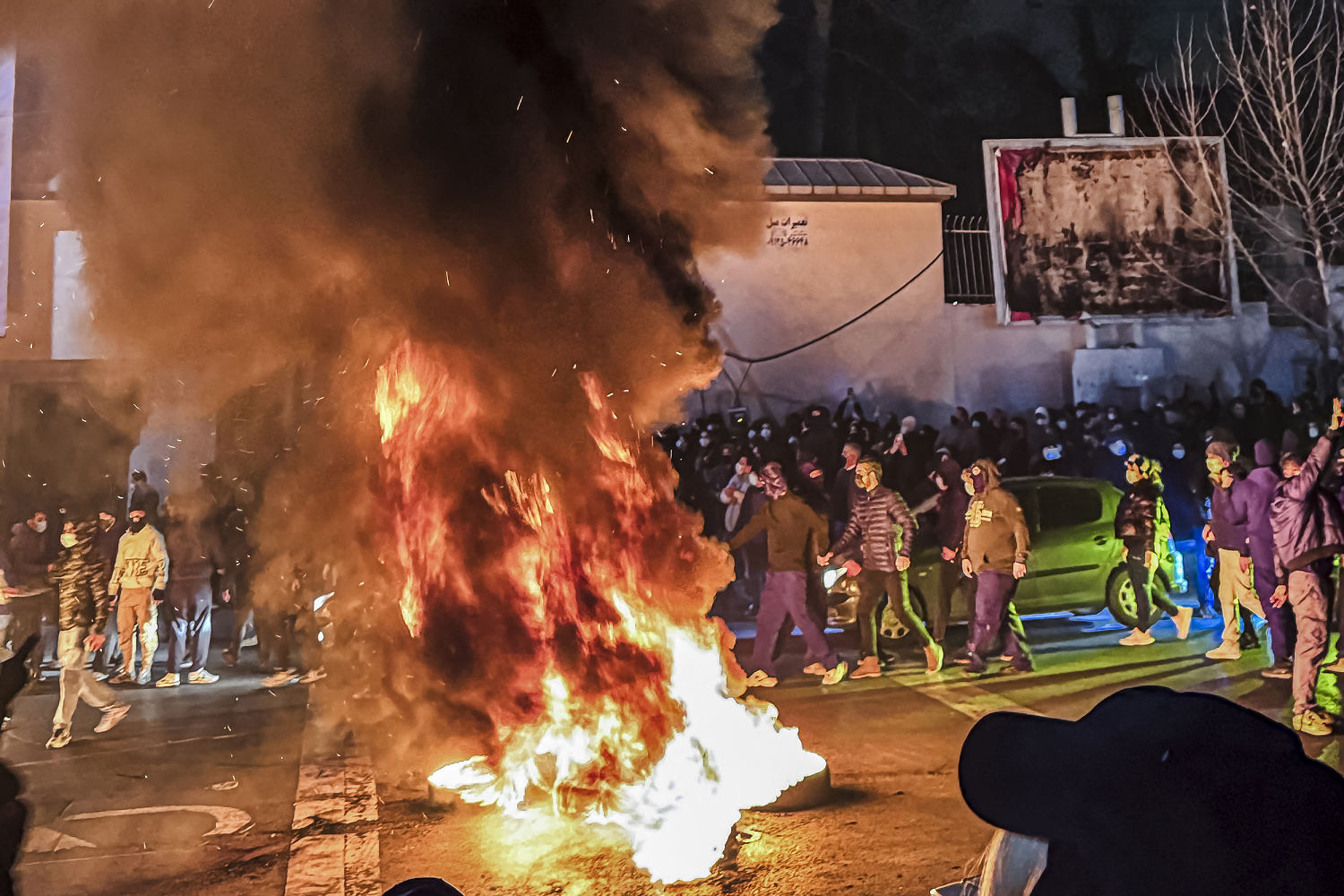
Protests in Iran January 2026 (MAHSA / Middle East Images / AFP via Getty Images)

Increasingly, regional authorities have signaled that the outages don't have an expiry date and could last until the war ends.

"This is quite a desperate tactic because you are accepting mounting economic loss and disruption of civilian life," said Bob Tollast, a land warfare expert at the Royal United Services Institute, a defense and security think tank in London. Many Ukrainian drones have multiple navigation methods, such as GPS, to mitigate the impact of the outages, he said.

Stopping drones connecting to a civilian cell network also requires the Russian government to black out large areas, he said, adding that any attempt to stop what is essentially a flying explosive device could have the unintended effect of sending it off course.

Artyom, from the western Chuvash Republic, told NBC News he has been experiencing mobile internet outages nearly every day. "It's happening because Ukrainian drones reach our territory, but blocking the internet doesn't seem to help," he said.

Even the country's prominent pro-war bloggers have expressed doubts.

"There's no evidence yet that shutting down the Internet has any impact on the effectiveness of enemy drone strikes,"war bloggerYuri Kotenok wrote last month, adding that the measure makes a "mockery" of ordinary Russians.

"The enemy immediately understood what countermeasures we would take. And they switched to satellites — they can't be jammed," popular pro-war Telegram channel "Two Majors"wrote, while blaming bureaucracy and lack of technological knowledge among Russia's upper military brass for the outages.

In September, the Russian Digital Ministry released a "white list" of websites that could still be accessed during outages — mostly government services, Russian search engine Yandex and Russian social networks. The list wasexpanded in Novemberto include some state media outlets, the website of Russia's post office, as well as taxi and weather services, among others.

Some people have complained that Telegram, that millions of Russians use and rely on for information daily — including for drone alerts — is not on the list despite being created by the Russian tech mogul Pavel Durov.

Presented as a temporary measure, the white lists have become part of Russia's wide-ranging censorship, said Sarkis Darbinyan, cyber lawyer and founder of digital rights organization RKS Global. "At any moment, Russian officials could get this idea — why not use this as a default model for the entire country?" Darbinyan said. "There is a big danger that in 2026, the authorities will adopt this model permanently."

The Russian Duma is currently reviewing a bill that would allow the country's powerful Federal Security Service to make telecom operators shut down communication services on their request "to protect against emerging threats to the security of citizens and the state."

The mobile internet outages are causing "huge discontent" among the Russian public, Darbinyan said, which the Kremlin can't ignore.

Russians aren't alone, with Iranianscut off from the internet for weeksafter authorities cracked down on nationwide unrest. In its own spin on white lists, the Islamic Republic is allowing access to the global Internet only for those with security clearance,according to an analysisfrom London-based think tank Chatham House.

Russia Internet Clampdown (Alexander Zemlianichenko / AP)

Ilya, from the Belgorod region that borders Ukraine, called the outages and the inconveniences they cause to ordinary people like him "complete nonsense."

He said he had experienced intermittent outages, which left him feeling "completely disconnected from the world."

Another Russian, Anastasia, a marketing specialist from the western city of Voronezh, said she had experienced near-daily mobile internet outages — they come without any warning too, she said. "You just empirically realize that nothing is loading."

The outages have affected Anastasia's work, hampering her ability to respond to clients via messaging apps.

So she finds herself connecting to public Wi-Fi at coffee shops and shopping malls to stay connected on the go.

"We are not used to this anymore. It feels as if we are communicationally degrading," she said.

Anastasia said she was ready to accept the restrictions if they were "truly" protecting her safety. "But I know people are not very happy about it," she added.

Russians feel strain of Putin's war with mobile internet shutdowns

Russians have put up withdrone attacks,rising pricesanda crackdown on free speech. But now, they are increasingly being asked to go without...
Gas leak caused blast in Iran's Bandar Abbas, Iranian media say

Jan 31 (Reuters) - An explosion that hit a building in the southern Iranian port city of Bandar Abbas on Saturday was caused by a gas leak, according to a preliminary assessment, the local head ​of the fire department said.

Earlier, Iranian state media reported that at least one person had been killed ‌and 14 injured in the blast, which comes amid heightened tensions between Tehran and Washington over Iran's crackdown earlier this month on nationwide protests and ‌over the country's nuclear programme.

"This (gas leak and accumulation) is the preliminary assessment. My colleagues will give more details in the next few hours," Mohammad Amin Liaqat, the fire department chief, said in a video published by Iran's semi-official Mehr news agency.

A video published on social media showed people standing among debris and wrecked cars in front of a damaged building following the explosion.

Reuters was ⁠able to verify the location by analysing ‌buildings, trees, and road layout, which matched satellite and file imagery. Reuters could not independently verify the date the video was filmed.

Separately, four people were killed after another gas explosion in ‍the city of Ahvaz near the Iraqi border, according to state-run Tehran Times. No further information was immediately available.

NERVES STRAINED AS TRUMP PILES PRESSURE ON IRAN

The explosions highlighted the jittery mood prevailing in Iran amid its clerical rulers' standoff with the Trump administration.

Before the reports ​of the two blasts on Saturday, Iranian President Masoud Pezeshkian accused U.S., Israeli and European leaders of exploiting Iran's ‌economic problems, inciting unrest and providing people with the means to "tear the nation apart".

The semi-official Tasnim news agency said social media reports alleging that a Revolutionary Guard navy commander had been targeted in the Bandar Abbas explosion were "completely false".

Two Israeli officials told Reuters that Israel was not involved in Saturday's blasts. The Pentagon did not immediately respond to a request for comment.

U.S. President Donald Trump said on January 22 an "armada" was heading toward Iran. Multiple sources said on Friday that Trump was ⁠weighing options against Iran that include targeted strikes on security forces.

Bandar ​Abbas, home to Iran's most important container port, lies on the Strait ​of Hormuz, a vital waterway between Iran and Oman which handles about a fifth of the world's seaborne oil.

The port suffered a major explosion last April that killed dozens and injured over 1,000 ‍people. An investigative committee at ⁠the time blamed the blast on shortcomings in adherence to principles of civil defence and security.

Iran has been rocked by nationwide protests that erupted in December over economic hardship and have posed one of the toughest challenges ⁠to the country's clerical rulers.

U.S.-based rights group HRANA has said at least 6,500 people were killed in the protests, including hundreds of security personnel.

(Reporting ‌by Dubai Newsroom and Menna Alaa El-Din and Enas Alashray in Cairo; Additional reporting by Phil Stewart ‌in Washington and Edward Carronin London; Editing by Gareth Jones)

Gas leak caused blast in Iran's Bandar Abbas, Iranian media say

Jan 31 (Reuters) - An explosion that hit a building in the southern Iranian port city of Bandar Abbas on Saturday was cau...
Pope gets invitation to visit Peru during a Vatican garden party, then stays for lunch

VATICAN CITY (AP) — Peru's ambassador to the Holy See publicly invited Pope Leo XIV to visit his second homeland on Saturday, as 2026 is shaping up to be an important year for the pontiff's travel with big trips under study for Africa and South America.

Associated Press Pope Leo XIV arrives to bless a mosaic of the Virgin Mary and a statue of St. Rose of Lima in the Vatican Gardens, Saturday, Jan. 31, 2026. (AP Photo/Andrew Medichini) Pope Leo XIV arrives to bless a mosaic of the Virgin Mary and a statue of St. Rose of Lima in the Vatican Gardens, Saturday, Jan. 31, 2026. (AP Photo/Andrew Medichini) Pope Leo XIV blesses a mosaic of the Virgin Mary and a statue of St. Rose of Lima in the Vatican Gardens, Saturday, Jan. 31, 2026. (AP Photo/Andrew Medichini) Pope Leo XIV blesses a mosaic of the Virgin Mary and a statue of St. Rose of Lima in the Vatican Gardens, Saturday, Jan. 31, 2026. (AP Photo/Andrew Medichini) Nuns take photos of statue of the Virgin Mary that was inaugurated by pope Leo XIV in the Vatican Gardens, Saturday, Jan. 31, 2026. (AP Photo/Andrew Medichini)

Vatican Pope

In recent days, the president of Equatorial Guinea and the Vatican ambassador in Angola have both confirmed that plans are underway for a papal trip this year, on top of rumored stops in Cameroon and Algeria. No dates have been announced but Vatican officials say the four-country Africa visit would likely take place sometime after Easter.

Leo himself has saidhe wants his second trip as pope to be in Africa, especially Algeria, which has special significance for Leo's Augustinian religious order. Algeria also plays an important role in Christian-Muslim relations that the Vatican is keen to highlight.

Leo has also said he hoped to visit three countries in Latin America in either 2026 or 2027: Argentina, Uruguay and Peru, where he lived for two decades as a missionary and where he holds citizenship. Argentina especially has been waiting for a papal visit, after Pope Francis never went home after his 2013 election.

On Saturday, Peru's new ambassador to the Vatican, Jorge Ponce San Roman, publicly invited Leo to visit during a ceremony in the Vatican gardens to inaugurate a new mosaic and statue dedicated to the Virgin Mary that Peru sponsored.

Advertisement

With all Peru's bishops on hand, Ponce said he and his fellow citizens "hoped to see you very soon in Peru."

Leo didn't respond but in his brief remarks at the ceremony recalled Peru was "such a beloved country to me."

In a break with usual protocol, Leo then stayed for a buffet lunch that the Peruvian Embassy organized for the invited diplomats and Vatican officials in the gardens. For around an hour, Leo sat with Ponce and the Peruvian bishops in a shady, hidden spot back where the caterers were preparing pisco sour cocktails and plates of ravioli with huancaina, the typical Peruvian creamy sauce.

Despite an occasional rain, the party had a joyful, relaxed vibe and Leo's prolonged presence suggested he feels very much at home with his fellow Peruvians.

Associated Press religion coverage receives support through the AP'scollaborationwith The Conversation US, with funding from Lilly Endowment Inc. The AP is solely responsible for this content.

Pope gets invitation to visit Peru during a Vatican garden party, then stays for lunch

VATICAN CITY (AP) — Peru's ambassador to the Holy See publicly invited Pope Leo XIV to visit his second homeland on S...
Hospitals on alert as Egypt readies for opening of Rafah crossing to Gaza's wounded

A key border crossing betweenthe Gaza Stripand Egypt is expected to partially open on Sunday morning, with Egyptian officials readying help for sickand injured Palestinians.

NBC Universal Image: FILES-PALESTINIAN-GAZA-ISRAEL-US-CONFLICT-DIPLOMACY (Said Khatib / AFP - Getty Images)

Dozens of Egyptian ambulances have assembled in front of the Rafah crossing gateon the Egyptian side. Hospitals in North Sinai are also on high alert and prepared to receive Palestinians arriving from Gaza in need of care.

Israel's Coordinator of Government Activities in the Territories said in a statement that the crossing will open on Sunday for the "limited movement of people only," with entry and exits from Gaza permitted "in coordination with Egypt, following prior security clearance of individuals by Israel."

For residents who left Gaza during the war, re-entry will only be permitted after clearance by Israel and additional screening and identification processes, the statement said.

The Associated Press, citing an Israeli official, has reported that only 50 medical evacuees will be permitted to exit Gaza each day. Medical evacuations were similarly prioritized under past ceasefire deals.

The opening comes just days after the remains ofthe last hostage held by Hamasin Gaza, 24-year-old police officer Ran Gvili, were returned to Israel on Monday, completing a key pillar of the truce after tensions over delays and accusations of ceasefire violations. Israel has repeatedly postponed reopening the crossing, signaling it would not open until the bodies of all the hostages were recovered.

Khaled Mujawir, the governor of Egypt's North Sinai province, told Egyptian state television earlier this week that officials are "100% ready" for the crossing to open, according to the Anadolu news agency. He also expressed hope that the crossing would be opened to aid convoys.

The Rafah crossing, the main checkpoint between Gaza and Egypt, has long been the primary gateway to the rest of the world for Palestinians living in the enclave, and now it is a considered a lifeline for the tens of thousands in need of treatment outside the territory, where the majority of medical infrastructure has been destroyed.

The reopening marks the first major step of the U.S.-brokered ceasefire's second phase, after the first phase came into effect nearly four months ago.

Advertisement

The second stage of the truce will alsorequire the disarmament of Hamas, a key sticking point in negotiations, as well as the development of Trump's international force to oversee security in Gaza.

For months, only Gvili's remains had yet to be returned, with Israel announcing their recovery Monday after launching a sweeping operation to locate them amid mounting pressure from the Trump administration to move forward with the next phase of the deal.

Hundreds of thousands of families across Gaza have been forced to wait out the first phase of the ceasefire in makeshift tents with little protection from the winter weather, as heavy rains flooded campsites.

While the ceasefire brought an end to the most severe attacks on the enclave, Israel has killed more than 500 people in Gaza since the ceasefire began, according to the Palestinian Health Ministry in the enclave, with Israel and Hamas both accusing the other of violating the truce.

Hospitals in Gaza saidIsraeli strikes killed at least 29 Palestinians Saturday, one of the highest tolls since the October ceasefire began.

Israel's military said in a statement that Saturday's strikes followed what it described as ceasefire violations a day earlier, when the army killed at least four militants emerging from a tunnel in an Israeli-controlled area.

For Palestinians on the ground, the crossing reopening would be a small glimmer of light.

"We hope the Rafah crossing opens so we can travel freely and meet many of our family members, those who have been forcibly displaced outside the Gaza Strip," Duaa Basem Al-Masri, a 26-year-old pharmacist from Beit Hanoun, told NBC News earlier this week.

She hoped the progress would soon also see the entry of "medical aid, medicines and proper shelter equipment into the strip, to ease the suffering" in Gaza.

"We hope there will be international pressure on them from President Donald Trump," Basem Al-Masri said.

Hospitals on alert as Egypt readies for opening of Rafah crossing to Gaza's wounded

A key border crossing betweenthe Gaza Stripand Egypt is expected to partially open on Sunday morning, with Egyptian offic...


CR GLOW © 2015 | Distributed By My Blogger Themes | Designed By Templateism.com