Concerning texts and a case of mistaken identity. Colin Gray trial testimony reveals frantic moments before school shooting

Minutes before the 2024 shooting at Apalachee High School, administrators and officers went to intercept a freshman student named Colt Gray, whose concerning comments that morning had raised several red flags.

CNN Colin Gray, the father of Apalachee High School shooter Colt Gray, appears in court in Winder, Georgia, on September 6, 2024. - Brynn Anderson/Pool/Getty Images

They went to his second period math class but learned he had gone to the bathroom. There, they found a student named Kolton Gray and brought him to the office for questioning.

Minutes later, Colt Gray began shooting.

The bizarre, unfortunate name mix-up was revealed in its full extent this week at thetrial of Colin Gray, the father of the school shooter, on charges of murder and manslaughter.

The shooting at Apalachee High in Winder, Georgia, on September 4, 2024, left four people dead and nine injured. Colt Gray surrendered to police and hasadmitted to the shooting, according to authorities. Now 16, he has pleaded not guilty to55 felony counts, including four counts of malice murder. A trial date has not been set.

Colin Gray, the teen's father, haspleaded not guiltyto charges of murder and manslaughter. Prosecutors say he acted recklessly by buying his son the rifle as a Christmas gift and allowing him access to it despite previous warnings that his son was a danger to others. His defense has said he was unaware his son was planning the shooting and had taken steps to try to get him help.

The trial has primarily focused on what the father knew about his troubled son and what he did with that knowledge before the attack. But it has also featured dozens of witnesses who have offered key testimony about the day of the attack and the "what-if" moments in which police nearly stopped it before it started.

In particular, the testimony revealed Colt Gray's alarming actions and statements prior to the attack: the school's efforts to locate him that day, the confusion with a similarly named student, and finally the horrific shooting itself.

Here's a closer look at what we now know about the shooting based on trial testimony so far:

Red flags were raised

On the morning of September 4, 2024, Colt's comments and actions raised multiple red flags.

In his first period class, Colt asked his teacher, Suzanne Harris, if the school had done any active shooter drills, she testified.

"It was a little bit alarming, and I did send an email to the counselor in regards to that," Harris testified.

She noticed Colt was carrying a backpack with a large poster sticking out of the top of it. Shortly after Colt left her classroom, Harris told an administrator she thought he had a gun. "I felt in every fiber of my being that something was wrong," she testified.

People attend a vigil following the shooting at Apalachee High School, at Jug Tavern Park in Winder, Georgia, on September 6, 2024. - Elijah Nouvelage/Reuters

The poster, reading "Happy Mama's Day," was wrapped around the part of the firearm that stuck out of the top of the backpack, according to trial evidence.

At 9:40 a.m., Colt sent several concerning texts to his father that alarmed him, according to phone records.

"I'm sorry," he wrote to his father. "It's not ur fault." Colin Gray, at his construction job, texted him what was wrong, but the teen didn't respond, text evidence shows.

Colin Gray then called his estranged wife, Marcee, who called the school guidance counselor, Lisa Butler, at 9:50 a.m. to ask them to check on Colt. Toward the end of that conversation, she told Butler Colt had access to a firearm and had an obsession with school shooters, alarming the counselor, Butler testified.

Butler relayed the information to Deigh Martin, the assistant principal at Apalachee. Martin and two school resource officers were already searching for Colt Gray based on the teacher's concerns about his backpack and questions about active shooter training, she testified.

Colt Gray vs. Kolton Gray

Martin and the officers then went to locate Colt but failed to find him due to a stranger-than-fiction mix-up: another student in the same class was named Kolton Gray.

At 9:53 a.m., Colt Gray took his backpack and left his second period classroom. His teacher, Katherine Greer, testified he asked to go see a crisis counselor, and she allowed him to do so.

But instead, Colt took his bag and the weapon inside to the bathroom. There, he texted his mother, "I'm sorry," and texted his father, "ur not to blame for any of it."

Advertisement

At 10:03 a.m., Kolton Gray – seated in the desk next to Colt – got up from his desk and also went to the bathroom.

At 10:06 a.m., Martin entered the classroom looking for Colt Gray but instead took Kolton Gray's backpack from the room. A minute later, the two school resource officers entered a nearby bathroom looking for Colt Gray but instead located Kolton Gray and took him to the office for questioning.

Martin testified they soon realized they had the wrong student and wrong backpack because of their similar names. "We kinda knew that was the mix-up," she said.

School shooting suspect Colt Gray exits court after a status hearing in Barrow County, Georgia, on December 9, 2025. - Mike Stewart/Pool/Getty Images

One explanation for the mix-up was that Colt Gray had only attended a few days of school at that point, and school employees did not know what he looked like.

He did not enroll in any school – online or otherwise – for his entire eighth grade year, school records showed. He missed the first two weeks of his freshman year at Apalachee High, and after that missed more days than he attended leading up to the day of the shooting. His student photo on file with the school was from years prior, so they did not know what he looked like.

"There was confusion in regards to the name and there was also confusion in regards to Colt Gray himself because he had not been at the school for an extended period of time," Georgia Bureau of Investigation agent Lucas Beyer said. "He was lesser known than Kolton Gray was."

Unable to find Colt Gray, Martin said she went to look at the school security cameras to try to figure out what he looked like.

Meanwhile, Colt Gray remained behind in the bathroom, surveillance video shows. He left the bathroom at 10:21 a.m. wearing yellow gloves, walked toward his classroom and removed the firearm from his backpack, the video shows.

Denied entry into his class

A female student looked out the door window and saw Colt Gray armed. She alerted Greer, who immediately pressed the emergency button on her badge, locking down the school.

At 10:22 a.m., unable to enter his own classroom, Colt Gray went to Cassandra Ryan's nearby algebra class, took three to four steps inside and opened fire for about 10 to 12 seconds, Beyer said.

"There was gunfire that started happening, and I could feel debris and bullets going over my head," Ryan said.

Christian Angulo, a student in the class, was killed, and several otherstudents were wounded by gunfire.

Colt Gray then left the class and walked down the hallway, where he fatally shot teachers Cristina Irimie and Richard Aspinwall and wounded another teacher, David Phenix, according to Beyer. He then fatally shot Mason Schermerhorn, a student who had come out of a bathroom.

School resource officersBrandon King and Chase Boydhad been searching for Gray when they heard the sound of gunshots, they testified. They sprinted toward the sound and came to a hazy and backlit hallway with limited visibility, they said.

King saw the outlines of a person standing and loudly said, "Show me your f***ing hands," he testified. The person immediately got on the ground, lay down in the prone position and put his arms out, he testified.

Boyd then put the shooter, Colt Gray, in handcuffs. A rifle sat next to him, and magazines were located on his body, he testified.

'I knew it,' father says

Meanwhile, Colin Gray texted his son at 10:23 a.m. – moments after his son had opened fire – and 10:27 a.m., asking him to call and saying he would take the teen out of school, text records show. Colt did not respond.

At 10:55 a.m., Colin Gray's daughter Jenni texted him, "I'm scared," and the father responded, "It's going to be ok." She said people had been killed at the high school, and Colin Gray asked how she knew that and whether she had spoken to Colt that day.

Colin Gray left his construction job at 11:18 a.m. and drove home, arriving at 12:27 p.m., where he saw the Sig Sauer firearm was not in Colt's room. Police arrived at the home five minutes later to question him, according to body-camera footage.

"God. I knew it," he said when they arrived, according to police body-camera footage. "My little girl just texted me – she's in middle school – she said, 'We're in lockdown.' I'm like, 'God almighty, please tell me your brother didn't do something.'"

CNN's Nicki Brown, Isabel Rosales, Maxime Tamsett, Chris Youd and Sabrina Castro contributed to this report.

For more CNN news and newsletters create an account atCNN.com

Concerning texts and a case of mistaken identity. Colin Gray trial testimony reveals frantic moments before school shooting

Minutes before the 2024 shooting at Apalachee High School, administrators and officers went to intercept a freshman stude...
Trump has claimed Iran is building missiles that could soon hit the US. Sources say that's not backed up by US intelligence.

In his first comments about Saturday's US military strikes against Iran, President Donald Trump claimed in a video posted to social media that Iran has been building missiles that "could soon reach the American homeland."

CNN WASHINGTON, DC - FEBRUARY 24: U.S. President Donald Trump delivers the State of the Union address during a joint session of Congress in the House Chamber at the Capitol on February 24, 2026 in Washington, DC. - Kenny Holston/Pool/Getty Images

It's an argument he also made in hisState of the Union addressTuesday night.

However, that assertion is not backed up by US intelligence, sources told CNN.

It was one of several claims about threats from Iran made publicly by the Trump administration in the lead up to Saturday's strikes.

Anunclassified assessmentfrom the Defense Intelligence Agency (DIA) from 2025 said that Iran could develop a "militarily-viable" intercontinental ballistic missile by 2035 "should Tehran decide to pursue the capability."

According to two sources, the claim that Iran will soon have a missile capable of hitting the US is not backed up by intelligence — there is no intelligence to suggest that Iran is pursuing an ICBM program to hit the US at this time, the sources said.

Iran does, however, possess short range ballistic missiles that could threaten US bases and personnel in the region, as the administration has warned.

Three sources told CNN there has been no change in recent assessments about Iran's intercontinental ballistic missile aspirations.

White House spokesperson Anna Kelly responded to CNN's reporting, saying "President Trump is absolutely right to highlight the grave concern posed by Iran, a country that chants 'death to America,' possessing intercontinental ballistic missiles."

The matter of Iranian missile technology did not come up in a briefing with Secretary of State Marco Rubio, CIA Director John Ratcliffe and the "Gang of Eight" congressional leaders this week, sources familiar with the briefing said.

Iranian Foreign Minister Abbas Araghchi said in an interview released this week that his country was not developing long-range missiles.

"We have deliberately limited the range of our missiles to 2,000 kilometers," he told India Today TV, saying the missiles were for defense.

Advertisement

The State Department referred CNN to remarks Rubio made Wednesday.

Pressed on Trump's claim that Iran could "soon" have missiles that could reach the US, Rubio said he would not speculate "as to how far away they are," but said Iran is "certainly" trying to achieve intercontinental ballistic missiles.

"You've seen them increasing the range of the missiles they have now, and clearly they are headed in the pathway to one day being able to develop weapons that could reach the continental US," he told reporters at a press conference in St. Kitts Wednesday.

He argued that Iran's refusal to discuss its ballistic missile program in negotiations that had been underway between the US and Iran in recent weeks is "a big problem." The rounds of discussions between Washington and Tehran have, so far, only focused on nuclear issues.

Asked about the DIA report on Iranian intercontinental ballistic missile development, Rubio said, "I won't comment on assessments or anything that the Intelligence Community says. Suffice it to say that it's a threat. We can see that it's possible."

"Beyond just the nuclear program they possess these conventional weapons that are solely designed to attack America and attack Americans, if they so choose to do so. These things have to be addressed," the top US diplomat said.

On the nuclear program, Rubio acknowledged that Iran is "not enriching right now," but said "they're trying to get to the point where they ultimately can."

However, Special Envoy Steve Witkoff – one of two main US negotiators – claimed in an interview released last Saturday that Iran was "probably a week away from having industrial-grade bombmaking material." That claim came despite the Trump administration's repeated assertions that the US had "obliterated" Iran's nuclear program in military strikes last year.

According to a source, intelligence shows that Iran is actively trying to build back its enrichment capability, including installing additional centrifuges, getting back online centrifuges that survived military strikes last year, and rebuilding facilities - many of which were damaged or destroyed - needed to weaponize the enriched uranium.

However, sources and experts say that work would take far longer than a week. And, according to a source, the work to build back the nuclear program is happening in places that are not likely to be impacted by military strikes.

CNN's Alejandra Jaramillo contributed to this report

For more CNN news and newsletters create an account atCNN.com

Trump has claimed Iran is building missiles that could soon hit the US. Sources say that’s not backed up by US intelligence.

In his first comments about Saturday's US military strikes against Iran, President Donald Trump claimed in a video po...
Are gamers the best drone fliers? The U.S. Army held a competition to find out

HUNTSVILLE, Alabama - The "hunter" lifted off first, scanning the grassy terrain for targets. Then came the "killers," drones that would hit them. With an insect-like hum, they rose one by one from the launchpad and buzzed away, high over the flat, muddy landscape.

USA TODAY

Simulating a real-life battle scenario, the soldiers huddled beneath a grove of trees, holding small controllers with joysticks akin to Nintendo Switch consoles. The drone operators hustled out to the launchpad, dropped the drones, and then dashed back to take cover. The mission: use the "hunter" drone to identify and "killer" drones to hit five high-value targets from a thousand meters up. They had 30 minutes.

<p style=A new Army drone warfighter competition in Huntsville, Ala tests soldiers' skills in racing drones through a challenging course and using "hunter-killer tactics."
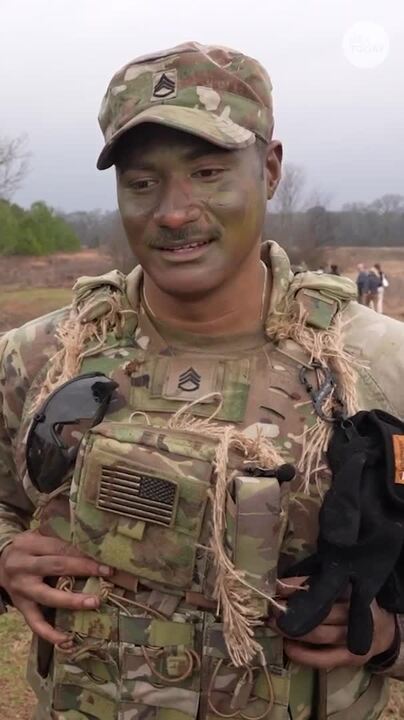
Staff Sergeant Salilo Fano at the Army Best Drone Warfighter Competition on Feb. 19, 2026 in Huntsville, Ala.

" style="max-width:100%; height:auto; border-radius:6px; margin:10px 0;" loading="lazy" /> Competitors race drones through an obstacle course at the Army Best Drone Warfighter Competition on Feb. 19, 2026 in Huntsville, Ala. Staff Sergeant Salilo Fano and Sergeant Carter Shook prepare their drones for flight during a field exercise at the Army Best Drone Warfighter Competition on Feb. 19, 2026 in Huntsville, Ala. Competitors race drones through an obstacle course at the Army Best Drone Warfighter Competition on Feb. 19, 2026 in Huntsville, Ala. Sergeant Carter Shook wears virtual reality goggles on his helmet that allow him to see what the drone sees and to aid his flying at the Army Best Drone Warfighter Competition on Feb. 19, 2026 in Huntsville, Ala. A drone controller is used during the Army Best Drone Warfighter Competition on Feb. 19, 2026 in Huntsville, Ala. Staff Sergeant Salilo Fano (R) and Sergeant Carter Shook prepare their drones for flight during a field exercise at the Army Best Drone Warfighter Competition on Feb. 19, 2026 in Huntsville, Ala. Competitors race drones through an obstacle course at the Army Best Drone Warfighter Competition on Feb. 19, 2026 in Huntsville, Ala. Drone and a controller are strapped to a field pack at the Army Best Drone Warfighter Competition on Feb. 19, 2026 in Huntsville, Ala. Specialist Robert Conley holds a drone equipped with a cutter designed and 3D printed by soldiers for use in cutting the fiber optic control lines of other drones at the Army Best Drone Warfighter Competition on Feb. 19, 2026 in Huntsville, Ala. Staff Sergeant Salilo Fano and Sergeant Carter Shook carry their drones and associated equipment through a field to a launch location at the Army Best Drone Warfighter Competition on Feb. 19, 2026 in Huntsville, Ala. Specialist Brogan Gravot uses virtual reality goggles to fly a drone at the Army Best Drone Warfighter Competition on Feb. 19, 2026 in Huntsville, Ala. Competitors race drones through an obstacle course at the Army Best Drone Warfighter Competition on Feb. 19, 2026 in Huntsville, Ala. Staff Sergeant Salilo Fano radios in a contact report after his drone spotted the enemy target at the Army Best Drone Warfighter Competition on Feb. 19, 2026 in Huntsville, Ala. Sergeant Carter Shook wears virtual reality goggles on his helmet that allow him to see what the drone sees and to aid his flying at the Army Best Drone Warfighter Competition on Feb. 19, 2026 in Huntsville, Ala. Competitors race drones through an obstacle course at the Army Best Drone Warfighter Competition on Feb. 19, 2026 in Huntsville, Ala. Competitors race drones through an obstacle course at the Army Best Drone Warfighter Competition on Feb. 19, 2026 in Huntsville, Ala.

Soldiers showcase skills in Army drone warfighter competition

A new Army drone warfighter competition in Huntsville, Ala tests soldiers' skills in racing drones through a challenging course and using "hunter-killer tactics."Staff Sergeant Salilo Fano at the Army Best Drone Warfighter Competition on Feb. 19, 2026 in Huntsville, Ala.

"It's not as easy as it looks," Staff Sgt. Salilo Fano, 31, one of the soldiers, told USA TODAY after the competition ended. One thing that helps "a lot" with training, he said, is playing video games.

Staff Sgt. Salilo Fano and Sgt. Carter Shook prepare their drones for flight during a field exercise at the Army Best Drone Warfighter Competition on Feb. 19, 2026 in Huntsville, Alabama.

The Army's first-of-its-kind drone warfighter competition this month comes amid a sweeping effort by the Pentagon toembed drones in every branchof the military. The event highlights a skill set some of these young soldiers honed long before they put on a uniform. The Army needs adept drone operators, and one thing the best pilots often have in common, Army leaders say: a knack for gaming.

"Were you a good video gamer? Do you build drones in your basement for fun? What made you have this passion, this desire to be good at this?" This is what the Army is asking as it searches for the next generation of recruits who can deftly operate drones, said Col. Nicholas Ryan, a member of Pentagon chiefPete Hegseth's "drone dominance team" and the Army lead for the Huntsville competition.

The mid-February event kicked off under gray skies on the University of Alabama's drone testing range.

On an obstacle course at the center, drones roughly the size of a microwave oven whizzed through circular plywood cutouts, backflipped over shipping carts, dodged an all-terrain vehicle and slalomed through a set of columns. From a tent on the side, a pair of soldiers delivered their best sports commentator impressions.

"And we're off," one said, "the first round moving aggressively through the yellow obstacle, those competitors sail through... over the Humvee and through our last obstacle, folks."

Sgt. Carter Shook gets his equipment ready to fly a drone in a field exercise at the Army Best Drone Warfighter Competition on Feb 19, 2026, in Huntsville, Alabama.

The crowd sporadically responded with cheers and oohs. Many drones sputtered to the ground before they crossed the first hurdle or crashed spectacularly into a wall.

Meanwhile, Fano, from American Samoa, and his partner, Sgt. Carter Shook, 22, a Pennsylvania native, were competing as a team in another event where soldiers race against the clock to smear camouflage paint on their faces, hoist water bottles over their heads,  run sandbags up and down a stretch of land, and then hustle about a mile across the muddy turf with their drones strapped to their backs.  The soldiers darted out from the trees, dropped their drones on a launchpad and sent them whizzing into the sky. Then they rushed back to their operating spot, scribbling notes on a pad and flipping on goggles to check their flight path.

"I haven't slept in 48 hours," one soldier told another as they prepared to start the competition. "As soon as I finish this, I faceplant."

The 200-plus competitors included soldiers who'd first touched a drone months prior and seasoned veterans who'd spent more than a decade piloting drones in various settings. One competitor, a member of the Army Reserves, uses drones in his package-delivery civilian job. Another flew drones for 13 years as a personal hobby. Most who spoke to USA TODAY said gamers make better drone operators.

Spc. Evan De Silva, 28, a contender in the "hunter killer" competition, said he flew his first drone just months prior. "There are video games that you can use to help you get, not exactly like this, but pretty damn close," he said.

Sgt. First Class Stephen Ringsmuth and Cpt. Jay Johns prepare to fly drones in an obstacle course race at the Army Best Drone Warfighter Competition on Feb 19, 2026, in Huntsville, Alabama.

Gamers "will pick up flying these a lot faster than people that don't play video games," said Sgt. Cory Koehn, 25, a member of the Army's 5-month-old drone team based in Fort Rucker, Alabama.

The selective team was at the competition to sniff out recruits with drone-operator chops. During a recent recruitment drive, just 20 people were picked from more than 120 applicants, theArmy said.

Army rushes to get up to speed on drones

Hegseth and Army Secretary Dan Driscoll have ambitious goals for amping up the Army's drone program.The Armyaims to buy a million drones by 2028, compared with the current rate of roughly 50,000 purchases annually.

In recent years, critics in Washington and the defense industry have voiced growingconcerns that the U.S. militarylags far behind China in preparing for future wars in which humans will no longer be seated in the cockpit. In a nod to those critics, Trump signed an executiveorderlast June aimed at "unleashing drone dominance," and Hegseth issued amemoshortly thereafter rescinding "restrictive policies that hindered production and limited access" to drones.

The military's plans to combat drones came into sharp focus this month after drone disputes at the southern border triggered two airspace closures in Texas, just weeks apart. In mid-February,aviation officials suddenly shut downthe El Paso airspace after border officials fired a military laser meant to take out threatening drones at an object that turned out to be a party balloon. Two weeks later,the airspace around Fort Hancock, about 50 miles southeast, was shut down after the military used the device to shoot a drone that ended up belonging to Customs and Border Protection.

Military leaders are also watching the war in Ukraine with a growing sense of urgency. First Person View, or FPV drones – the type used in the Army drone competition – have dominated the battlefield in Ukraine, as it has sought, for the past four years, to fend off Russia's more substantial military.

Advertisement

Staff Sgt. Salilo Fano radios in a contact report after his drone spotted the enemy target at the Army Best Drone Warfighter Competition on Feb. 19, 2026, in Huntsville, Alabama.

In Ukraine, the gamification of drone warfare has been far more explicit. Ukraine's military has created a drone "bonus system" in which drone operators areawarded pointsfor wounding and killing Russian troops that they can exchange for new weapons on anAmazon-like online marketplace.

This concept is not new in the United States, where the military maintains a mutually beneficial relationship with gaming companies and communities.

For decades, military services haveused simulatorsbased on commercially available video games to train soldiers. During the last fiscal year, the Army spent roughly $10.1 million on "gaming technology in support of Army training," according to budgetdocuments. Military handsets to control weapons systemsare modeled onXbox and PlayStation controllers.

Branches of the military each have their ownesports teamsthat compete against one another and in wider competitions with civilian teams. The militaryaims to recruityoung people through its gaming content on streaming platforms such as Twitch and ads that resemble popular teen games. (The Army's Twitch channel stirred controversy in 2020 when itbanned userswho asked questions in gaming chats about war crimes.)

The gaming industry, in turn,hires retired generalsas advisors andsells equipmentperfected by commercial designers to the military. In Call of Duty, the iconic and realistic military game, players can net a "hunter killer" drone as a reward for racking up roughly six "kills."

Competitors in actionat the Army Best Drone Warfighter Competition, on Feb. 19, 2026, in Huntsville, Alabama.

The Pentagon and the gaming industry "use each other opportunistically," said Matthew Thomas Payne, an associate professor at the University of Notre Dame who studies gaming culture and authored "Playing War: Military Video Games after 9/11."

The video game industry "will look at the military and say, 'What kinds of assets can you provide us so that we can make our games more realistic?'" he said.

"The military sees the video game industry as soft power. It's a way of leveraging popular culture to win hearts and minds."

Wayne Phelps, a retired Marine Corps Lieutenant Colonel and author of "On Killing Remotely: The Psychology of Killing with Drones," said it makes sense that the military would recruit gamers with transferable skills, such as good hand-eye coordination and the ability to multitask, to be drone operators.

Spc. Brogan Gravot uses virtual reality goggles to fly a drone at the Army Best Drone Warfighter Competition on Feb. 19, 2026, in Huntsville, Alabama.

"It's how you would recruit anybody for a job," said Phelps, who commanded a drone squadron on counterterrorism operations.

In interviews for Phelps' book, drone pilots told him that they "rejected the notion that they didn't understand what they were doing was real" and "understood that they're often using lethal force and taking human lives."

Drone pilots can suffer visceral, real-life trauma from afar

As the Pentagon and the defense industry rush to embrace drones and recruit skilled young people to operate them, the well-being of drone operators is often ignored, said Tanner Yackley, a retired Air Force drone pilot who founded Remote Warrior, a mental health advocacy organization for drone pilots.

Drone and a controller are strapped to a field pack at the Army Best Drone Warfighter Competition on Feb. 19, 2026, in Huntsville, Alabama.

"You have all these people in industry pushing, looking at what's the end goal, and you're skipping... the human in the loop," he said.

Quick reflexes developed from a gaming hobby might lend themselves to operating a drone, Yackley said. But video games were nothing like his experience of remote warfare around the world, including in Afghanistan, from thousands of miles away at Holloman Air Force base in Las Vegas.

"That job chewed me up and spit me out," he said.

Yackley described the visceral experience of his four-year stint flying daily remote combat missions during the height of the War on Terror – sleeping two hours a night and working for seven, rewatching bloody footage of drone kills dozens of times over, suffering from "nervous system fragmentation" caused by always having a finger on the trigger. Viewing him as a "desk job" worker, Yackley said, veterans' doctors dismissed his debilitating post-traumatic stress.

Multiplestudieshavefoundthat drone crews suffer from intrusive thoughts, depression, problems in their personal relationships and "moral injury." Although this year's defense policy bill included a provision that the Pentagon must study the mental health impact of drone warfare on operators, Yackley said it was "too little, too late."

From thousands of miles away, at a safe post in the United States, Yackley witnessed the horrors of war unfolding. "In 2012, I watched a wife drag half her husband across a courtyard. I was 19 at the time," Yackley said. "That's what nobody's preparing for, because we all want to put this silly video game spin on it."

"What happens when they flip the goggles up and go, 'I just killed this guy'?"

This article originally appeared on USA TODAY:Are gamers better at flying a drone? The Army wants to find out.

Are gamers the best drone fliers? The U.S. Army held a competition to find out

HUNTSVILLE, Alabama - The "hunter" lifted off first, scanning the grassy terrain for targets. Then came the ...
Pakistan says it killed more than 300 Afghan forces in dayslong airstrikes inside Afghanistan

ISLAMABAD (AP) — Pakistan's military, backed by artillery and air power,struck more Afghan military installationsdeep inside Afghanistan overnight and into early Saturday, killing over 300 Afghan forces in dayslong border clashes, a government spokesman and officials said.

Associated Press People carry the coffin of an army soldier, killed in the cross-border clashes of Pakistan and Afghan forces, for his funeral prayer at a village in Lakki Marwat, a district of Pakistan's Khyber Pakhtunkhwa province, Saturday, Feb. 28, 2026. (AP Photo/G.A. Marwat) Smoke emits from Afghan side as trucks are parked along roadside following cross-border clashes between Pakistan and Afghan forces, at near Torkham border crossing point, Pakistan, Saturday, Feb. 28, 2026. (AP Photo/Maaz Awan) People attend funeral prayer of an army soldier, killed in the cross-border clashes of Pakistan and Afghan forces, at a village in Lakki Marwat, a district of Pakistan's Khyber Pakhtunkhwa province, Saturday, Feb. 28, 2026. (AP Photo/G.A. Marwat) Trucks carrying Afghan refugees and their belongings are parked along roadside in a safer place following cross-border clashes between Pakistan and Afghan forces, at near Torkham border crossing point, Pakistan, Saturday, Feb. 28, 2026. (AP Photo/Maaz Awan) People gather around the coffin of an army soldier, killed in the cross-border clashes of Pakistan and Afghan forces, during a funeral prayer in a village in Lakki Marwat, a district of Pakistan's Khyber Pakhtunkhwa province, Saturday, Feb. 28, 2026. (AP Photo/G.A. Marwat)

Pakistan Afghanistan

Thetwo sides have targeted each other's military positionssince Thursday night, when Afghanistan launched strikes in response to Pakistani attacks that Islamabad said hit seven training camps and hideouts of the outlawed Pakistani Taliban, known as Tehrik-e-Taliban Pakistan. The group is separate but closely allied with Afghanistan's Taliban.

More than 331 Afghan Taliban forces had been killed and over 500 others wounded during the ongoing military strikes in Afghanistan, according to Pakistan's Information Minister, Attaullah Tarar, who said Pakistan also destroyed 102 Afghan posts, captured 22 others and destroyed 163 tanks and armored vehicles at 37 locations.

On Saturday, Pakistan's state-run media reported the country's air force carried out strikes targeting key military installations in various areas of eastern Afghanistan.

According to Pakistani authorities, hundreds of residents living near the northwestern Torkham border crossing have fled to safer areas. In recent days,Pakistan has also transported dozens of Afghan refugeeswho had been waiting at the Torkham crossing to return home to safer locations.

There was no immediate comment from Afghanistan's government on the Pakistani claims Saturday.

Afghanistan's Defense Ministry on Saturday said Afghanistan attacked Pakistani military bases in Miranshah and Spin Wam overnight, destroying military installations and causing heavy casualties in response to the ongoing airstrikes by Pakistan.

In eastern Afghanistan, the Department of Information and Culture accused Pakistan of targeting civilian areas, destroying homes and killing at least 11 people. There was no immediate response from Pakistan, which has said it is targeting only military installations to avoid any civilian casualties.

Mullah Taj Mohammad Naqshbandi, an Afghan commissioner on Afghan side of the Torkham border, in a statement said Saturday that the "brave forces of the Islamic Emirate destroyed the Pakistani military regime's commissariat, military units, and three important security towers."

On Friday, the Afghan government said 55 Pakistani soldiers were killed during its strikes and Afghan losses were far lower than Pakistan claimed.

Advertisement

Afghan government spokesman Zabihullah Mujahid said Friday that the country's attacks on Pakistani military targets were meant as "a message that our hands can reach their throats and that we will respond to every evil act of Pakistan." He added that "Pakistan has never sought to resolve problems through dialogue."

The same day, Pakistan's Defense Minister Khawaja Mohammad Asif wrote on X: "Our patience has now run out.Now it is open war between us."Pakistan has frequently accused Kabul of sheltering the TTP, allegations the group and Afghanistan's Taliban government deny.

Pakistan's army spokesman, Lt. Gen. Ahmed Sharif Chaudhry, said Friday the Afghan government had only one choice:"either choose TTP or Pakistan."

Ejaz Ul Haq, an Afghan refugee stranded near the Torkham border with his family, said he could not return to Afghanistan because of the fighting. Many others were struggling to obtain food during the fasting month of Ramadan, he said.

Guftar, a Pakistani villager living near Torkham, urged the governments to reach a ceasefire, saying ordinary people are bearing the brunt of the conflict.

Tensions have been high since October, when dozens of soldiers, civilians and suspected militants were killed in border clashes. A Qatari-mediated ceasefire ended the intense fighting that month, but several rounds of peace talks in Turkey in November failed to produce a lasting agreement. The two sides have occasionally traded fire since then, though the ceasefire had largely held until last week, when Pakistan struck what it described as TTP hideouts.

Since then, Turkey, Saudi Arabia, Qatar, China and several other countries are again attempting to defuse tensions by offering mediation.

Qatar's minister of state, Mohammed bin Abdulaziz Al-Khulaifi, spoke Friday with the foreign ministers of Afghanistan and Pakistan in an effort to de-escalate tensions, Qatar's Foreign Ministry said in a post on X.

Abdul Qahar Afghan reported from Kabul, Afghanistan. Riaz Khan and Rasool Dawar in Peshawar, Pakistan, contributed to this story

Pakistan says it killed more than 300 Afghan forces in dayslong airstrikes inside Afghanistan

ISLAMABAD (AP) — Pakistan's military, backed by artillery and air power,struck more Afghan military installationsdeep...
U.S. and Israel launch strikes on Iran

The U.S. and Israel were striking Iran on Saturday morning, with Iranian media reporting explosions across the capital Tehran.

NBC Universal Daily life in Iran (Fatemeh Bahrami / Anadolu via Getty Images)

President Donald Trump said U.S. forces have begun "major combat operations in Iran," in an eight-minute video messageshared on Truth Social.

"Our objective is to defend the American people by eliminating imminent threats from the Iranian regime," he said.

A spokesperson for Israel's defense minister had said earlier that Israel had "launched a preemptive strike against Iran to remove threats against the State of Israel."

Retaliation is expected, the spokesperson said.

"As a result, a missile and UAV attack against the State of Israel and its civilian population is expected in the immediate time frame," the Israeli spokesperson said.

The strikes in Iran are significant, and are not small strikes, two U.S. officials told NBC News.

Iran's airspace was closed early on Saturday, Iran's semi-official news agency Tasnim reported, as smoke was seen rising above buildings in Tehran.

The strikes come afterTrump oversawa massive military build up in the Middle East while holding talks with Tehran aimed at agreeing a new deal to curtail Iran's nuclear program.

"It has always been the policy of the United States, in particular my administration, that this terrorist regime can never have a nuclear weapon. I'll say it again, they can never have a nuclear weapon," Trump said in his video Saturday.

Iran vowed before the strikes that it would retaliate against any attack, threatening to target Israel as well as American bases across the region.

Advertisement

Other Middle Eastern nations have warned any attack could spiral into another major conflict for a region still reeling from the Israel-Hamas war in the Gaza Strip.

Trump raised the prospect of another attack on Iran afterauthorities cracked down on huge nationwide demonstrations, which erupted in December and January over the country's ailing economy but morphed into demands for the overthrow of the clerical regime.

Trumpwrote on Truth Social: "KEEP PROTESTING — TAKE OVER YOUR INSTITUTIONS!!! Save the names of the killers and abusers." Then he added: "HELP IS ON ITS WAY."

The regime ended up crushing the protests, killing thousands andarresting tens of thousands morein the weeks afterwards.

Trump then threatened a military attack if a deal could not be reached with Tehran over its nuclear program — which the president had said theU.S. "obliterated"with strikes in June. Alater U.S. assessmentfound these only destroyed one of three sites targeted.

More recently, the administration said Iran was trying to rebuild its nuclear program, and that it could have enough fissile material for an atomic bomb within "a week" and that its ballistic missiles could "soon" be able to strike the U.S.

There is no publicly available evidence that Iran has made major progress in reviving its damaged nuclear program, including whether it has resumed significant uranium enrichment. The Trump administration has not specifically accused Iran of renewing uranium enrichment work.

Iran, which has always insisted that it has not pursued nuclear weapons, resists demands that it halt uranium enrichment or expand talks to include its ballistic missile program and support for proxy forces across the Middle East.

At the same time as holding talks with Iran, the U.S. amassed forces and built up its air defenses at bases across the region.

Trump sent the USS Gerald R. Ford, the world's largest aircraft carrier, to join another at the head of what he dubbed an "armada."

Iran has already signed a nuclear deal with the U.S. and other world powers. The 2015 Joint Comprehensive Plan of Action, or JCPOA, was seen by supporters as a landmark agreement that provided transparency and confidence internationally that Tehran was not building nuclear weapons.

Trump and other critics saw the deal as weak, however, and claimed it would only delay Iran from obtaining a bomb. In 2018, Trump unilaterally withdrew the U.S. from the agreement.

U.S. and Israel launch strikes on Iran

The U.S. and Israel were striking Iran on Saturday morning, with Iranian media reporting explosions across the capital Te...
Pakistan, Afghan Taliban forces clash as diplomatic efforts intensify

KABUL, Feb 28 (Reuters) - Fighting between Pakistan and Afghanistan's Taliban military entered its third day on Saturday, following overnight clashes as the international community expressed increasing concern about the conflict and called for urgent talks.

Reuters A police officer controls traffic flow as a security measure, following exchanges of fire between Pakistani and Afghan forces, along a road leading to the airport in Karachi, Pakistan, February 28, 2026. REUTERS/Asim Hafeez Taliban soldiers stand on top of a their post as they guard near the Pakistan-Afghanistan border, in Khost province, Afghanistan, February 27, 2026. REUTERS/Stringer Police officers check vehicles as a security measure, following exchanges of fire between Pakistani and Afghan forces, along a road leading to the airport in Karachi, Pakistan, February 28, 2026. REUTERS/Asim Hafeez An army soldier stands guard at a post at the Friendship Gate, following exchanges of fire between Pakistan and Afghanistan forces, at the border crossing between the two countries in Chaman, Pakistan February 27, 2026. Picture taken with a mobile phone. REUTERS/Abdul Khaliq Achakzai Zabihullah Mujahid, Taliban spokesperson, gestures during a press conference, following an escalation in cross-border tensions with Pakistan, in Kandahar, Afghanistan, February 27, 2026. REUTERS/Stringer

A police officer controls traffic flow as a security measure, following exchanges of fire between Pakistani and Afghan forces, along a road leading to an airport in Karachi

Pakistan's strikes on Friday ‌hit Taliban military installations and posts, including in Kabul and Kandahar, in one of the deepest Pakistani incursions into ‌its western neighbour in years, officials said.

Islamabad accuses the Taliban of harbouring Tehreek-e-Taliban Pakistan (TTP) militants, who it claims are waging an insurgency inside Pakistan, a charge the Taliban ​denies.

Pakistan described its actions as a response to cross-border assaults, while Kabul denounced them as a breach of its sovereignty, saying it remained open to dialogue but warned any wider conflict would result in serious consequences.

The fighting has raised the risk of a protracted conflict along the rugged 2,600-km (1,615-mile) frontier.

Diplomatic efforts gathered pace late on Friday as Afghanistan said its foreign minister, Amir Khan Muttaqi, spoke by telephone with Saudi Arabia's ‌Prince Faisal bin Farhan about reducing tensions and ⁠keeping diplomatic channels open.

The European Union called for both sides to de-escalate and engage in dialogue, while the United Nations urged an immediate end to hostilities.

Russia urged both sides to halt the clashes and return ⁠to talks, while China said it was deeply concerned and ready to help ease tensions.

The United States supports Pakistan's right to defend itself against attacks by the Taliban, a State Department spokesperson said.

A U.S. official, speaking on condition of anonymity, said Washington did not view Pakistan as the aggressor ​in ​the latest escalation and that Islamabad was under pressure to address its security ​challenges, adding Washington hoped the situation would not escalate ‌further.

BORDER FIGHTING CONTINUES

Advertisement

Exchanges of fire continued along the border overnight.

Pakistani security sources said an operation dubbed "Ghazab Lil Haq" was ongoing and that Pakistani forces had destroyed multiple Taliban posts and camps in several sectors. Reuters could not independently verify the claims.

Both sides have reported heavy losses with conflicting tolls that Reuters could not verify. Pakistan said 12 of its soldiers and 274 Taliban were killed while the Taliban said 13 of its fighters and 55 Pakistani soldiers died.

Taliban deputy spokesman Hamdullah Fitrat said 19 civilians were killed and 26 wounded ‌in Khost and Paktika. Reuters could not verify the claim.

Pakistan's Defence Minister Khawaja ​Muhammad Asif said "our cup of patience has overflowed" and described the fighting as "open ​war", warning that Pakistan would respond to further attacks.

Taliban Interior ​Minister Sirajuddin Haqqani said in a speech in Khost province that the conflict "will be very costly," and that ‌Afghan forces had not deployed broadly beyond those already ​engaged.

He said the Taliban had defeated "the ​world, not through technology, but through unity and solidarity," and through "great patience and perseverance," rather than superior military power.

Pakistan's military capabilities far exceed those of Afghanistan, with a standing army of hundreds of thousands and a modern air force.

In stark contrast, ​the Taliban lacks a conventional air force and ‌relies largely on light weaponry and ground forces.

However, the Islamist group is battle-hardened after two decades of insurgency against ​U.S.-led forces before returning to power in 2021.

(Reporting by Mohammad Yunus Yawar in Kabul and Ariba Shahid in Karachi; ​Additional reporting by Trevor Hunnicutt in Washington; Editing by Sam Holmes)

Pakistan, Afghan Taliban forces clash as diplomatic efforts intensify

KABUL, Feb 28 (Reuters) - Fighting between Pakistan and Afghanistan's Taliban military entered its third day on Satur...


CR GLOW © 2015 | Distributed By My Blogger Themes | Designed By Templateism.com